Tag Archives: investing

October 2025 thru March 2026: Still Likely Positive

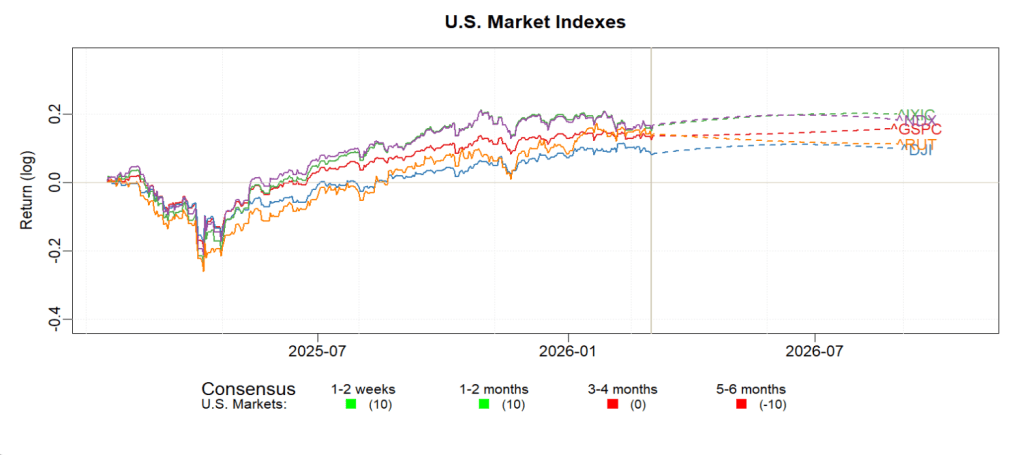
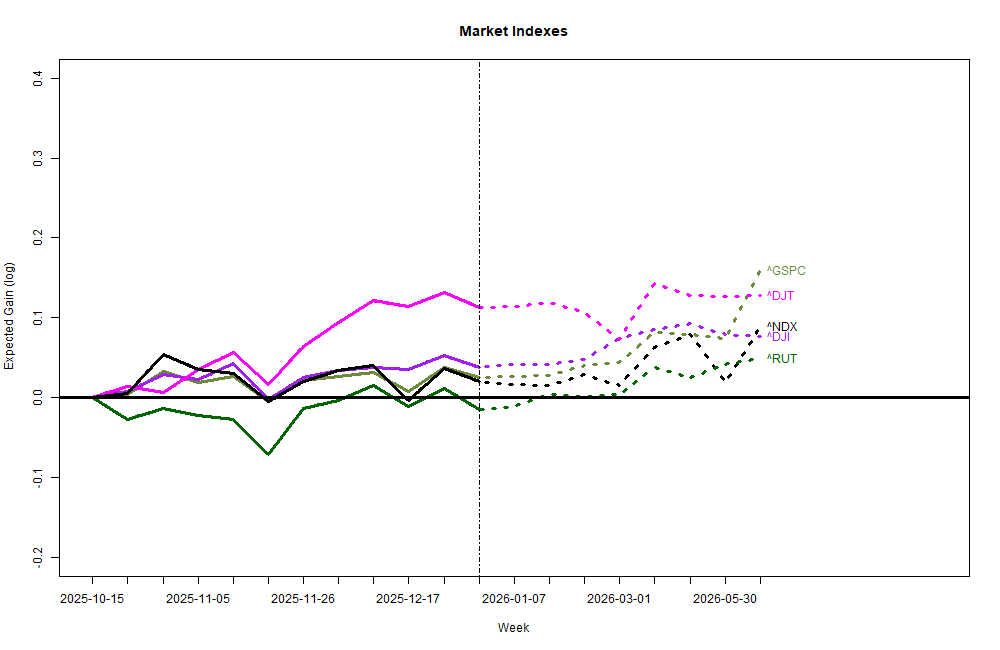
My 2-decade-old market models and my data-intensive AI models basically agree that the U.S. stock market will probably perform fairly well over the next half year with a gain of roughly 6%. The newer models have a few extra worries for the next month or so than the old timers; even so, they are positive/flat. This could change suddenly, of course, if the Government shutdown continues very long — your guess on that is probably as good as mine. Also, I have no idea what the immediate market response would be if the Supreme Court shuts down the legally questionable parts of the Trump tariffs. Again, your guess is as good as mine and my models are silent on the subject.

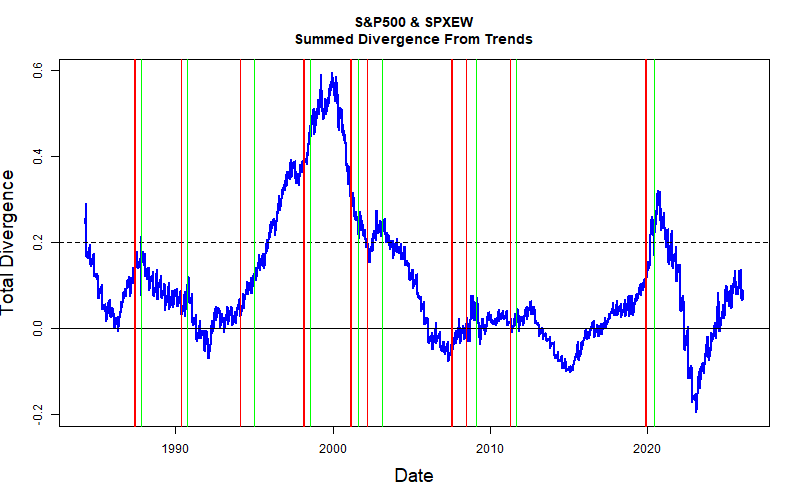
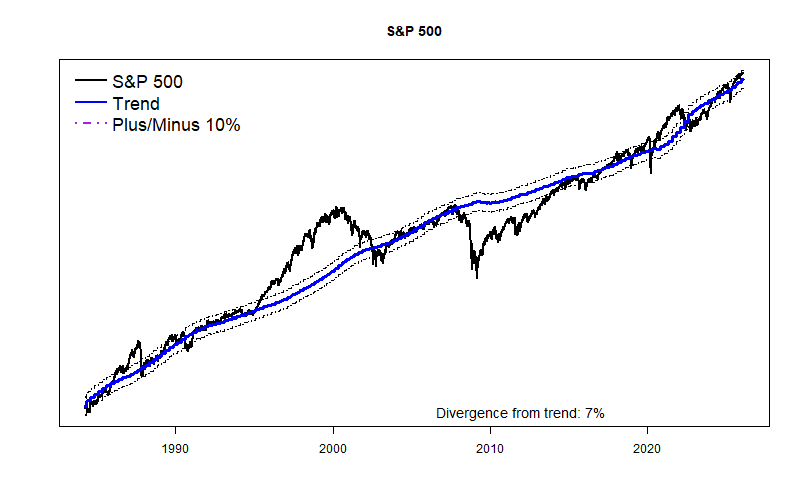
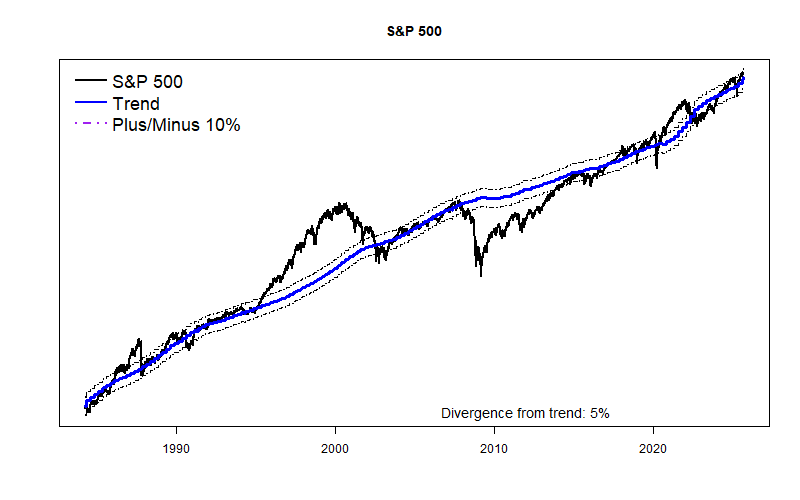
Overall, the U.S. stock market continues to be split: the AI-supercharged Magnificent 7 stocks are still surging and the established market keeps performing a bit below normal expectations. Right now, the S&P 500 is about 8% above my long term trend line. Last round, it turned south when it reached 10% above trend. (The trend line has been rather reliable for the past few years.)

There is a real split between short-term stock market expectation indicators and long term expectations. Short-term indicators like current stock market index trends and several leading indicators (like the Sahm Rule) have been rather steadily positive. It is as if stock market ’emotion’ has been inoculated in some way so that it no longer gets jarred by erratic moves by the White House. Professional economists, however, are less positive looking forward. In the most simple sense, on one hand they see bad news coming, and on the other hand they see bad news coming. The actual impacts of the Trump tariffs are critical. If tariffs do, indeed, produce a ton of revenue, that means a net reduction in government overspending/stimulus and so a drain on the economy. The other option is that the tariffs don’t actually reduce the deficit significantly — heading the U.S. toward a debt crisis.

By Halloween we should see if stock market investors will continue to keep “whistling past the graveyard”. Expect fewer chocolates this year if the tariffs remain intact.

September thru February 2026: Probably OK

My stock market forecasting tools are still blessed by not being able to read the daily newspaper. My hometown Washington, DC is essentially under martial law with gun-toting National Guard troops patrolling the streets reacting to a trumped-up ’emergency’ that does not exist, but my stock market performance models (except for September) remain reasonably positive. The forecasting models, with an excellent long term track record, indicate that a wide swath of U.S. economic data is basically benign and so the U.S. stock market will probably perform fairly well over the next 6 months. The September exception is that the S&P 500 (^GSPC on the chart) looks like it has gotten ahead of itself. Both my 18 year-old models with about a dozen economic variables and my current data-intensive models reach similar conclusions.

The macroeconomic data remains positive. Unemployment is still just 4.2%; money supply is growing at a 4% annual rate; inflation, only a bit higher than the Federal Reserve wants, is 2.7%; and corporate profits as of last quarter are growing mildly. Leading economic indicators generally are modestly positive with very low probabilities of a near-term recession.

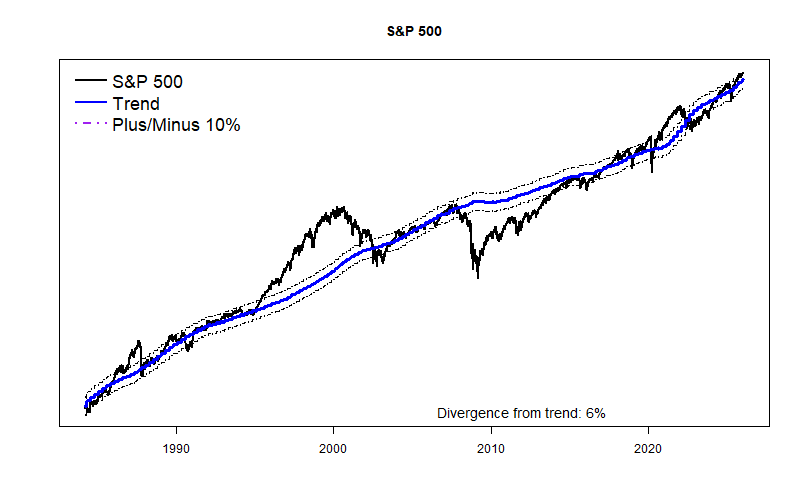
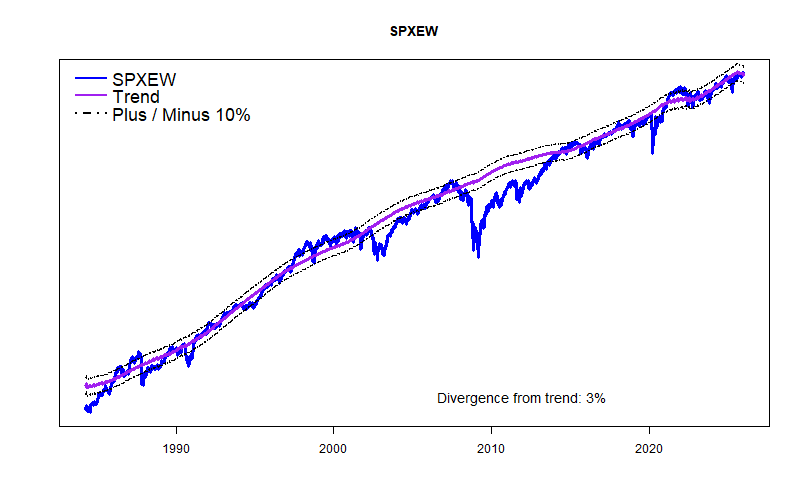
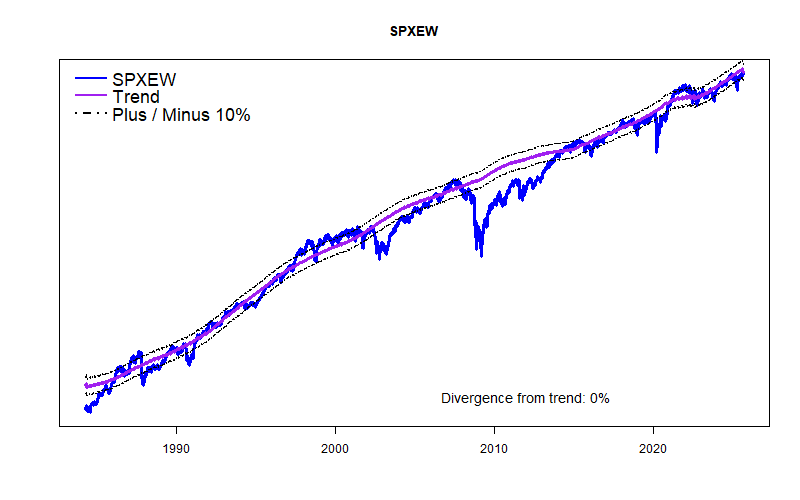
The stock market division between highflyers like Nvidia versus the rest of the world decreased last month. As the graphs below show, the S&P 500 (NVDA accounts for 8% of the index) is now just 5% above its long term GDP-based trend line, and the equal weight version of the same stocks (SPXEW) is now exactly at the long term trend line.

I have a hunch that September will show stock market indecision, but volatility could easily shoot up toward the end of the month and into October. First, the question of the basic legality of the Trump tariffs will wind its way through the courts, eventually through the Supreme Court. Second, there is a significant chance of a U.S. government shutdown at the end of September since the FY2026 budget will probably need some measure of Democrat approval. And third, there is increasing concern over Trump’s health. (The helicopter flight path from the White House to Walter Reed Medical Center goes directly over my house.) I find a bit of comfort with the thought that the stock market, having weathered so much back and forth uncertainty in the Trump second term’s first months, may have been inoculated from instant major responses to potential new calamities. Wishful thinking no doubt.

Just before the storm? Or not?

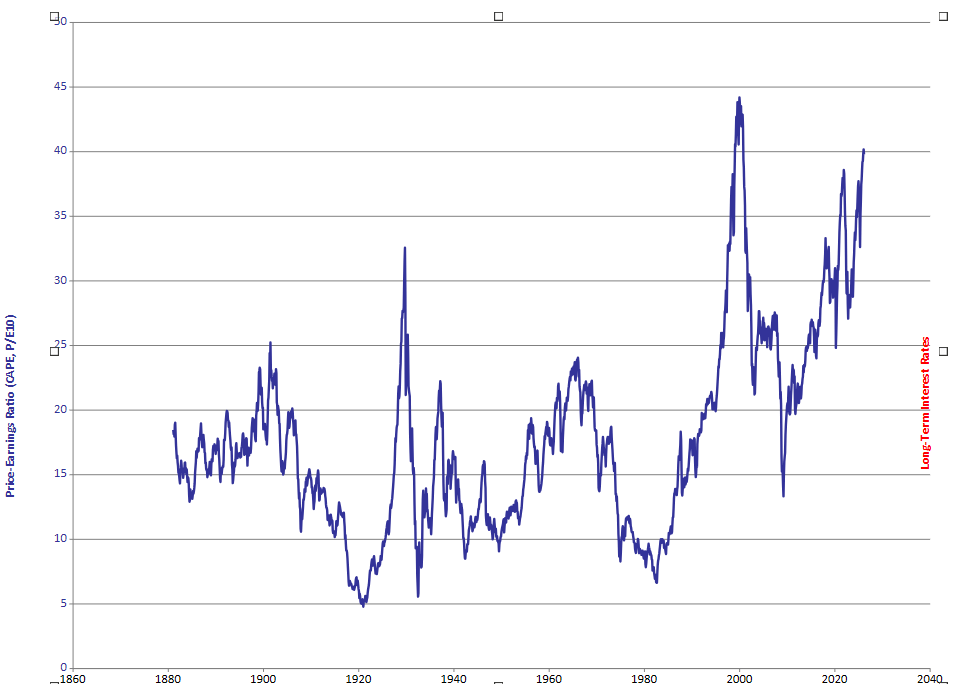
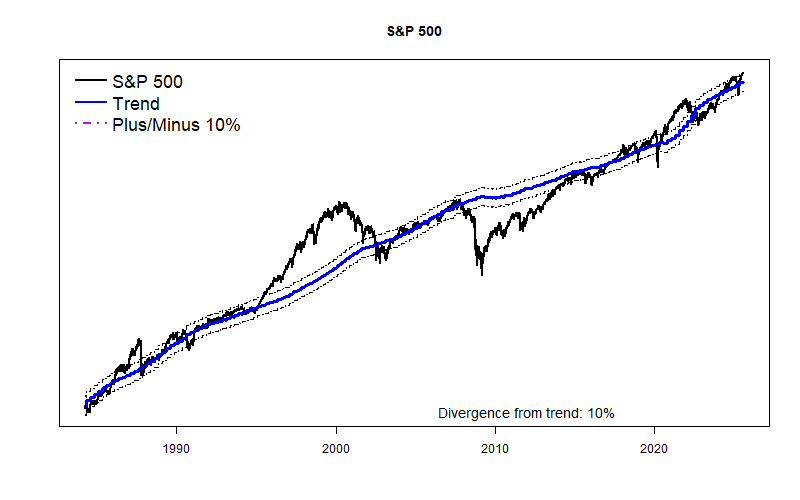
Near term stock market forecasts from my most detailed current models are basically flat (above), but for the coming half year they are “OK”. Not great, just OK. My older models running since 2007 say about the same thing with a 4% gain expected for the U.S. stock market. Meh. As shown in the following graphs, the S&P 500 is running about 10% above its long term GDP-based trend line (a little worrisome) and an equal-weighted version of the same stocks is running about 6% below its long term average. Translation: the market is still dominated by high-tech high-flyers, but the broader market of everyday companies has been mildly weakening for some time.

What worries me at the moment is that my family has started to ask me if the stock market is going to crash. That is never a good sign; usually they pay no attention to this blog or any of my other stock market stuff. If they ask, it means they are actually worried. And if they are worried it probably means a lot of others are scared as well. If a lot of people get scared, then most anything can happen. Rapidly.

The best part about Donald Trump’s sweeping economic program is that very little of it has actually occurred. All those cutbacks in government programs? While painful to many individuals, most do not kick in until October, and even then they are mere pocket change in the overall economy. All the Medicaid cuts? Don’t actually hit until 2027. And the huge tariff increases? They were supposed to begin today, August 1, but then we learn they won’t be implemented until August 8. Or, until…. There has been so much word-garbage spewed by the Trump world that most of the financial world has turned a deaf ear and has returned to following the actual economic data numbers.

For now, the actual economic data are not very exciting. GDP is growing; how fast is a question because of freakish shifts in foreign trade and business inventories, but GDP is definitely growing and is already as high as the Congressional Budget Office sees as possible without over-heating. Money supply and interest rates are normal-ish. Unemployment at 4.2% is still low. Home building is in the dumps and unfortunately is likely to stay that way for the foreseeable future. Inflation has only ticked up a bit. The U.S. Dollar (DXY) rose a rapid 10% last autumn as Trump was elected — and then fell even more after his inauguration. The almighty Dollar is still falling.

But, the overall economy is basically pretty good. So what is the concern about a stock market crash?

Increasing financial instability Big money, the accounts holding billions and trillions, normally moves investments around very slowly. Big money, like an aircraft carrier, is well accustomed to the countless small ups and downs of the economic seas. But, big money accounts cannot accept even the smallest chance of a total wipe-out. So, when there is even a hint of financial panic big money stampedes to the exits bringing about a financial and stock market crash. It will probably start in the long term bond markets. I see two ways that the Trump administration has assured a financial crash; just a question of which? and when?

World Markets In 1997-1998 the world experienced a series of national financial collapses that largely stemmed from increasing U.S. long term interest rates. In one country after another (Russia, Indonesia, Malaysia, Singapore, Thailand, Argentina, etc.) economic collapse was sudden. It even got a name tag: “Asian Contagion”.

No one knows, of course, what the Trump tariffs will actually end up. It seems the President himself likes to be surprised by what he does. TACO? But, certainly the potential exists for nations with frail economies to begin a cascade of national economic collapses. With the U.S. on an isolationist course, a clear potential exists for massive financial failure contagion. This sort of crash would be horrible, but does not appear to be on the immediate horizon.

U.S. Debt As I have written for months, the U.S. federal deficit at near 7% of GDP is unsustainable. It cannot continue forever, but no one knows when trust in the “full faith and credit” of the U.S. will break. Trump’s ‘one big beautiful bill’ further increases the deficit. Deceit (with delays in Medicaid reduction and only partial accounting for new tax cuts) continues to hide the full scale of the new deficit spending, something like $500B per year. Eventually, probably already, big money will “sell USA”. It would be best if that occurs with a slow further decline of the Dollar and gradual increases in long term interest rates. But, that is usually not how these things go.

In answer to my family’s question about a stock market crash my response is that none of my fancy stock market models see a crash as likely in the next half year. But, my models really aren’t very good at spotting truly crazy behavior. Sorry.

“What if” analysis. Ulp!

I really don’t want to be alarmist, but things in the stock market could get much worse. 40% further decline? 60% more?

My stock market forecasts rely on gobs of tremendously boring data on a wide range of economic fundamentals. Usually economic fundamentals don’t shift instantly, nor do comprehensive data compilations such as for Gross Domestic Product or inflation. Most of the data I use is issued monthly or even quarterly. It is always somewhat out of date, and I just make adjustments.

Trump’s tariff announcements DID spin the economic world on a dime. My current data instantly became bogus. Suddenly ,the world economy is facing a dramatically different trade picture that threatens many countries with recession, or worse. Prior to the tariff announcements the US was already slowly sliding into recession. Now a US recession is highly likely according to more and more forecasters.

So, I shifted my forecasting process around to be able to ask it “What if?” questions, as in “What if the US was highly likely to be in recession next quarter, and certain to be in recession by September?” “What if oil prices continued to plummet down to $50 per barrel?”

Based on my entire existing database, what usually happens if the world economic order goes really out of whack is horrific. The S&P 500 6 month forecast would be an additional 40% loss and the worst probably 6 month loss could be 75% to 85%.

These are not hard and firm forecasts. No way. I only looked at a few possible alternatives. But, based on decades of stock market experience this is most probably how the market would perform. What we are facing now is a mild form of what did hit the stock market when Covid first spread.

The only thing that is certain is that more bad economic news should be expected and any positive news would be a major surprise.

On the eve of: (a) Liberation? (b) Destruction?

In 2 days the Trump government says it will announce a comprehensive package of trade tariffs. These taxes will be imposed on top of the recently adopted 25% tax on imported automobiles and components, steel and aluminum tariff increases, and additional tariffs on products from China. This will be a surprise announcement — the Trump White House typically leaks information like a sieve, but this time the leaks are so confusing and contradictory that they effectively have been equivalent to a full news black out. The most quoted insider statement is that they are hoping to gain $6 trillion in tariff revenue over the next decade — $600 billion per year. A hundred billion dollars here, a hundred billion there, and sooner or later you are starting to talk about real money.

My opinions on this exploding Trade War don’t count. No one cares about my opinions, nor should they as I am not an economist, let alone one with extensive knowledge of international trade. Economics 101, however, told me that when “Trade War” is capitalized it is not a good thing.

What this blog does is to document how well my macroeconomic statistical forecasting approach succeeds in forecasting US stock market prices in time spans from 1 week to 6 months.

My forecasts are largely blind to what is coming. The monthly forecasting approach that I have been reporting on for 17 years sees a subdued next half-year. We have been inching toward a recession for quite some time. The probability of at least breaking even over the next 6 months is roughly 45% to 60%, definitely below the normal 70% to 85% likelihood. The predicted 6-month gains average at a below-normal 2% gain, but the swarming models range from -2% to +7%. The 1-month models are all positive, but slightly below average. I will report on my more advanced daily forecasting methods in a couple of days, after the tariff announcements, but their current numbers are comparable to the long-standing monthly models.

Last month’s sharp stock market decline puts the S&P 500 price almost exactly at my long-term price trend line, and the equal-weight Value Line Arithmetic Average is about 8% BELOW trend. So, unlike a few months ago, stocks now “have room” to move either up or down. That’s a good thing, but does nothing to suggest what happens next.

The current market direction is down, not up.

Economy: Rock/Hard Place … Crunch?

The U.S. stock market is overdue for a significant correction. The GDPNow forecasting model of the Federal Reserve Bank of Atlanta estimates that U.S. GDP growth has turned negative. When the economy sputters, corporate profits evaporate, and the stock market implodes.

My forecasting models currently expect problems with the stock market to hit somewhere between April and July. (They see a minor downturn, but nothing spectacular.) I expect a sharper decline a bit earlier, in March or April triggered by Washington craziness.

I curate many stock valuation models these days. Though all are based on macroeconomic data, they don’t fully agree; each considers somewhat different economic data sets. Collectively, the models are now more negative than positive. With my newer models, 1-month and 2-month forecasts are mildly positive (see chart above), but the 6-month forecasts are flat at best. My older models that have been running since 2007 expect a 6% loss over the next 6 months. A number of models in both the new and old forecast series collectively see the probability of gain for the next 6 months as 0.2 to 0.5 — that is way below the average probability of gain as about 0.75. So, collectively, these forecasting models say the stock market is about to roll over.

As I have written many times, these models don’t read the newspaper. They see weakness coming because the economy has been overstimulated, price/earning multiples are unsustainable, and leading economic indicators are starting to weaken slightly.

I live in Washington, DC and cannot avoid reading the newspapers. I see several ways the economy can be damaged in the near term. Some of this damage certainly will occur.

Reduced government spending: -1% of GDP A wild guess. The speed at which Trump and Musk have curtailed government spending has been breathtaking. I live in the eye of the storm and do not have a clear view of things. Too many people I know have lost their jobs or fear that they may be out of work soon. With many legal actions pending and the Trump administration just getting going, I doubt that a clear accounting is possible yet. So, it is just a wild guess that all the budget cutting will hit GDP by 1%. (Their goal is actually higher than this.) More likely GDP could drop something like 3% because of the multiplier effect of government deficit spending, disruption losses, malaise and fears. On the positive side, lower government spending can lead to lower taxes and therefore help both individuals and business — but these benefits will not kick in until 2026 at the earliest. The pain comes long before any gains. Will the spending cuts evaporate? Maybe.

Increased tariffs: -1% of GDP Another wild guess, but there have been estimates that the average American will incur roughly $1,200 in additional costs because of the China, Canada, and Mexico tariffs. Trump has referred many times to additional tariffs as well that would up the ante. There certainly will be increases in U.S. production due to the protections offered by the tariffs — But, any economic benefits will not occur for months of years — it takes time to build new factories, hire and train workers, and create new supply chains. The pain (probably mainly in the form of inflation) will come long before any potential gains. Will the tariffs evaporate? Maybe.

Cryptocurrency crash: -1% of GDP Just a guess. The underlying justification for these assets is that they cannot be affected by, or traced by government. Therefore they are the perfect way to hide illegal activity. I had my first experience with what is called The Intelligence Community in 1994. I have great faith that the Intelligence Community can track crypto just as much as it wants. Cryptocurrency is a bubble that will have a sudden and unpleasant explosion. I have no idea when the bubble will burst, but when multiple economic bubbles exist like now, they tend to pop at the same time.

Government shutdown: -1% of GDP Another wild guess since it might not even happen. On March 14, federal budget authorization expires and a partial government shutdown will begin unless Congress acts first. Though the House of Representatives have passed a budget outline, the details of any actual legislation are weeks away. Passage of the largest budget cuts such as for Medicaid is questionable. A Continuing Resolution (CR) to authorize spending at current levels until September 30 is the temporary solution that Republican leadership and the President want. The problem is that a number of Republican House members usually vote against any CR’s. And Democrats are unlikely to support a CR unless there is some sort of guarantee that the Trump regime will actually adhere to spending legislation rather than cutting spending at will. Thus, a confrontation and government shutdown is highly likely. The real question is how long it will last. President Trump created the government shutdown record of 35 days in his last term. Here the pain is highly likely and there is no real gain possible. Will the shutdown be avoided or curtailed quickly. Don’t know.

A Recession is zero net GDP gain and a 2% drop is enough to be called a Depression I have not seen a credible estimate of all the economic uncertainties of the moment, but they are both significant and real. Famously, Saul Samuelson quipped in 1982 that the stock market has predicted 9 of the last 5 recessions. That could easily happen again in a couple of weeks. Or not.

January thru June 2025: Stocks positive next 6 months, but plenty of worries.

My models for various US stock market indexes are surprisingly positive for the first half of 2025: flat to negative for January, but then generally rising over the next 6 months. The forecast for the NASDAQ 100 ( ^NDX) is strong. My older monthly-based models for the S&P 500 and the ValueLine Arithmetic Average are not as encouraging, just flat for the coming half year.

The models reflect a strong macroeconomic picture. Gross Domestic Product is robust, running about 2% above the Real Potential GDP model maintained by the Congressional Budget Office. Inflation for consumers and industrial commodities is down, so the Federal Reserve has shifted from trying to restrain the economy to a more neutral stance. Interest rates are high-ish compared to the past half-decade, but rates are modest compared to the past half-century. Crucially, long-term interest rates have finally climbed above short-term rates; that is a good thing as it gives the financial sector room to breathe. Money supply if easing a bit; that’s always nice. Corporate profits remain strong. Several indicators say prospects for a near-term recession are minimal. Unemployment at 4.1% has crept up slightly, but is historically good. We are on the leading edge of major technological change through Artificial Intelligence, and already there are huge new capital investments underway with prospects for more to come. The stock market has scored up the best two-year returns since 1998! What’s not to like?

Unfortunately there are three problems that eventually will slam the stock market. The only real question is: When?

First, the US economy is only glowing brightly because of huge and unsustainable federal government budget deficits, not mainly through real intrinsic growth. Second, even if the economy was not propped up unrealistically, the market is still way over-priced by nearly all traditional valuation measures. Third, all other industrialized countries are going through the same process of cutting covid-related government deficits. Already, the parliaments of Germany, France and South Korea have fallen because there were no agreements on budgets going forward. Bond markets are starting to worry.

And, it is totally unclear what the U.S. Congress is going to do about the budget this spring. Will the deficit shrink or will it explode in size? Unknown. Aside from that, everything is great, and it doesn’t seem like the world is ready to explode this month.

I recalibrated my long-term trendlines for the S&P 500 and the Equal Weight S&P 500. The recalibration better recognizes the impacts of inflation on the market. The modified trendlines have a slightly better fit with the past 4 decades of market behavior. The good news is that according to the new trend lines the S&P 500 is somewhat nearer to trend and the Equal Weight S&P 500 is actually slightly below trend.

Happy New Year!

… The stock market year should start out benignly calm

(For the next year or so I will report on two sets of market forecasts. I will keep up my monthly forecasting models which I have documented for about 17 years. I will also be reporting monthly on newer market forecasting models that create forecasts on a daily basis. These newer models, however, have only about a year of forward-testing. I apologize in advance to both of my readers for confused reporting on the two sets of analyses.)

My original forecasting equations originating in 2007 are somewhat negative for the US stock market for the first half of 2025. My newer, much more data-intensive forecasts are mildly positive for the next 6 months. The difference isn’t huge, but it is real.

The stock market has been making new highs, climbing the Wall of Worry, and is historically overpriced. In the near term, stocks have plenty of room to fall down, but little chance of quickly falling up. Given those caveats, my forecasts for the near future are mildly positive.

My long term trend models for the US stock market keep showing a developing price bubble. The S&P 500 is 15% above trend and the equal-weighted version of the S&P is 12% above trend. This bubble will probably keep growing. The bubble is still minor in comparison to the Dot-Com Bubble before 2000.

The Federal Reserve has begun to reduce short term rates, but the high level of short-term rates compared to long-term interest rates is still a very real negative factor in finance. Banks can’t make money lending money for long terms if they need to pay very much for short-term funds. They are painfully squeezed and have only been saved through Federal Reserve intervention.

On the other hand, truly massive Federal deficit spending — currently 6.11 percent of GDP — is dominating the economic situation. For comparison purposes, the total economic contribution of ALL FARMING to GDP is less than 1% of GDP ( 0.7%). Including all agriculture, food, and related industries takes the share up to just 5.6% of GDP. So, the US current deficit of greater than the economic impact of all the food we consume — all the food, supermarkets, restaurants, warehouses, even the Taco Bells! That is an incredibly high level of splurge spending that has only occurred during major national emergencies. It is not sustainable.

This spring the new administration and the new Congress will begin to deal with the deficit situation. It will either get better or get worse. (If you think the deficit will improve significantly, I’d like you to consider buying a nice bridge I recently obtained in Brooklyn.) Recent increases in long-term interest rates show that Big Money expects the deficit to get worse. In that case the stock market’s developing Bubble will expand. The math is pretty simple.

Time for giving thanks

(No forecast, just words.)

I am especially thankful that none of my forecasting models can read the newspaper, or even know what I think.

The only things the models know are long established reputable economic data series. Each data set has been publicly available for at least 10 years; most have at least 3 decades of experience. A few go back much further. Each variable has a proven statistical relationship to at least some stock market prices. (Mimimum 95% confidence level.) Nearly two decades ago the models started with about a dozen key economic variables, but now roughly 4 dozen macroeconomic variables are included along with millions of data elements from individual stocks. Variables still are almost entirely focused on the US stock market. Things started with a single macro model that went unchanged for years. Now there is an AI swarm of thousands of models, each with a slightly different point of view, and each having to prove its current value and accuracy profile. Each model gets refined on a weekly basis. Every forecast for any stock results from a minimum of 30 independent analyses.

I started these stock forecasting models because I was absolutely horrible at picking and timing stock purchases. My heart, emotions and hunches always got the best of me. Partly for that reason, there are no parts of the models that include my own expectations (like on interest rates or corporate profits in the coming month). Very pointedly, however, I do include a number of variables that do have a high ’emotional’ quotient. The VIX market ‘fear gage’ is one example. Numerous long-standing surveys make the cut as well.

My point in saying all of this is that over the next year or so it seems highly likely that individual stocks and the stock market will have an unusually high level of uncertainty. The stock market DOES read the newspaper and dwells on rumors and false trends. I expect to see unusually high volatility. Should that occur, the models reported on here will almost certainly predict a reversion back toward trend.

In the end, I trust the stock market will usually do what it usually does in response to changing economic circumstances. That’s what it has done for the past 17 years, at least. Who knows, maybe all of that will change, and pigs can start to fly. Perhaps, but I have no evidence of that.

We are in the early stage of what promises to be a major US stock market bubble. This is unlikely to be especially high and sustained real economic growth, just pure bubble. And it could last for a couple of years.

Wall of Worry. Bubble Starting?

Forecast October 2024 thru March 2025: Climbing the Wall of Worry continues. My oldest and most accurate long term models are skeptical about the market, and have been negative for months. These econometric models can never forget the plunging prices of past stock market crashes. That’s their job. They are supposed to worry.

This time might be ‘slightly’ different. I won’t be surprised if the models are overly cautious for several more months, and the market keeps gaining.

The U.S. stock market is climbing a “Wall of Worry“, a classic stock market expression that applies at about this time during every business cycle. Stock valuations have been rising for several years and now are high by nearly all measures. But, prices keep rising anyway. ‘Everyone’ knows the market is overdue for a tumble, but ‘nobody’ wants to miss out on the relentless gains that stocks keep washing in. Eventually ‘all’ markets do falter, and most speculators are completely surprised. My most recent and detailed models say the end may not be imminent, At least, not for the next few months.

At the request of one of my few readers, I am bringing back my oldest and ugliest chart to illustrate. My wife calls it ‘garish’ and she is never wrong.

The graph below displays all of my actual 6-month market forecasts going back to 2007. The shape of the graph is the S&P 500 plotted on a logarithmic scale. Each dot is color-coded with the dot color indicating the approximate forecast value for the coming 6 months. (So, ideally a big market drop should follow a black diamond, and a strong market rise should follow a big green triangle.)

The message here is that the negative (red) forecasts of the past several months paint the wall of worry, just like they did through the pandemic mini-bubble. Eventually, they will probably prove to be approximately correct. At some point not too far away the market will probably be cheaper than is is today.

The plot (below) of a long-term model of the S&P 500 shows what certainly looks like the start of a new market bubble. Since at least 1871, the growth of U.S. GDP and the U.S. stock market have corresponded quite closely. That is no surprise: GDP tries to estimate the total volume of goods and services, while the S&P corresponds to a big chunk of that same economic output. The trend line here plots the current (and future) path of the S&P 500 based on the ongoing relationship between Real Potential GDP and long term interest rates. It is far from a perfect model, but it shows a growing divergence: a new bubble? (This model shows the S&P 10% above trend, another model says 14% above trend.)

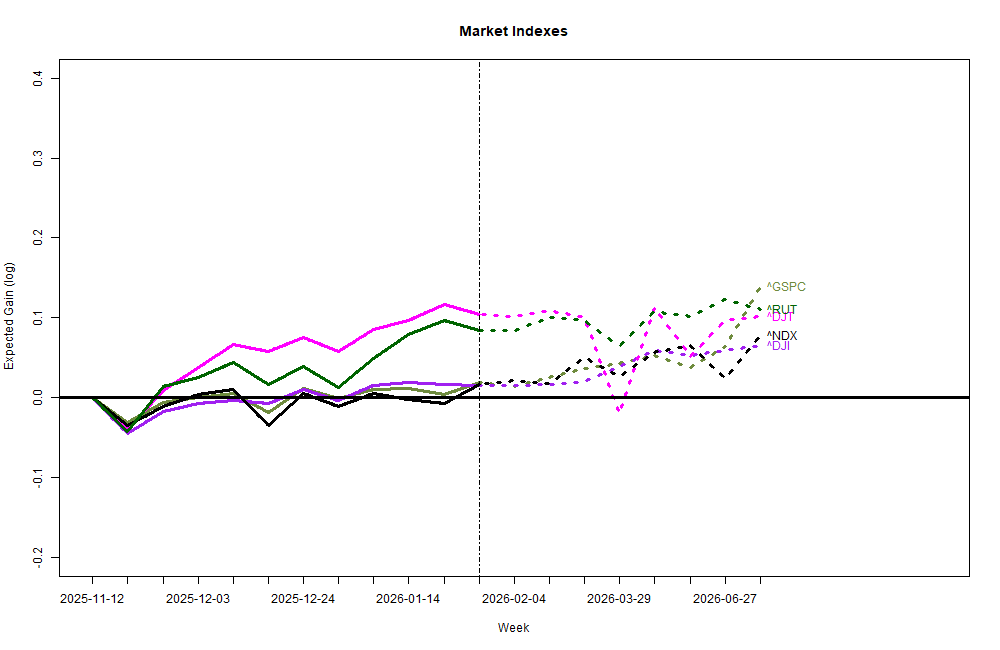
Here is a somewhat more positive look at a series of market index forecasts. The forecasts span from 1-week through 6-months. The models that produce these plots are based on gobs more data than my original models and are not quite as ‘fixated’ on the market crashes of the past. For good or ill, they are more trusting of current economic data.

If the Orange Octogenarian does something exceptionally bizarre in the next month, then all bets are off.