Tag Archives: economics

Just before the storm? Or not?

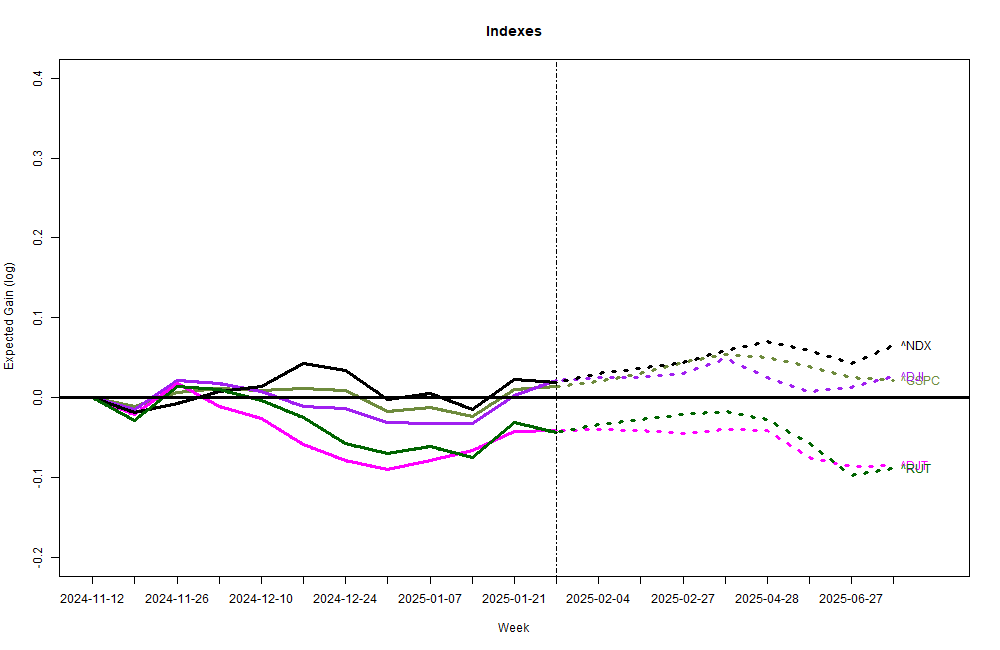
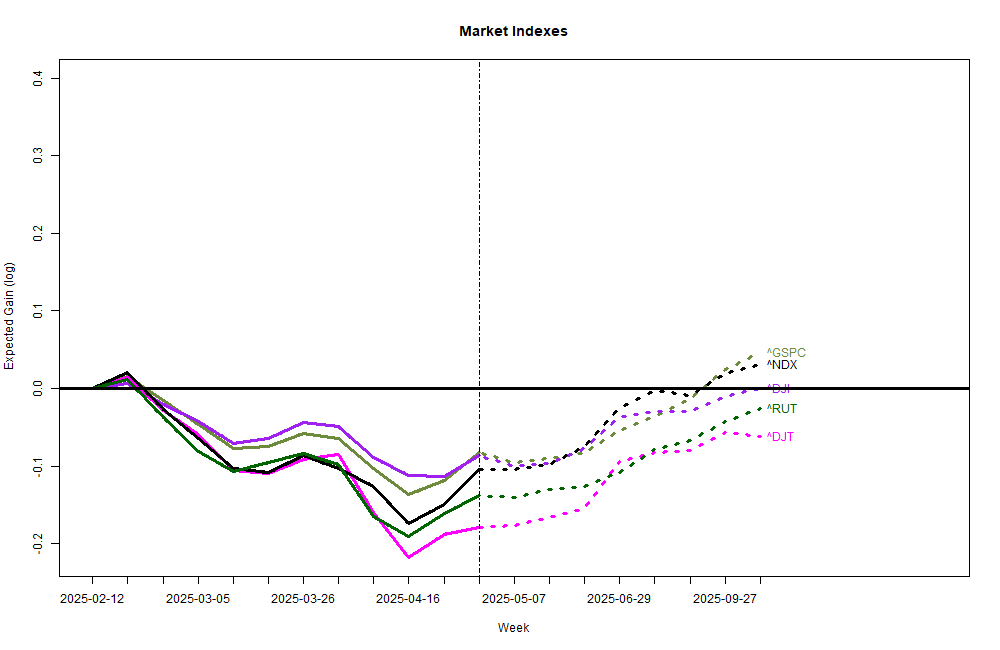
Near term stock market forecasts from my most detailed current models are basically flat (above), but for the coming half year they are “OK”. Not great, just OK. My older models running since 2007 say about the same thing with a 4% gain expected for the U.S. stock market. Meh. As shown in the following graphs, the S&P 500 is running about 10% above its long term GDP-based trend line (a little worrisome) and an equal-weighted version of the same stocks is running about 6% below its long term average. Translation: the market is still dominated by high-tech high-flyers, but the broader market of everyday companies has been mildly weakening for some time.

What worries me at the moment is that my family has started to ask me if the stock market is going to crash. That is never a good sign; usually they pay no attention to this blog or any of my other stock market stuff. If they ask, it means they are actually worried. And if they are worried it probably means a lot of others are scared as well. If a lot of people get scared, then most anything can happen. Rapidly.
The best part about Donald Trump’s sweeping economic program is that very little of it has actually occurred. All those cutbacks in government programs? While painful to many individuals, most do not kick in until October, and even then they are mere pocket change in the overall economy. All the Medicaid cuts? Don’t actually hit until 2027. And the huge tariff increases? They were supposed to begin today, August 1, but then we learn they won’t be implemented until August 8. Or, until…. There has been so much word-garbage spewed by the Trump world that most of the financial world has turned a deaf ear and has returned to following the actual economic data numbers.

For now, the actual economic data are not very exciting. GDP is growing; how fast is a question because of freakish shifts in foreign trade and business inventories, but GDP is definitely growing and is already as high as the Congressional Budget Office sees as possible without over-heating. Money supply and interest rates are normal-ish. Unemployment at 4.2% is still low. Home building is in the dumps and unfortunately is likely to stay that way for the foreseeable future. Inflation has only ticked up a bit. The U.S. Dollar (DXY) rose a rapid 10% last autumn as Trump was elected — and then fell even more after his inauguration. The almighty Dollar is still falling.

But, the overall economy is basically pretty good. So what is the concern about a stock market crash?

Increasing financial instability Big money, the accounts holding billions and trillions, normally moves investments around very slowly. Big money, like an aircraft carrier, is well accustomed to the countless small ups and downs of the economic seas. But, big money accounts cannot accept even the smallest chance of a total wipe-out. So, when there is even a hint of financial panic big money stampedes to the exits bringing about a financial and stock market crash. It will probably start in the long term bond markets. I see two ways that the Trump administration has assured a financial crash; just a question of which? and when?

World Markets In 1997-1998 the world experienced a series of national financial collapses that largely stemmed from increasing U.S. long term interest rates. In one country after another (Russia, Indonesia, Malaysia, Singapore, Thailand, Argentina, etc.) economic collapse was sudden. It even got a name tag: “Asian Contagion”.

No one knows, of course, what the Trump tariffs will actually end up. It seems the President himself likes to be surprised by what he does. TACO? But, certainly the potential exists for nations with frail economies to begin a cascade of national economic collapses. With the U.S. on an isolationist course, a clear potential exists for massive financial failure contagion. This sort of crash would be horrible, but does not appear to be on the immediate horizon.

U.S. Debt As I have written for months, the U.S. federal deficit at near 7% of GDP is unsustainable. It cannot continue forever, but no one knows when trust in the “full faith and credit” of the U.S. will break. Trump’s ‘one big beautiful bill’ further increases the deficit. Deceit (with delays in Medicaid reduction and only partial accounting for new tax cuts) continues to hide the full scale of the new deficit spending, something like $500B per year. Eventually, probably already, big money will “sell USA”. It would be best if that occurs with a slow further decline of the Dollar and gradual increases in long term interest rates. But, that is usually not how these things go.

In answer to my family’s question about a stock market crash my response is that none of my fancy stock market models see a crash as likely in the next half year. But, my models really aren’t very good at spotting truly crazy behavior. Sorry.
Trump blinked on tariffs. Still not usual economic times.

I wouldn’t pay much attention to these stock market forecasts for the next couple of months. Through executive orders Donald Trump continues to unpredictably shake up and shake apart the world economy. Then he largely reverses himself a few days later; saying that that is not what just he did. This is not usual for the US government and the economy, and it is not just about minor changes. My economic performance models don’t know about any really similar circumstances upon which they can draw conclusions. All they can estimate is what would happen if today’s situation was somewhat usual — which it is not.

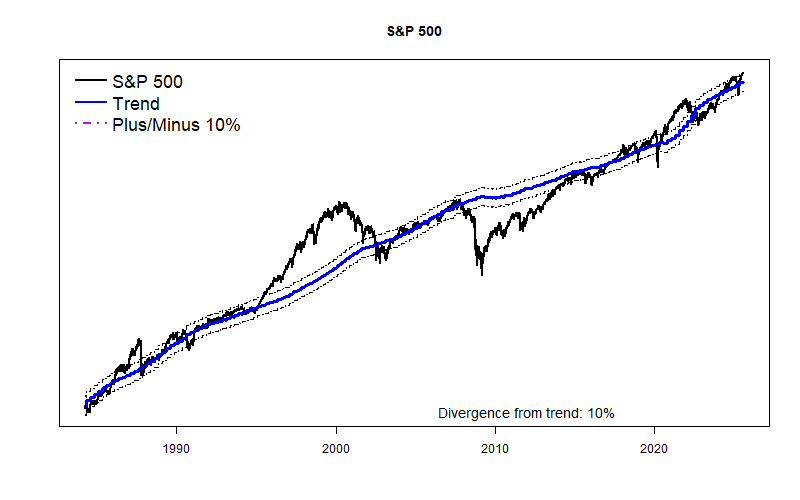
My long term GDP-based trendline for the S&P 500 index is not much guidance either. Before April it was about 10% above the long-term trend. Then it crunched down in fear to being about 10% below trend. And now it is almost exactly at the trend line.

My older forecasting methods which have been documented since 2007 expect the market to probably slide a percent or so over the next two months and then stage a mild rise. My newer and more elaborate forecasts (shown at the top of this blog) say about the same thing.

What really matters, though, is what Donald Trump and the Republican Congress actually do about passing a budget authorization for FY2026, dealing with reauthorization of the US debt, and setting up a tariff regime that lasts for more than a few weeks. What could go wrong with that?

My guess remains that there will be a great deal of puffery and grandstanding. There will be much fear and theater. But, in the end they will declare a great victory of cutting spending and lowering taxes. This will actually result in some new and wonderful tax-loopholes, a major increase in wasteful government spending, and most importantly, a huge expansion of US debt. Most probably they will blame this on the Democrats.

Come July, I think a stock market boom might be underway. I feel sick.

“What if” analysis. Ulp!

I really don’t want to be alarmist, but things in the stock market could get much worse. 40% further decline? 60% more?

My stock market forecasts rely on gobs of tremendously boring data on a wide range of economic fundamentals. Usually economic fundamentals don’t shift instantly, nor do comprehensive data compilations such as for Gross Domestic Product or inflation. Most of the data I use is issued monthly or even quarterly. It is always somewhat out of date, and I just make adjustments.

Trump’s tariff announcements DID spin the economic world on a dime. My current data instantly became bogus. Suddenly ,the world economy is facing a dramatically different trade picture that threatens many countries with recession, or worse. Prior to the tariff announcements the US was already slowly sliding into recession. Now a US recession is highly likely according to more and more forecasters.

So, I shifted my forecasting process around to be able to ask it “What if?” questions, as in “What if the US was highly likely to be in recession next quarter, and certain to be in recession by September?” “What if oil prices continued to plummet down to $50 per barrel?”

Based on my entire existing database, what usually happens if the world economic order goes really out of whack is horrific. The S&P 500 6 month forecast would be an additional 40% loss and the worst probably 6 month loss could be 75% to 85%.

These are not hard and firm forecasts. No way. I only looked at a few possible alternatives. But, based on decades of stock market experience this is most probably how the market would perform. What we are facing now is a mild form of what did hit the stock market when Covid first spread.

The only thing that is certain is that more bad economic news should be expected and any positive news would be a major surprise.

The Economy: Rock/Hard Place

My forecasting models have started to twitch nervously, even though they still cannot read the newspaper. Overall, the models look at a significant array of economic data and conclude that the corporate economic environment is really pretty good. GDP is above trend. Profits are wonderful. The Federal Reserve is tightening less and less. Chances for a recession very soon are miniscule. All good. Unfortunately, stock prices generally are way above normal — historically above normal. Sooner or later something is going to break, with the question being: When? The exact “Why?” may be becoming clear.

My older econometric forecast formulas (followed since 2007, R.sq ~ 0.5) are turning somewhat pessimistic for the coming half year with an expected SP500 loss of roughly 4%. The 6-month probability of loss is slightly higher than the probability of gain. The newer forecasts (graph above) are based on much more data and “should” be more accurate. Just like last month, the newer forecasting models are a bit more positive than my older models with the SP500 gaining a bit for the next two months, but then falling so that the index is essentially flat by the end of July. Both sets of models are starting to fret a bit about late spring.

In my view, the new Trump-2 administration is trying to avoid having the US economy crushed between a proverbial rock and a hard place. The clash is not easily avoidable.

The crushing “rock” in the analogy is the US Federal Deficit. At 6.3% of GDP the current federal deficit is at an unsustainable level characteristic of economic emergencies. Usually, this level of deficit occurs when GDP is down (recession) and Federal recovery spending is way up, and it corrects naturally and quickly when the economy recovers and emergency Federal spending runs out. That is not the case today; GDP is already unusually high and most Federal stimulus spending has already run out. The crushing deficit today is structural, not temporary, and stems from entitlement programs (Medicare, Social Security) and the Trump tax cuts of 2017 that are expiring this year. If the tax cuts are not renewed, the deficit will quickly move toward normal. But, that probably won’t happen.

The “hard place” stems from Mr. Trump promising to renew the tax cuts and even increase them, adding further reduction in corporate taxes, lower taxes on social security earnings, increased State and local tax deductions, no tax on tip income, etc. He also has promised to leave Medicare and Social Security programs untouched.

The President has made clear that he intends to escape the deficit bind through drastically reduced federal spending and massive tariff increases. As he has said of the tariffs: “It’ll be a tremendous amount of money for our country, tremendous amount.”, also: “Tariffs are going to make us very rich and very strong.” So far, he has presented only a general sketch of his plans.

Supposedly, 25% tariffs on Canada and Mexico begin today, as I write. On the federal spending side, last week, there was a pause in nearly all federal grant programs and roughly a million federal employees received an email encouraging them to resign with the bonus of 6 months of administrative leave (or face unpleasant working conditions). There appears to be no legal authorization for either initiatives.

As of last Friday, the stock and bond markets appears to have ignored all the fireworks. I have a strong feeling that is going to change. For this spring, I expect a period of high volatility as world markets try to understand what is actually happening.

… The stock market year should start out benignly calm

(For the next year or so I will report on two sets of market forecasts. I will keep up my monthly forecasting models which I have documented for about 17 years. I will also be reporting monthly on newer market forecasting models that create forecasts on a daily basis. These newer models, however, have only about a year of forward-testing. I apologize in advance to both of my readers for confused reporting on the two sets of analyses.)

My original forecasting equations originating in 2007 are somewhat negative for the US stock market for the first half of 2025. My newer, much more data-intensive forecasts are mildly positive for the next 6 months. The difference isn’t huge, but it is real.

The stock market has been making new highs, climbing the Wall of Worry, and is historically overpriced. In the near term, stocks have plenty of room to fall down, but little chance of quickly falling up. Given those caveats, my forecasts for the near future are mildly positive.

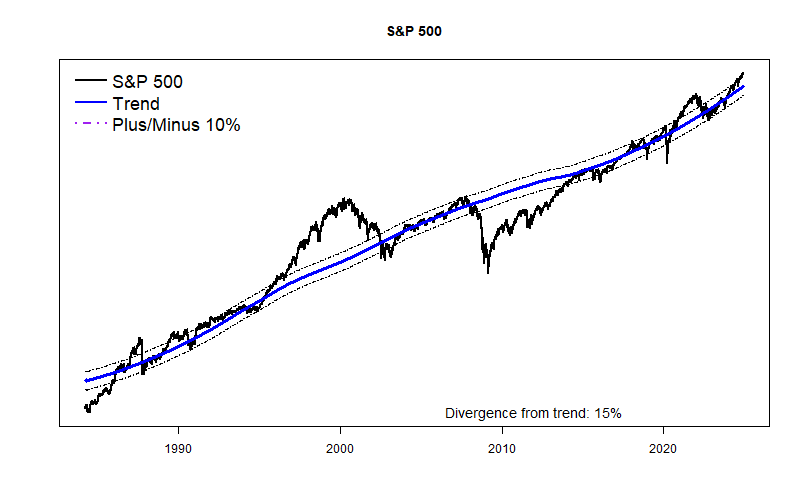
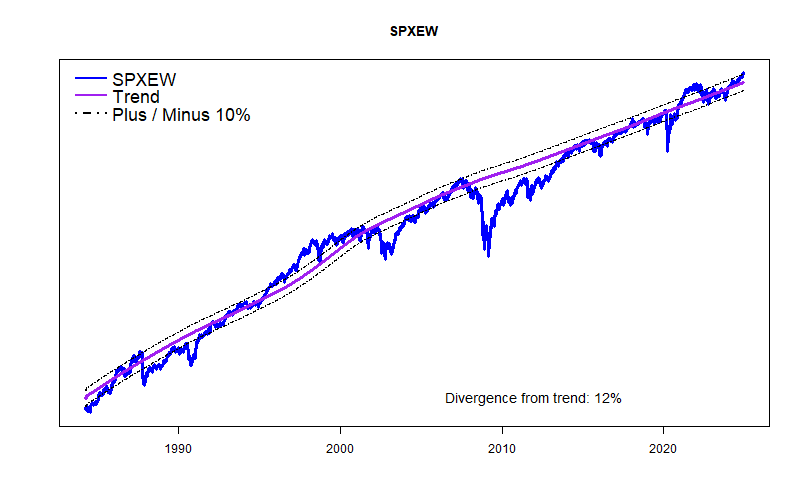
My long term trend models for the US stock market keep showing a developing price bubble. The S&P 500 is 15% above trend and the equal-weighted version of the S&P is 12% above trend. This bubble will probably keep growing. The bubble is still minor in comparison to the Dot-Com Bubble before 2000.

The Federal Reserve has begun to reduce short term rates, but the high level of short-term rates compared to long-term interest rates is still a very real negative factor in finance. Banks can’t make money lending money for long terms if they need to pay very much for short-term funds. They are painfully squeezed and have only been saved through Federal Reserve intervention.

On the other hand, truly massive Federal deficit spending — currently 6.11 percent of GDP — is dominating the economic situation. For comparison purposes, the total economic contribution of ALL FARMING to GDP is less than 1% of GDP ( 0.7%). Including all agriculture, food, and related industries takes the share up to just 5.6% of GDP. So, the US current deficit of greater than the economic impact of all the food we consume — all the food, supermarkets, restaurants, warehouses, even the Taco Bells! That is an incredibly high level of splurge spending that has only occurred during major national emergencies. It is not sustainable.

This spring the new administration and the new Congress will begin to deal with the deficit situation. It will either get better or get worse. (If you think the deficit will improve significantly, I’d like you to consider buying a nice bridge I recently obtained in Brooklyn.) Recent increases in long-term interest rates show that Big Money expects the deficit to get worse. In that case the stock market’s developing Bubble will expand. The math is pretty simple.