Long Term Model

In Brief: 
This long term stock market model compares the current level of the U.S. stock market against its very long term trend.  The market has followed an exponential growth trend closely most of the time since at least 1871.  When it wandered off course in the past, things did not end well.

The model relies on 5 key elements:

  • Long term exponential growth history of the S&P 500 (adjusted) going back to 1871,
  • Factoring out major booms and busts when the market deviates wildly from its long term track. 
  • Congressional Budget Office  (CBO) Real Potential Gross Domestic Product model using GDP data back to 1949
  • 10-year Treasury bond interest rates
  • Contrast the S&P 500 with a market index that is calculated on an equal-weight basis, making it less influenced by financial speculation.

The model’s aim is simply to point out if stock market indexes are grossly distorted and are ripe for a major correction. The model does not say ‘when’ a correction will occur; that’s the purpose of my 6-month stock market model. But, the long term stock market model will tend to give a solid indication of the direction of the next major market move and some guidance on the likely magnitude of a coming correction.

From the Beginning
With a bit of distortion, the stock market reflects the economy, and from the dawn of civilization the world economy has been growing — not at a steady rate, but at an increasing rate.  The chart below from Wikipedia.org shows per capita GDP growth since 1500.  Data is available elsewhere showing that growth has been increasingly-increasing for the past half million years! More people, more accumulated capital and capacity, and advancing technology (very broadly defined) are the reason for this amazing growth.  It has been far from steady (e.g. the Black Plague, World Wars) but growth has been relentless.  The rest of this blog post shows that the same basic exponenetial-exponential growth rate is still intact.

(Credit: By Qwfp – Own work, CC BY-SA 3.0, https://commons.wikimedia.org/w/index.php?curid=7122503)

Increasingly Increasing Growth Since 1871
The Standard & Poor’s 500 Index is probably the most widely recognized index for U.S. stocks. It began as the Standard & Poor’s Composite Index in 1923 and assumed its present form in 1957.  Data is available, however, going back to 1871 that is based on the principles used to calculate the index.

Running a statistical regression analysis shows that the S&P 500 Index has grown at a fairly constant rate for that century-and-a-half period — despite booms, busts, wars, countless leaps in technology, a developing world, and innumerable changes in government, from when the U.S. had 13 fewer states and the “talking telegraph” (telephone) was invented.  It was not a random process. We know that too many factors to count do, indeed, impact the stock market day by day, week by week, and even decade by decade.  None the less, a simple, fairly steady growth curve describes roughly 150 years of stock market history remarkably well.  In the long run the stock market isn’t so crazy after all. Thank the Law of Large Numbers for that.

Stock market growth has not been perfectly constant.  Instead, the rate of growth of the S&P 500 has been slowly increasing.  Growth of the Index over time has been “increasingly increasing”.

Inflation has also been a factor in the increasing level of the S&P 500.  But, it is not entirely clear exactly how inflation should be factored into the equation. The erosion of the value of the dollar has been far from constant, and there also can be fair disagreements over how inflation gets measured, (For example, a very significant aspect of our recent low inflation has been the radical continuing decline in the price of personal electronics.  Does a faster cell phone actually decrease your real cost of living? Or do you just have a faster cell phone out of the deal?)  One way or another, though, continuing inflation is part of the picture of the increasingly increasing level of the S&P 500.

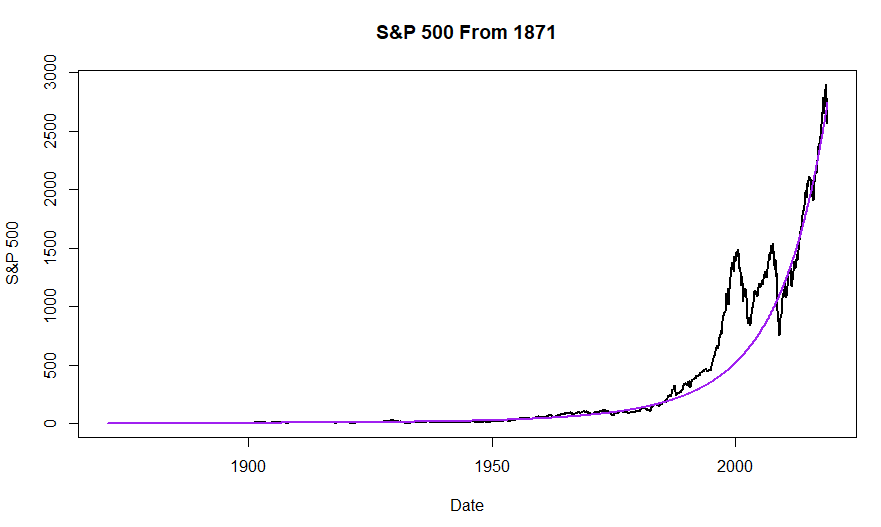
The graph below shows the best fit of an exponential-exponential trend line with the S&P 500 Index.. The correlation between the S&P 500 and the simple steady growth path is 0.95 — where a correlation of 1.0 would be a perfect match and 0 would be no match at all.  At first glance it looks like the trend curve and the actual Index match incredibly well except for two glaring divergences which turn out to be the Dot Com Bubble and the Great Recession.  That is very far from the truth.  The curve fit in earlier years was not as smooth as it looks and the recent divergences were not as bad as they look in this graph. Next, let’s see why.

(Click on image to enlarge.)


Percentage Growth is What Matters
The graph below also shows the path of the S&P 500 Index since 1871 with the same exponential trend. It is the same data as the previous graph, but the vertical axis plots the logarithm of the Index value.  Each vertical unit is a given percentage change in the Index, not a linear increase.  If the market grew at a constant percentage rate the resultant plot would be a straight line.  Since the actual plot curves up smoothly, it means the rate of growth has been slowly and somewhat-steadily increasing.

Focusing on percentage market shifts is essential. It becomes clear that the early years of the S&P 500 were nowhere near as smooth as they appear in the first graph.  For example, through the Dot Com crash, on a month by month basis the S&P 500 dropped roughly 650 points, a gut-wrenching collapse of over 40%.  In contrast, the Great Crash of 1929 amounted to only about a 25 point fall in the S&P 500 — but that amounted to an incredible drop of over 80%! This log-based plot shows how the Great Depression severely held back the stock market for over a decade.  Our more recent Great Recession was a minor blip in comparison. Overall, the Index recently was no more erratic than long ago.

(Click on image to enlarge.)
Sometimes Things Do Go Crazy

From the graph above — and my experienced reality — I take a general view that for, say, 75% of the time the stock market behaves normally. (Literally, its relative value and frequent variations tend to follow a statistical normal distribution very closely with large deviations happening every once in a while.) Investing bubbles and market busts, bull and bear markets are extremes /aberrations from normal market growth.

Through history most investors have not been able to spot the top of large developing market bubbles — they always expect “Greater Fools” to keep coming along. Most people did not see either the Great Crash of 1929 or the Dot Com Bubble coming.  The usual cry is “This time it’s different”  Probably not next time either. Probably.

So, in building a long term trend model let’s drop out what the market has been doing for the past few years. With certainty we can  identify past bubbles and busts.  So, as a definition, in my long term model, bubbles are times in the past when the market was way above the long term trend, and implosions were when the market was way below trend.  This is a major simplification of a lot of complexities in the market and the economy.  But, it turns out to be a very useful simplification.

The chart below shows the long term growth of the S&P 500 Index after elimination of the most egregious periods when the actual market value diverged from the first approximation of the long term trend. Most of the deletions were related to the Great Crash of 1929 and the Great Depression,  I could have gone a bit further in my data pruning and the Dot Com Bubble and Great Recession scars would have disappeared as well.  But, with just limited data scrubbing the correlation with smooth exponential goes up to 0.98 (again, 1.0 would be a perfect score.)

In all the analysis that follows, I’ll continue to drop out the largest market crises in order to better define the normal growth of the stock market.

 Market Growth from 1949

The Great Depression and World War II spurred incredible increases in the range and quality of economic data collected.  Later, computers made it possible to amass a tremendous volume and range of data and to develop sophisticated economic models. To get a more accurate long term model of the stock market we need to bring in additional information content that is only available from 1949 on.

I have a second motivation here beyond just increasing precision.  As shown above, we can show that with really surprising accuracy the U.S. stock market has followed an exponential-exponential growth trend. Also, because the U.S. economy is a massive behemoth, we can be pretty sure that the long term trend — even if it shifts — won’t shift all that much in the next few years.  But, several current economic factors could make the near term trend vary more than usual.  By pulling in the next data stream I can bring to bear another model of long term exponential economic growth that effectively reflects the combined efforts of some of the world’s top economists for the past few decades. By no coincidence, at its core this other model also focuses on exponential-exponential growth.

Real Potential GDP The Congressional Budget Office (CBO) is a highly respected, objective and non partisan arm of the U.S. Congress established in 1974. Both political parties and nearly every powerful vested interest group would like to bend the  CBO analysis to fit their agenda. That intense and highly bankrolled attention from all sides keeps the CBO model objective.  The stakes are very high in this game!

 Each year the office issues forecasts of government expenses and revenue along with anticipated 10-year impacts of proposed legislation — but, by its basic rules CBO does not make policy recommendations.

A central part of CBO analysis is a highly detailed  sector-by-sector computer model of the workings of the U.S. economy. The details of the CBO model are public, and are subject of extensive outside review.  The model is described  in 55 pages here.  CBO staff make minor adjustments to the model every few years.  Because of its pedigree, this model probably has more impact on the views of financial analysts than any other.  (Any Econ PhD student, professor or quant lobbyist would find fame and fortune if they could identify a flaw in the model or even just give the model a tweak.)

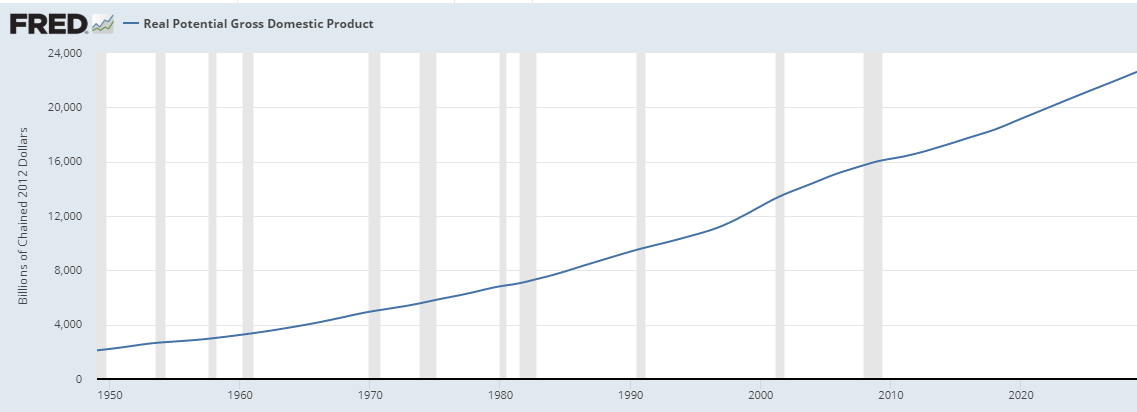
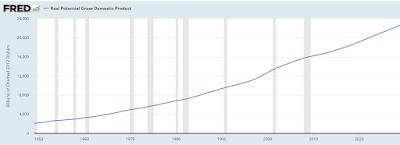
The CBO Real Potential GDP model closely matches the historical path of actual GDP (adjusted for inflation).  But, for the purposes of my long term stock market model, it does not matter much if the CBO model is accurate — it is a major cornerstone of what economists and financial analysts believe to be valid.  And, with the stock market “belief” trumps “accuracy” always. CBO Real Potential GDP data — projected 10 years into the future — is available from the Federal Reserve Economic Data (FRED) site here.

U.S. Gross Domestic Product data has only been available since 1949. That is the starting point for the CBO Real Potential GDP estimates as well. It is important to emphasize that the CBO model is focused on how the U.S. economy should perform at a sustainable pace at low unemployment. Also, the model addresses what economists call ” real” GDP — the confusing impacts of inflation are factored out.

There is a small difficulty here, however.  The CBO Real Potential GDP model addresses the U.S. economy, not the U.S. stock market.  They are far from being the same thing.

The S&P 500 Index grows faster than the U.S. economy. First, since 1949 the relative share of GDP attributable to major industry has increased. More and more we live in a world of gigantic corporations rather than small businesses. Second, the mega corporations that comprise the S&P 500 have become increasingly international in scope. In a continuing process of globalization, growth of S&P companies is not limited by the U.S. economy anymore. Third, over the second half of this period, to reduce shareholder tax burdens, corporations have shifting away from issuing dividends toward seeking faster growth and  using stock buybacks to increase stock prices.  Fourth, since the early ’80’s the rise of index-based funds, 401k – type retirement investment, no-load funds and ETF’s,  and online trading have drawn a disproportionate amount of investing directly to the S&P 500 and its component companies.  Fifth, the CBO model is of inflation-adjusted “real” , GDP, not actual raw GDP. To my mind, at least, there is an open question of which sorts of price inflation (commodity, food price, rents, entertainment, etc.) best relate GDP and stock market prices. Each of these 5 factors cause the S&P 500 Index, in particular, to grow at a different rate than the general economy.  For these reasons the long term model also includes an empirical exponential adjustment factor to better link the CBO Real Potential GDP and S&P 500 growth rates. (Yes, “empirical adjustment factor” is a contrivance or ‘kludge’ to force a better fit, but I think it is legitimate here.)
(Click on image to enlarge.)

10-Year Treasury Bond Rates Interest rates have a profound effect on the stock market. At the most simple level, it is relatively easy to start a profitable business if  your dad gives you many millions of dollars, or even if you borrow your start up money at 2% .  But, it would be near impossible to start a business if you can only borrow money at a 40% rate!

Another take on interest rates comes from seeing that owning stocks is an alternative to owning commercial or government bonds, or holding property such as real estate.  Changing interest rates makes some investments more attractive than others — spurring massive capital flows from one kind of investment to another.  Capital can flow fast, but the relative prices of alternative investments will shift even faster.

Additionally, changing interest rates also have a huge direct effect on business profitability, the business cycle, and recessions. More expensive borrowing directly reduces profits for most businesses. Large increases to interest rates can suddenly shut down the financial system and make previously successful businesses go bankrupt.

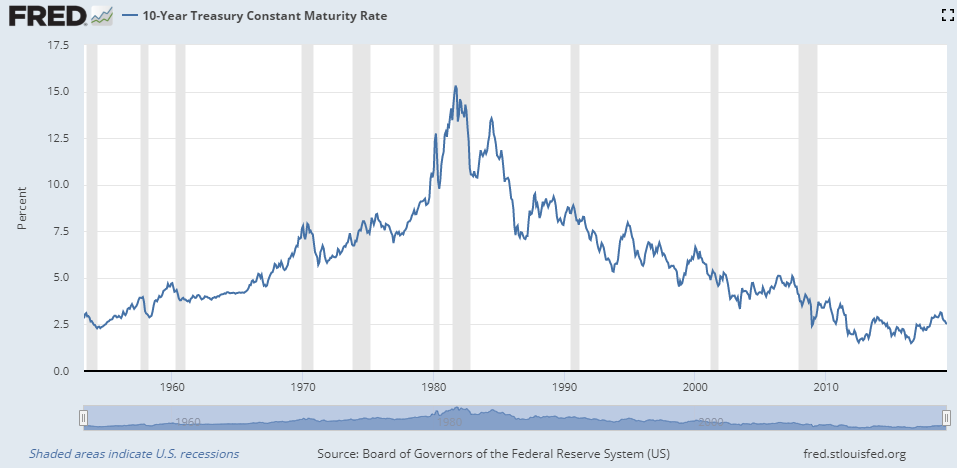
Take a bit of time to enlarge the graph of long term interest rates below. Notice that before most periods of recession interest rates rose sharply and significantly — that is the Federal Reserve “taking away the punch bowl just as the party is getting started”. Large and fast increases in long term interest rates bring on recessions.  And stock markets tend to crash well before a recession actually begins and often more than a year before a recession is officially announced..

Also, in the period from 1949 to the present there has been a major secular (long term) pattern to interest rates.  Over the course of decades long term interest rates increased, culminating in explosive rate increases from roughly 1970 to 1981.  The trend then reversed with a continuing decline in interest rates until recently.  This prolonged change has had a huge effect on the stock market.  Steadily rising interest rates put a damper on the stock market for decades. Market pundits called this slow growth period “stagflation” — stagnant economic growth coupled with high inflation.  Then Federal Reserve policy reversed. Interest rates fairly consistently fell and the stock market reaped wonderful gains that were well above the long term average.

That three decade run of good luck caused by declining long term interest rates is over.

Long term interest rate shifts are especially relevant now — in future years interest rates have little room to drop — they can only stay roughly level or go up. The past decade or so of historically low interest rates, besides making businesses more profitable, also led businesses to borrow huge amounts of capital in order to buy back shares of their own stock thereby directly increasing their per-share market price.   Further, the residential housing market — a major factor in the economy and family wealth –became based on very low long term interest rates.  For homeowners an increase of just a couple percent could lead to a mortgage payment increase of easily 20% to 60%.  That would shut down the housing and construction markets and cripple all the businesses that flourish when people move and change houses. When interest rates go up in the next round of increases the negative economic tidal waves may be huge..

The wonderful tail wind of gradually reducing interest rates benefited both the stock market and long term bond investors since 1981.  But, that tail wind is gone. The outlook for the next decade of stock ownership is much less rosy than the last few decades. Interest rates are a major key to what happens.

(Click on image to enlarge.)

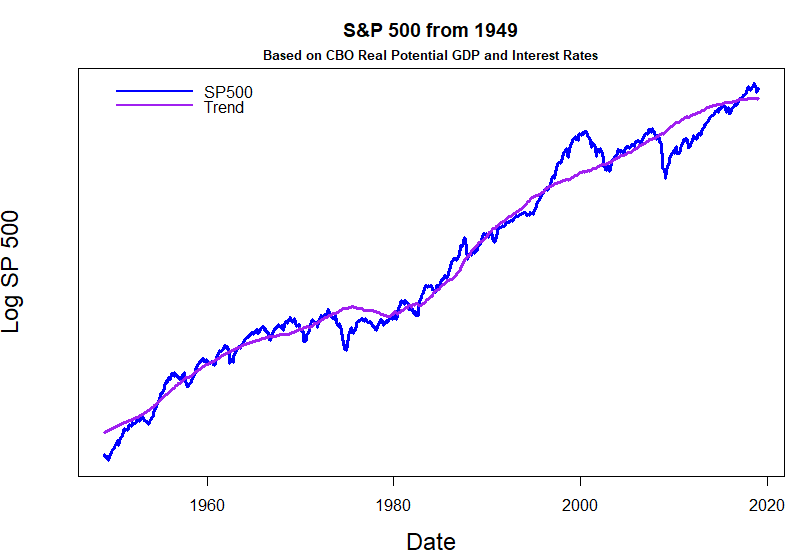
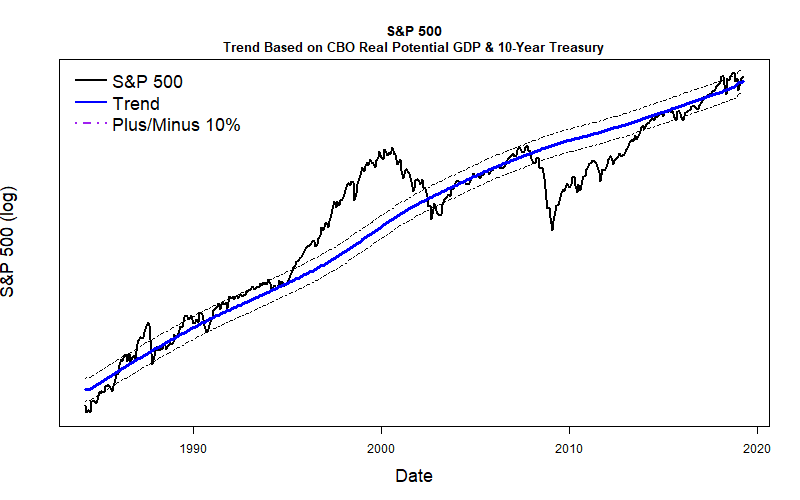
The next graph shows the S&P 500 since 1949 along with a modified trend line.  The modified line factors in long term exponential growth, CBO Real Potential GDP, smoothed 10-year Treasury rates, and a factor to reconcile the difference between GDP and stock market growth rates.

With the addition of Real Potential GDP and interest rates elements, trend correlation goes up to 0.995 if we ignore the excesses of the Dot Com Bubble and the Great Recession. But, if we include all data points, the correlation is still 0.98.

(Click on image to enlarge.)


Consider a Different Kind of Stock Market Index
Look at this next part as a way to gauge market speculation levels.

Though the S&P 500 Index is the most widely followed stock market average, it is not the only game in town.

As discussed earlier, the very popularity of the S&P 500 makes it subject to stock market speculation. Vast quantities of index funds and exchange traded funds based on the index mean that incredible trading volumes and dramatic price swings can occur in a flash.

The basic approach by which the value of the S&P 500 is calculated further makes it prone to speculative bubbles and sudden crashes.  The Index is based on 500 of the nation’s largest corporations that collectively amount for roughly 80% of total market capitalization. That’s good. But…

The Index is calculated based on the total capitalization of each company (number of shares times the current share price).  Those huge corporations are not weighted equally.  As this is written, Microsoft Corporation has a weight of 4.11 and Mattel Inc. has a weight of slightly under 0.016.  So, Microsoft is over 250 times more important than Mattel.

A net result is that a relatively small number of truly gigantic companies, generally with astronomical Price/Earnings ratios, dominate the S&P 500 calculation.  They don’t have to be profitable, just highly capitalized. During a market bubble a small number of companies can become the subject of massive speculation and rapidly rise within the Index, pushing down companies that are less in favor.  Once it was the Dot Com companies.  Now it is the FAANG companies like Facebook, Amazon, and Apple. Speculative greed can turn in a heartbeat to a panicked stock market crash.

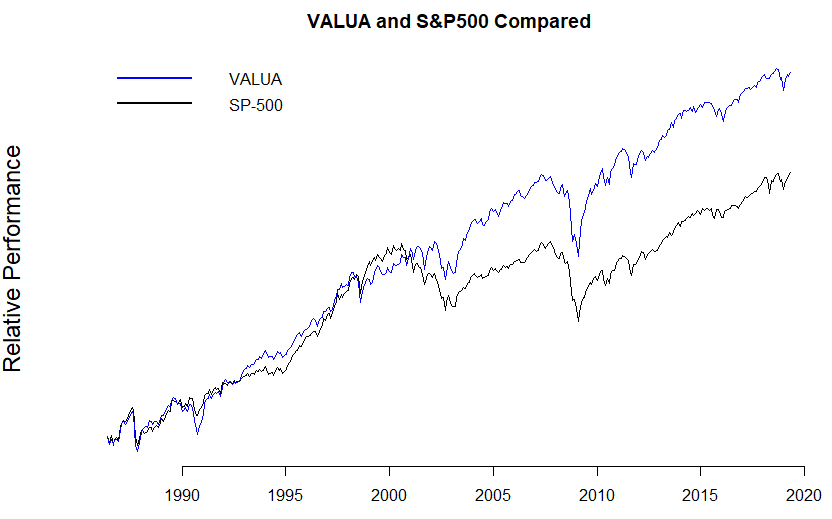
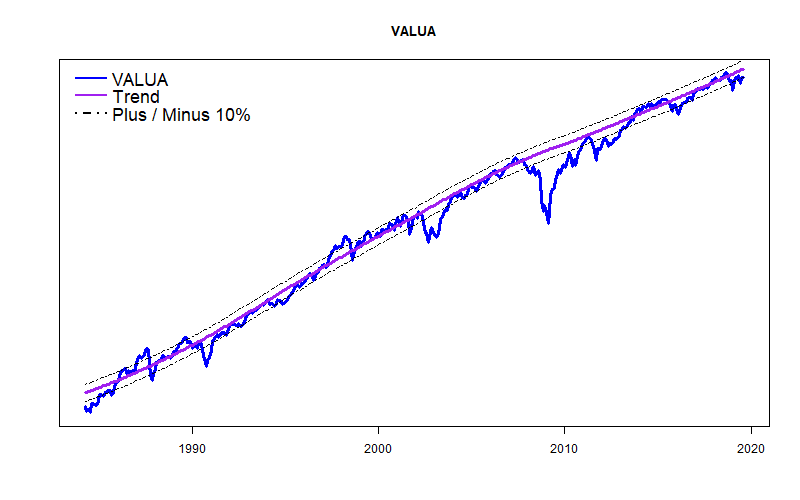
I prefer to follow a major market index, the Value Line Arithmetic Average (VALUA) that includes roughly three times as many companies as the S&P 500, but weighs each of them equally. In VALUA both Microsoft and Mattel count the same — as do many companies you may never have even heard of.  VALUA is not currently available as an exchange traded fund.  An equal weight fund based on the S&P 500 companies is available with the ticker symbol RSP.

The plot below shows both VALUA and the S&P 500 Index from 1984 to the present. VALUA has performed significantly better than the S&P 500.  But, they both experience major market disruptions at about the same time.

Bringing It All Together
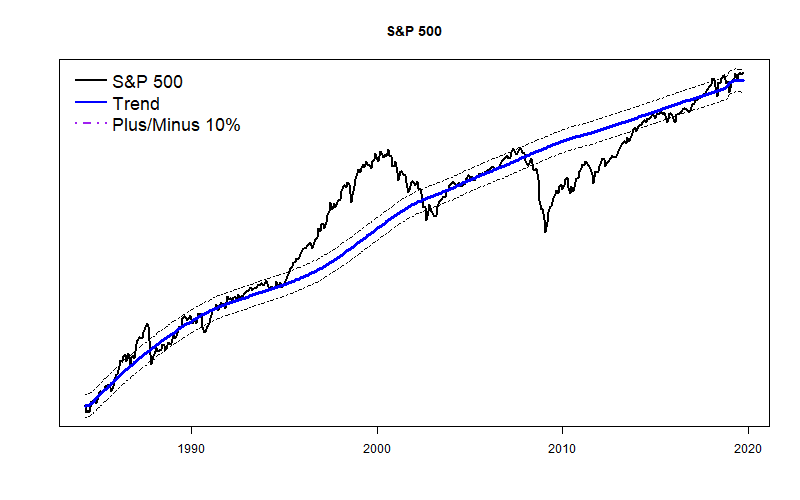
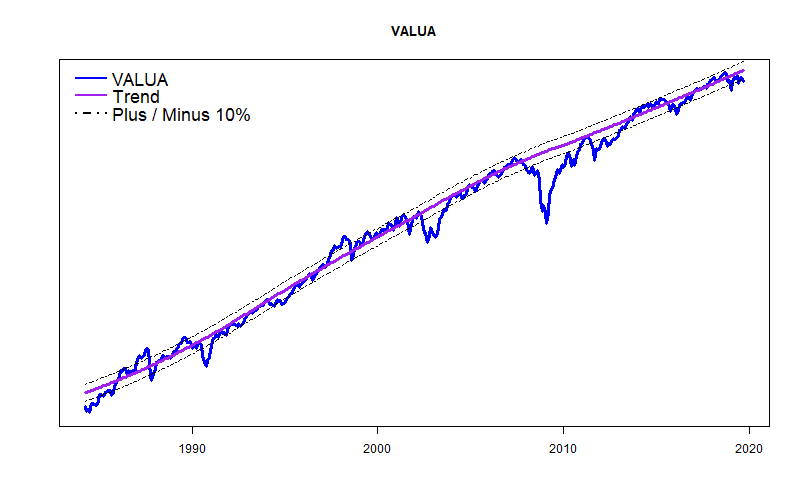
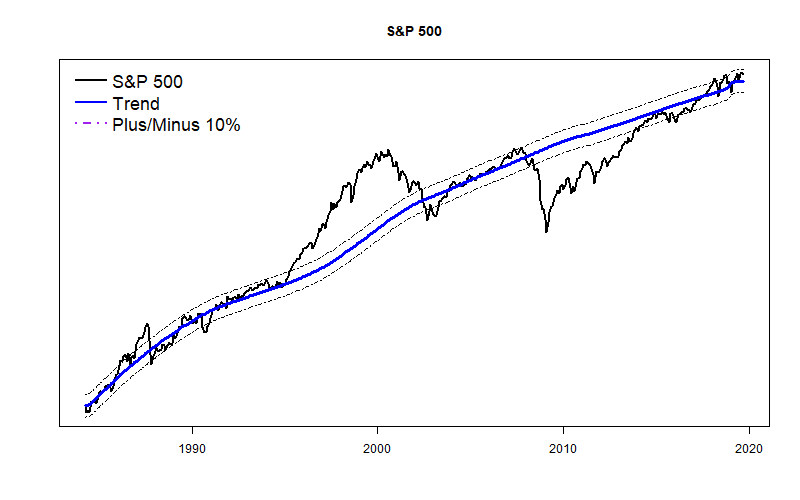
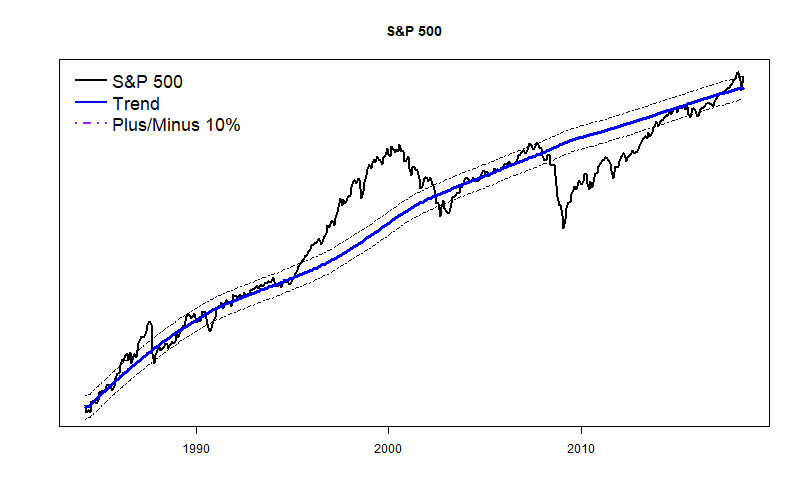
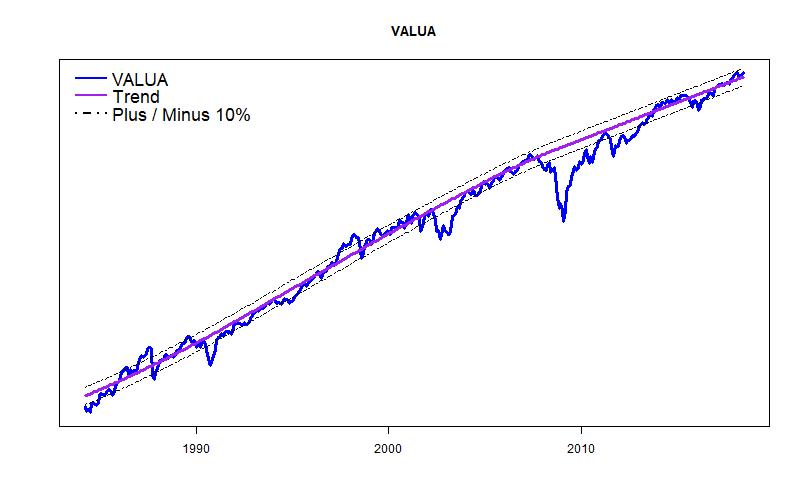
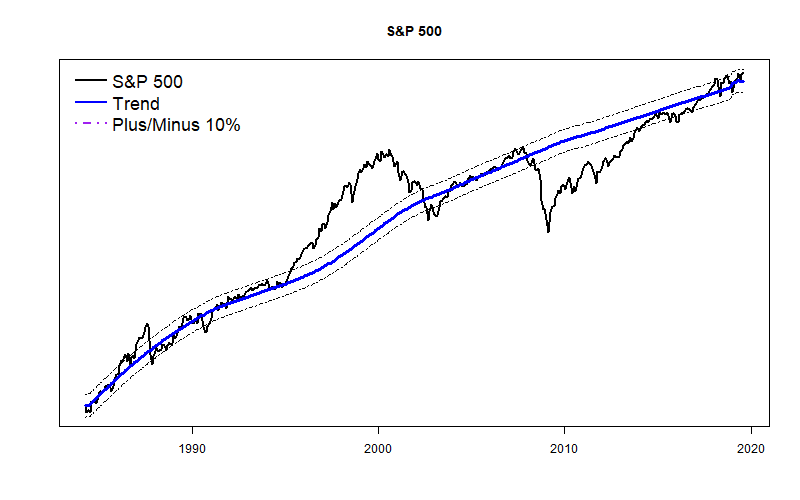
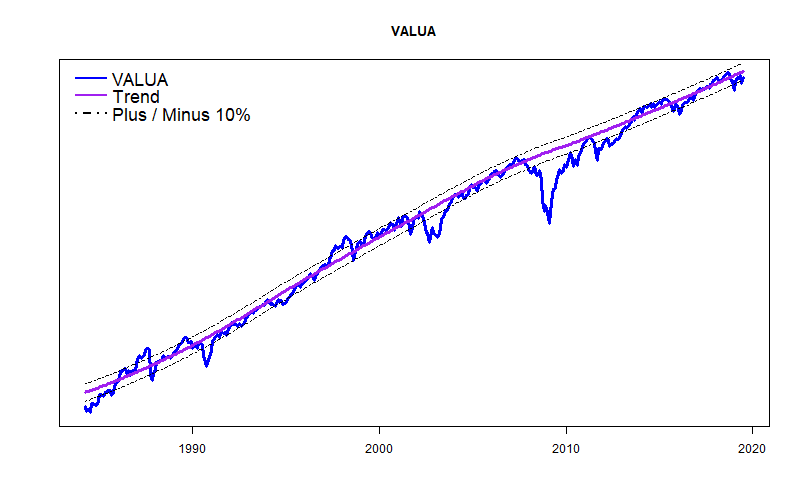
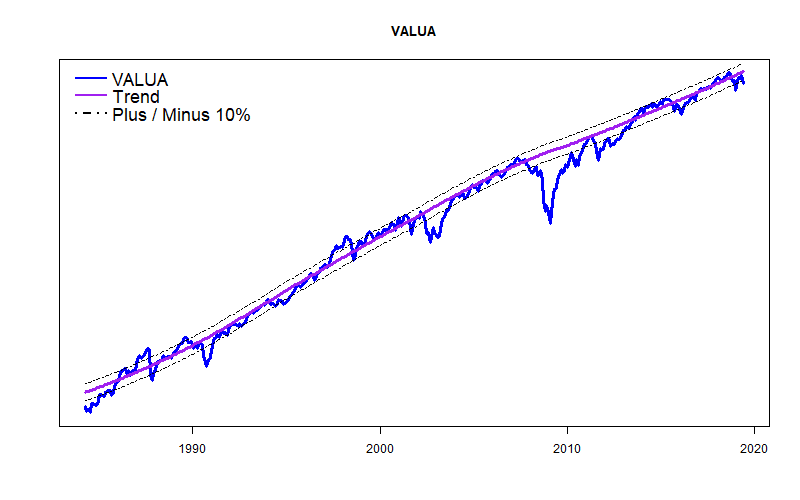
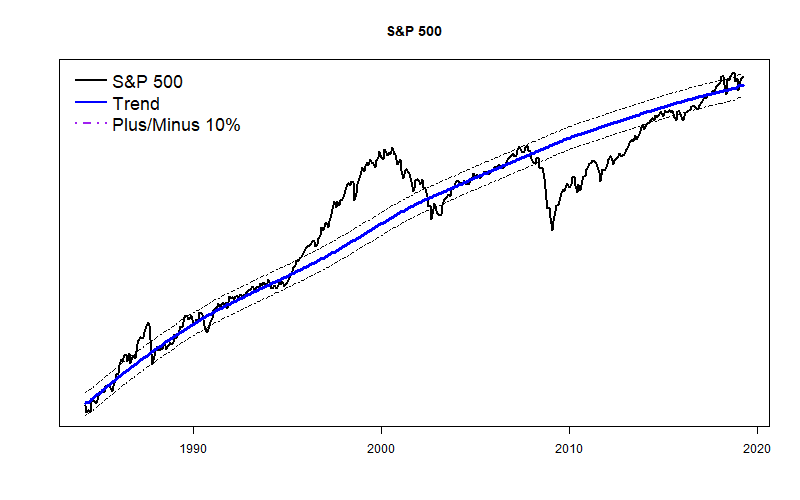
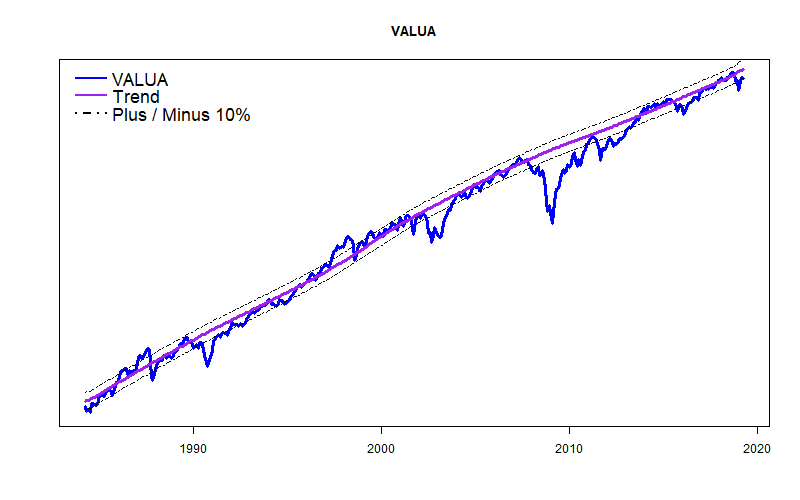
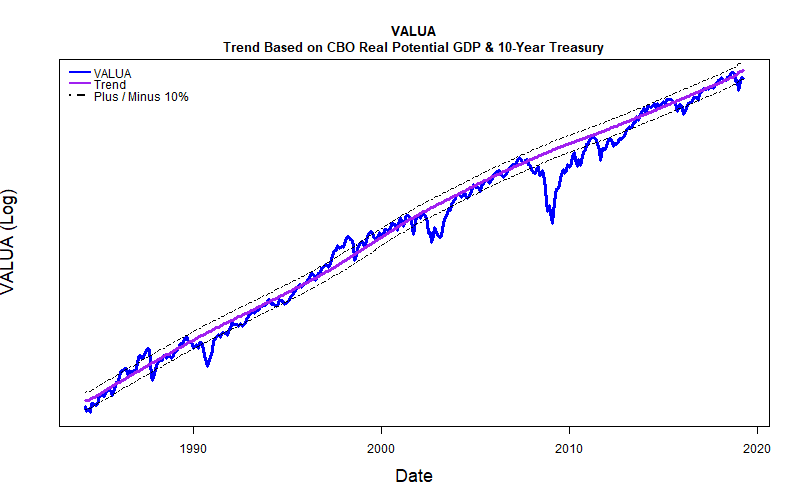
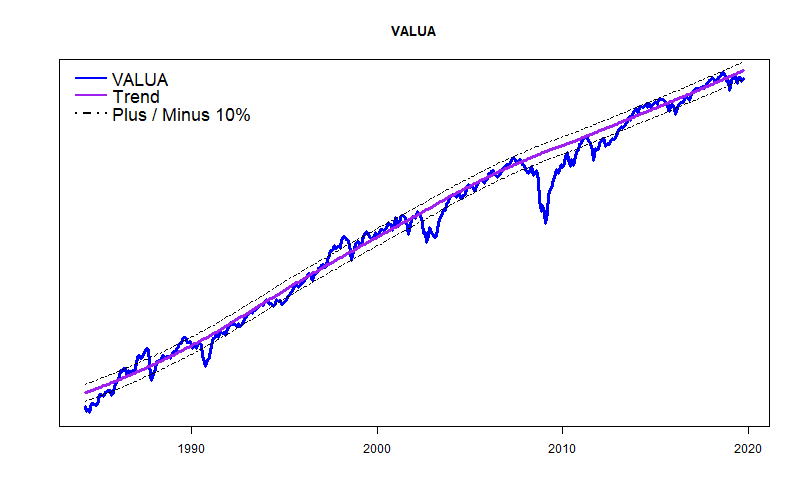
Finally, the two graphs below show the long term trends of VALUA and the S&P 500 since 1984.  Both are based on long term exponential-exponential growth, CBO Real Potential GDP and 10-year Treasury bond interest rates.  Both show bands that indicate 10% above and 10% below the respective trend lines.  I will be showing these graphs in most of my future blog posts. The relative strength of each compared to their long term trend lines should prove to be interesting.

(Graphs shown here are as of May, 2019)

(Click on image to enlarge.)

(Click on image to enlarge.)

And what, after all of this explanation do these charts say? First, both indexes are fairly close their very long term trend lines. That is comforting. Second, both indexes are somewhat above their long term trend lines.

So?

The stock market is a little high, but does not appear to be going really crazy now.  The long term odds, of course, favor “regression to the mean” — a small correction.
Stock Prediction August thru January, 2020 — Still Excellent

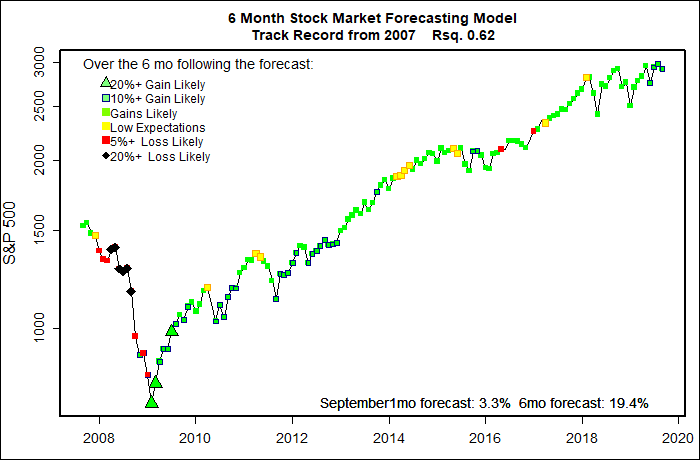
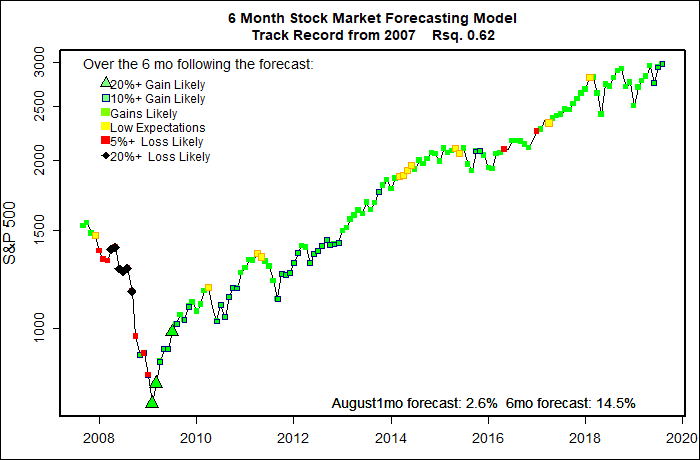
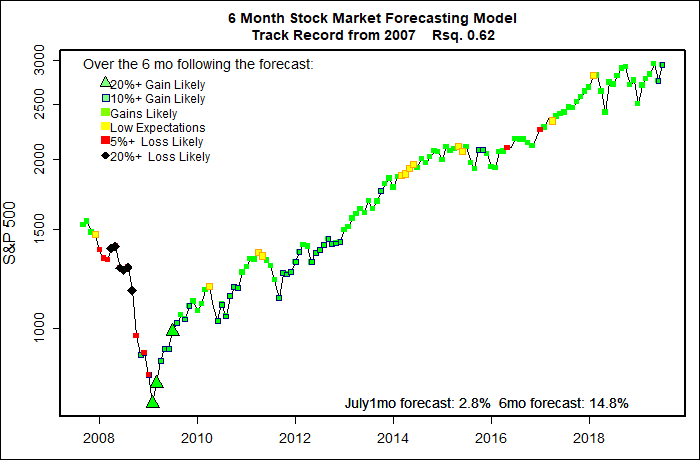
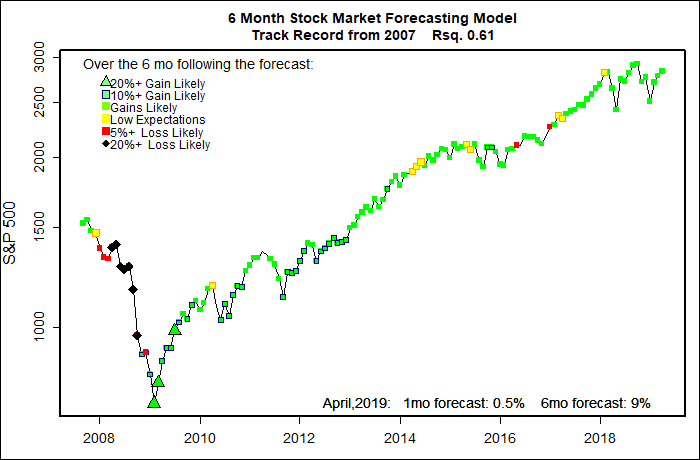
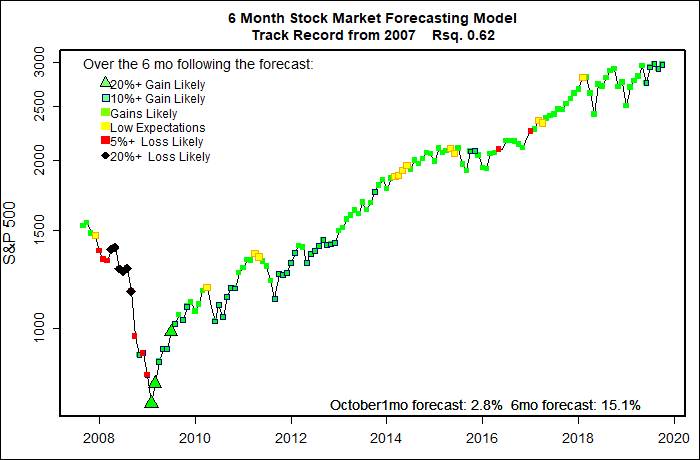
The statistical forecasting model says:
August, 2019:  +2.6% (Outstanding.)
Next 6 Months:  +14%  (Very high!)
Probability of at least breaking even: 96% – 98% (Excellent)
What am I doing? Fully invested since spring 2009.

My rosy forecasts are getting horribly boring, but this is what my econometric forecasting models are spitting out.

These stock market prediction models remain highly positive.  As long as the Federal Reserve continues to keep filling up the punch bowl of intoxicating low interest rates the story probably will not change.  The U.S. economy is an incredibly large and powerful juggernaut that just keeps chugging along — despite the current irresponsible administration. 

Hey, no one really wants to be the grownup in the place who will advocate fiscal responsibility.

When the stock market and the U.S. economy eventually crash down, hopefully these models will give us some warning. But, for right now the models — several of them in fact — see the party continuing.


(Click on image to enlarge.)

And, overall the stock market remains in its long term growth trend.  More speculative high flyers are doing better than the meat and potatoes stocks that make up most of the U.S. economy. Maybe the S&P 500 is going in to a little bubble? Or maybe not.


(Click on image to enlarge.)


(Click on image to enlarge.)


Stocks July thru December, 2019 : Still Very Positive

The statistical forecasting model says:
July, 2019:  +2.8% (Outstanding.)
Next 6 Months:  +15%  (Very high!)
Probability of at least breaking even: 97% – 98% (Excellent)
What am I doing? Fully invested since spring 2009.

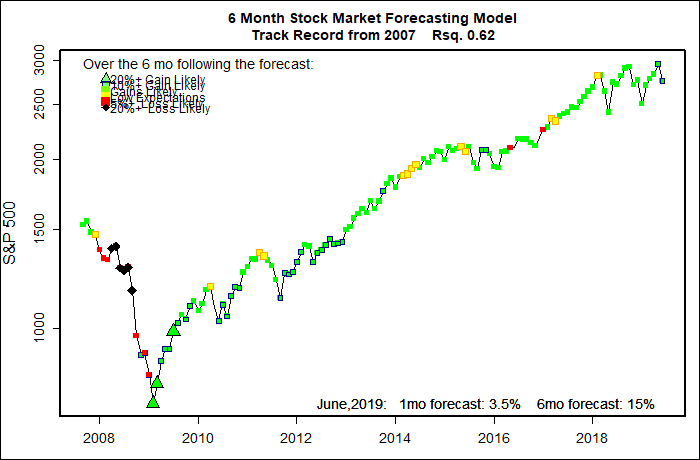
Last month the model was extremely positive, but I was dubious.  Once again, the model was more nearly right than I.  No surprise there. The model expected a one month gain of 3.5%, but the S&P 500 actually rose over 6%!  Best June in decades.

The model (actually, several flavors that each view data a bit differently) remains highly positive, seeing little chance that the stock market will fall during the second half of the year. That, of course, doesn’t mean that the market cannot possibly crash.  It just means that if the market does what it typically does in response to a number of economic variables, then it will do just fine. Fortunately, the market usually does what it usually does.


(Click on image to enlarge.)


Long Term Trend Lines
Not much news here.  Both the S&P 500 and the Value Line Arithmetic Average are within their normal envelopes. As a minor corroboration, the Morningstar Fair Value Graph , a favorite of mine, says the overall market is about 3% undervalued.

These are quite boring graphs, but hopefully they illustrate that the stock market is not in the middle of any wild and crazy bubble. It is just following the same basic trend it has followed for decade after decade.  The one worry is that these trend lines take account of prevailing interest rates. If interest rates shoot up, stocks will certainly tumble down. That does not appear likely for months at least.

(Click on image to enlarge.)


(Click on image to enlarge.)


Stocks June thru November, 2019: Really Great?

The statistical forecasting model says:
June, 2019:  +3.5% (Outstanding.)
Next 6 Months:  +15%  (Very high!)
Probability of at least breaking even: (Excellent . 97% – 98%)
What am I doing? Fully invested since spring 2009.

I guess it’s put up or shut up time for my forecasting models.  There is not much I can write to hedge or try to obscure what their calculations conclude.

Lots of scary financial / economic /political news. Not much positive sounding news. The models don’t seem to care. They look at other stuff, and still can’t read internet news stories.

There was a big stock market drop last month.  Interest rates have inverted (short term interest rates are lower than long term rates).  Usually that means a recession is in the cards sooner or later. The federal deficit (remember when that used to be big news?), well, it is growing faster than when the Obama stimulus plan kicked in to provide emergency economic relief. I can’t keep track of all the trade wars the President has started, or seems to want to start. Brexit seems more certain, whatever that means. Home sales are down — always a bad sign. The President seems to be sinking deeper and deeper into his swamp. The list of bad omens seems pretty long at the moment.

But, my forecasting models — all my current flavors — are incredibly optimistic. They appear to be shouting: Yippee! The one month predictive model points to a 3.5% gain, which for that model is very high.  The models dealing with probability of at least breaking even see winning over the next 6 months as a near-sure thing (around 97%) The 6 month models are uniformly expecting gains of around 15% — again, that is very high for them.

So, the models aren’t hedging their forecasts.

All I know for sure is that for the past 11 years the models have a much better track record than my gut feelings. I am just staying fully invested to see how this plays out.

Time will tell.

(Click on image to enlarge.)

The Long Term Picture

The Value Line Arithmetic Average (VALUA) is slightly worse than 10% below its long term trend line.  The S&P 500 is right at the long term trend line.  Combined, these say to me that there is room for the market to jump back up 10%. The market could certainly fall or do whatever it wants.  But, the net long term pressure to revert to the mean points upward.


(Click on image to enlarge.)

(Click on image to enlarge.)


Long Term Stock Market Model

Spoiler Alert: I plan to turn this post into a semi-permanent tab at the top of this blog page.  Most of the discussion I already covered in previous posts as I developed this long term model.

However wonderful this long term market model may be, it tells you very little about what the market is most likely to do in the next few months.


In Brief: 
This long term stock market model compares the current level of the U.S. stock market against its very long term trend.  The market has followed an exponential growth trend closely most of the time since at least 1871.  When it wandered off course in the past, things became.disturbingly interesting.

The model relies on 5 key elements:

  • Long term exponential growth history of the S&P 500 (adjusted) going back to 1871,
  • Factoring out major booms and busts when the market deviates wildly from its long term track. 
  • Congressional Budget Office  (CBO) Real Potential Gross Domestic Product model using GDP data back to 1949
  • 10-year Treasury bond interest rates
  • Contrast the S&P 500 with a market index that is calculated on an equal-weight basis, making it less influenced by financial speculation.

The model’s aim is simply to point out if stock market indexes are grossly distorted and are ripe for a major correction. The model does not say ‘when’ a correction will occur; that’s the purpose of my 6-month stock market model. But, the long term stock market model will tend to give a solid indication of the direction of the next major market move and some guidance on the likely magnitude of a coming correction. 

Increasingly Increasing Growth Since 1871
The Standard & Poor’s 500 Index is probably the most widely recognized index for U.S. stocks. It began as the Standard & Poor’s Composite Index in 1923 and assumed its present form in 1957.  Data is available, however, going back to 1871 that is based on the principles used to calculate the index.

Running a statistical regression analysis shows that the S&P 500 Index has grown at a fairly constant rate for that century-and-a-half period — despite booms, busts, wars, countless leaps in technology, a developing world, and innumerable changes in government, from when the U.S. had 13 fewer states and the “talking telegraph” (telephone) was invented.  It was not a random process. We know that too many factors to count do, indeed, impact the stock market day by day, week by week, and even decade by decade.  None the less, a simple, fairly steady growth curve describes roughly 150 years of stock market history remarkably well.  In the long run the stock market isn’t so crazy after all. Thank the Law of Large Numbers for that.

Stock market growth has not been perfectly constant.  Instead, the rate of growth of the S&P 500 has been slowly increasing.  Growth of the Index over time has been “increasingly increasing”.

The graph below shows the best fit of an exponential-exponential trend line with the S&P 500 Index.. The correlation between the S&P 500 and the simple steady growth path is 0.95 — where a correlation of 1.0 would be a perfect match and 0 would be no match at all.  At first glance it looks like the trend curve and the actual Index match incredibly well except for two glaring divergences which turn out to be the Dot Com Bubble and the Great Recession.  That is very far from the truth.  The curve fit in earlier years was not as smooth as it looks and the recent divergences were not as bad as they look in this graph. Next, let’s see why.

(Click on image to enlarge.)


Percentage Growth is What Matters
The graph below also shows the path of the S&P 500 Index since 1871 with the same exponential trend. It is the same data as the previous graph, but the vertical axis plots the logarithm of the Index value.  Each vertical unit is a given percentage change in the Index, not a linear increase.  If the market grew at a constant percentage rate the resultant plot would be a straight line.  Since the actual plot curves up smoothly, it means the rate of growth has been slowly and somewhat-steadily increasing.

Focusing on percentage market shifts is essential. It becomes clear that the early years of the S&P 500 were nowhere near as smooth as they appear in the first graph.  For example, through the Dot Com crash, on a month by month basis the S&P 500 dropped roughly 650 points, a gut-wrenching collapse of over 40%.  In contrast, the Great Crash of 1929 amounted to only about a 25 point fall in the S&P 500 — but that amounted to an incredible drop of over 80%! This log-based plot shows how the Great Depression severely held back the stock market for over a decade.  Our more recent Great Recession was a minor blip in comparison. Overall, the Index recently was no more erratic than long ago.

(Click on image to enlarge.)
Sometimes Things Do Go Crazy

From the graph above — and my experienced reality — I take a general view that for, say, 75% of the time the stock market behaves normally. (Literally, its relative value and frequent variations tend to follow a statistical normal distribution very closely with large deviations happening every once in a while.) Investing bubbles and market busts, bull and bear markets are extremes /aberrations from normal market growth.

Through history most investors have not been able to spot the top of large developing market bubbles — they always expect “Greater Fools” to keep coming along. Most people did not see either the Great Crash of 1929 or the Dot Com Bubble coming.  The usual cry is “This time it’s different”  Probably not next time either. Probably.

So, in building a long term trend model let’s drop out what the market has been doing for the past few years. With certainty we can  identify past bubbles and busts.  So, as a definition, in my long term model, bubbles are times in the past when the market was way above the long term trend, and implosions were when the market was way below trend.  This is a major simplification of a lot of complexities in the market and the economy.  But, it turns out to be a very useful simplification.

The chart below shows the long term growth of the S&P 500 Index after elimination of the most egregious periods when the actual market value diverged from the first approximation of the long term trend. Most of the deletions were related to the Great Crash of 1929 and the Great Depression,  I could have gone a bit further in my data pruning and the Dot Com Bubble and Great Recession scars would have disappeared as well.  But, with just limited data scrubbing the correlation with smooth exponential goes up to 0.98 (again, 1.0 would be a perfect score.)

In all the analysis that follows, I’ll continue to drop out the largest market crises in order to better define the normal growth of the stock market.

 Market Growth from 1949

The Great Depression and World War II spurred incredible increases in the range and quality of economic data collected.  Later, computers made it possible to amass a tremendous volume and range of data and to develop sophisticated economic models. To get a more accurate long term model of the stock market we need to bring in additional information content that is only available from 1949 on.

I have a second motivation here beyond just increasing precision.  As shown above, we can show that with really surprising accuracy the U.S. stock market has followed an exponential-exponential growth trend. Also, because the U.S. economy is a massive behemoth, we can be pretty sure that the long term trend — even if it shifts — won’t shift all that much in the next few years.  But, several current economic factors could make the near term trend vary more than usual.  By pulling in the next data stream I can bring to bear another model of long term exponential economic growth that effectively reflects the combined efforts of some of the world’s top economists for the past few decades. By no coincidence, at its core this other model also focuses on exponential-exponential growth.

Real Potential GDP The Congressional Budget Office (CBO) is a highly respected, objective and non partisan arm of the U.S. Congress established in 1974. Both political parties and nearly every powerfful vested interest group would like to bend CBO analyses to fit their agenda. That intense and highly bankrolled attention from all sides keeps the CBO model objective.  The stakes are very high in this game!

 Each year the office issues forecasts of government expenses and revenue along with anticipated 10-year impacts of proposed legislation — but, by its basic rules CBO does not make policy recommendations.

A central part of CBO analysis is a highly detailed  sector-by-sector computer model of the workings of the U.S. economy. The details of the CBO model are public, and are subject of extensive outside review.  The model is described  in 55 pages here.  CBO staff make minor adjustments to the model every few years.  Because of its pedigree, this model probably has more impact on the views of financial analysts than any other.  (Any Econ Phd student, professor or quant lobbyist would find fame and fortune if they could identify a flaw in the model or even just give the model a tweak.)

The CBO Real Potential GDP model closely matches the historical path of actual GDP (adjusted for inflation).  But, for the purposes of my long term stock market model, it does not matter much if the CBO model is accurate — it is a major cornerstone of what economists and financial analysts believe to be valid.  And, with the stock market “belief” trumps “accuracy” always. CBO Real Potential GDP data — projected 10 years into the future — is available from the Federal Reserve Economic Data (FRED) site here.

U.S. Gross Domestic Product data has only been available since 1949. That is the starting point for the CBO Real Potential GDP estimates as well. It is important to emphasize that the CBO model is focused on how the U.S. economy should perform at a sustainable pace at low unemployment. Also, the model addresses what economists call ” real” GDP — the confusing impacts of inflation are factored out.

There is a small difficulty here, however.  The CBO Real Potential GDP model addresses the U.S. economy, not the U.S. stock market.  They are far from being the same thing.

The S&P 500 Index grows faster than the U.S. economy. First, since 1949 the relative share of GDP attributable to major industry has increased. More and more we live in a world of gigantic corporations rather than small businesses. Second, the mega corporations that comprise the S&P 500 have become increasingly international in scope. In a continuing process of globalization, growth of S&P companies is not limited by the U.S. economy anymore. Third, over the second half of this period, to reduce shareholder tax burdens, corporations have shifting away from issuing dividends toward seeking faster growth and  using stock buybacks to increase stock prices.  Fourth, since the early ’80’s the rise of index-based funds, 401k – type retirement investment, no-load funds and ETF’s,  and online trading have drawn a disproportionate amount of investing directly to the S&P 500 and its component companies. Each of these 4 factors cause the S&P 500 Index, in particular, to rise faster than the general economy.  For these reasons the long term model also includes an empirical exponential adjustment factor to better link the CBO Real Potential GDP and S&P 500 growth rates.

(Click on image to enlarge.)

10-Year Treasury Bond Rates Interest rates have a profound effect on the stock market. At the most simple level, it is relatively easy to start a profitable business if  your dad gives you many millions of dollars, or even if you borrow your start up money at 2% .  But, it would be near impossible to start a business if you can only borrow money at a 40% rate!

Another take on interest rates comes fron seeing that owning stocks is an alternative to owning commercial or government bonds, or holding property such as real estate.  Changing interest rates makes some investments more attractive than others — spurring massive capital flows from one kind of investment to another.  Capital can flow fast, but the relative prices of alternative investments will shift even faster.

Additionally, changing interest rates also have a huge direct effect on business profitability, the business cycle, and recessions. More expensive borrowing directly reduces profits for most businesses. Large increases to interest rates can suddenly shut down the financial system and make previously successful businesses go bankrupt.

Take a bit of time to enlarge the graph of long term interest rates below. Notice that before most periods of recession interest rates rose sharply and significantly — that is the Federal Reserve “taking away the punch bowl just as the party is getting started”. Large and fast increases in long term interest rates bring on recessions.  And stock markets tend to crash well before a recession actually begins and often more than a year before a recession is officially announced..

Also, in the period from 1949 to the present there has been a major secular (long term) pattern to interest rates.  Over the course of decades long term interest rates increased, culminating in explosive rate increases from roughly 1970 to 1981.  The trend then reversed with a continuing decline in interest rates until recently.  This prolonged change has had a huge effect on the stock market.  Steadily rising interest rates put a damper on the stock market for decades. Market pundits called this slow growth period “stagflation” — stagnant economic growth coupled with high inflation.  Then Federal Reserve policy reversed. Interest rates fairly consistently fell and the stock market reaped wonderful gains that were well above the long term average. 

That three decade run of good luck caused by declining long term interest rates is over.

Long term interest rate shifts are especially relevant now — in future years interest rates have little room to drop — they can only stay roughly level or go up. The past decade or so of historically low interest rates, besides making businesses more profitable, also led businesses to borrow huge amounts of capital in order to buy back shares of their own stock thereby directly increasing their per-share market price.   Further, the residential housing market — a major factor in the economy and family wealth –became based on very low long term interest rates.  For homeowners an increase of just a couple percent could lead to a mortgage payment increase of easily 20% to 60%.  That would shut down the housing and construction markets and cripple all the businesses that flourish when people move and change houses. When interest rates go up in the next round of increases the negative economic tidal waves may be huge..

The wonderful tail wind of gradually reducing interest rates benefited both the stock market and long term bond investors since 1981.  But, that tail wind is gone. The outlook for the next decade of stock ownership is much less rosy than the last few decades. Interest rates are a major key to what happens.

(Click on image to enlarge.)

The next graph shows the S&P 500 since 1949 along with a modified trend line.  The modified line factors in long term exponential growth, CBO Real Potential GDP, smoothed 10-year Treasury rates, and a factor to reconcile the difference between GDP and stock market growth rates.

With the addition of Real Potential GDP and interest rates elements, trend correlation goes up to 0.995 if we ignore the excesses of the Dot Com Bubble and the Great Recession. But, if we include all data points, the correlation is still 0.98.

(Click on image to enlarge.)


Consider a Different Kind of Stock Market Index
Look at this next part as a way to gauge market speculation levels.

Though the S&P 500 Index is the most widely followed stock market average, it is not the only game in town.

As discussed earlier, the very popularity of the S&P 500 makes it subject to stock market speculation. Vast quantities of index funds and exchange traded funds based on the index mean that incredible trading volumes and dramatic price swings can occur in a flash.

The basic approach by which the value of the S&P 500 is calculated further makes it prone to speculative bubbles and sudden crashes.  The Index is based on 500 of the nation’s largest corporations that collectively amount for roughly 80% of total market capitalization. That’s good. But…

The Index is calculated based on the total capitalization of each company (number of shares times the current share price).  Those huge corporations are not weighted equally.  As this is written, Microsoft Corporation has a weight of 4.11 and Mattel Inc. has a weight of slightly under 0.016.  So, Microsoft is over 250 times more important than Mattel.

A net result is that a relatively small number of truly gigantic companies, generally with astronomical Price/Earnings ratios, dominate the S&P 500 calculation.  They don’t have to be profitable, just highly capitalized. During a market bubble a small number of companies can become the subject of massive speculation and rapidly rise within the Index, pushing down companies that are less in favor.  Once it was the Dot Com companies.  Now it is the FAANG companies like Facebook, Amazon, and Apple. Speculative greed can turn in a heartbeat to a panicked stock market crash.

I prefer to follow a major market index, the Value Line Arithmetic Average (VALUA) that includes roughly three times as many companies as the S&P 500, but weighs each of them equally. In VALUA both Microsoft and Mattel count the same — as do many companies you may never have even heard of.  VALUA is not currently available as an exchange traded fund.  An equal weight fund based on the S&P 500 companies is available with the ticker symbol RSP.

The plot below shows both VALUA and the S&P 500 Index from 1984 to the present. VALUA has performed significantly better than the S&P 500.  But, they both experience major market disruptions at about the same time.

Bringing It All Together
Finally, the two graphs below show the long term trends of VALUA and the S&P 500 since 1984.  Both are based on long term exponential-exponential growth, CBO Real Potential GDP and 10-year Treasury bond interest rates.  Both show bands that indicate 10% above and 10% below the respective trend lines.  I will be showing these graphs in most of my future blog posts. The relative strength of each compared to their long term trend lines should prove to be interesting.

(Graphs shown here are as of May, 2019)

(Click on image to enlarge.)

(Click on image to enlarge.)

And what, after all of this explanation do these charts say? First, both indexes are fairly close their very long term trend lines. That is coforting. Second, both indexes are somewhat above their long term trend lines.

So?

The stock market is a little high, but does not appear to be going really crazy now.  The long term odds, of course, favor “regression to the mean” — a small correction. My 6-month market model may beg to differ or not.
May thru October 2019: Probably OK.

The statistical forecasting model says:
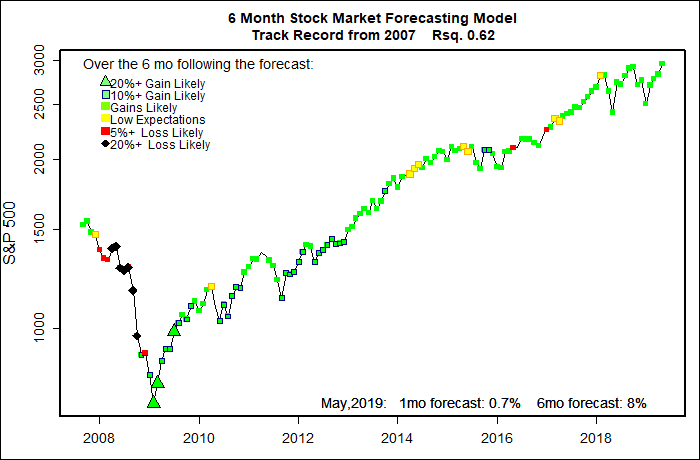
May, 2019:  +0.7%  (Models not very certain about May)
Next 6 Months:  +6 to +8% 
Probability of at least breaking even: Good to Very Good.
What am I doing? Fully invested.

The models’ forecasts for the coming half year are somewhere good but not great.  The models that I have been reporting on for the last decade are mainly in the “good performance” camp.  I am in the process of transitioning to updated versions of the models.  These newer models have about the same view of the market.  

I have no idea what is likely in the coming month, however. The several models’ forecasts for just the month of May are split.  But the only time these one-month models deserve any attention anyway is when their forecasts are either very high or very low. So, ignore them. :o)

Overall, it looks like there is a good chance the stock market is heading into a “blow off top”. My personal expectation is for some volatility. Seems like time for a bit of fear to creep back in.


(Click on image to enlarge.)

The trend lines for the S&P 500 and the Value Line Arithmetic Index together say that the stock market overall is following its very long term track based on Real Potential GDP and long term shifts in interest rates. That’s good.

But, there is a somewhat interesting nuance — the S&P 500 is near to the top of the channel while the Value Line Arithmetic is not.  No big deal, but normally that means that stocks may be moving into a minor bubble.

 (Click on image to enlarge.)

(Click on image to enlarge.)


April thru September, 2019 — Volatile

The statistical forecasting model says:
March, 2019:  +0.5%  (Average)
Next 6 Months: +9% (Above average)
Probability of at least breaking even: Good.
What am I doing? Fully invested.

The interest rates for 10-year Treasury Notes and 3-month Treasury Bills were the same this past week.  That is usually a very bad sign of low confidence in economic growth and typically points to economic recession. But, it doesn’t mean that the stock market is going to crash right away. 

If the spread between long and short term rates gets worse over the next couple of months, it will be time to worry.  Current statements from the Federal Reserve are dove-ish. The Fed is not intentionally trying to slow the economy. They are willing to be very very patient in maneuvering the economy out of the historically low rates needed to end the Great Recession. (Don’t hold your breath — it could take another decade to complete the process.)

My forecasting model has become more optimistic, expecting the next 6 months to be bullish for the stock market.  Me? I’m not so sure. I expect more volatility as we go through the process of treating government and the economy as some sort of reality TV show that is mainly interested in high ratings.


(Click on image to enlarge.)


Long Term Trends
I have included graphs of long term trends for the Value Line Arithmetic Average and the S&P 500.  In both cases the trend lines are based on the Congressional Budget Office Real Potential Gross Domestic Product model and smoothed data on 10-year U.S. Treasury notes. You will need to click on the images to enlarge them enough to really see much. At the moment, VALUA is slightly below trend and S&P 500 is a bit above trend.  I wouldn’t read too much into these differences.  The whole purpose of these long term trend lines is to see if the market is grossly above or below their long term trends. Right now, both appear to be fairly close.  No big bubble.

Well, actually that isn’t quite true. Over the long haul the broad-based VALUA has performed distinctly better than the S&P 500. But, when investors are enthusiastic the S&P will shoot up faster.  We are seeing a bit of that now.

(Click on image to enlarge.)


(Click on image to enlarge.)


Stock Market Trend Line — Part 3

(This post does not contain a new market forecast.)

In brief:  Over the span of decades the basic nature of the stock market can change somewhat, and sometimes the stock market “goes off the rails”, Accepting these two major characteristics can help to better understand the long term market trend.

The goal of this series of posts is to explain a new, ‘intelligent’ stock market trend line that I will be including in my monthly stock market forecasts. By ‘intelligent’, I mean that it is focused on where the market ‘should’ be heading based on its long standing relationship with the economy. The new trend line is not just a simple extension of the current trend of recent stock market behavior.

Trusting in simplistic trend lines can lead to disaster — that’s part of my story.
I got burnt badly during the DotCom Bubble.  During the 1990’s the graph below shows how I saw the stock market — one great big ascending curve of market expansion as the U.S. economy shot up, powered largely by computer technology.  The great upward trend was so obvious! I was a computer jock, and that time was exhilarating!. This time was different!

(Click on image to enlarge.)

There wasn’t much free public electronic economic data available then, and the stock data that was available didn’t go back very far in time.  I knew enough to plot growth with a percent gain (logarithmic) Y-axis, and that immediately straightened out the market growth curve, revealing an amazing steady straight line of growth.

(Click on image to enlarge.)


All things tend to follow a trend.  Until they don’t.
So, when the stock market eventually turned down, I foolishly trusted the well-established market trend that I had been following for years.  I didn’t sell much stock as the market fell.  When I did sell during the worst days of the market crash, it turned out to be near the bottom that eventually formed.

(Click on image to enlarge.)

Now and then the market actually does change.
The simple trend line I established in the first two parts of this series is based on just the fairly steady growth of the economy and on fairly long term shifts in interest rates.  The trend matches the long term path of the stock market fairly well as shown in the graph below.  The most noticeable characteristic of the trend line is that it did mimic the flattening of stock market growth during the 1970’s that largely resulted from tremendous increases in interest rates.

(Click on image to enlarge.)

But, the simple trend does not fit with some factors we know for certain about the stock market.  From the 1970’s to early 1990’s a couple of huge factors did change with the stock market, changes that had little to do with shifts in Gross Domestic Product or with interest rates. From the early 1980’s the stock market started rising at a greater pace than it had in earlier years. And there were reasons for that change.

An immediate example of a non-GDP shift in the stock market is that since 1980 it has become easier and easier to buy and sell stock.  Prior to the birth of discount brokers it was common to pay hundreds of dollars as a commission for buying shares of stock. Now, the same transaction would cost a few dollars at most.  Also, formerly, individual investors would end up buying mutual funds from major brokerage funds the had steep fees (loads)  of up to 8 % for buying and or selling. Now, most discount brokers will sell no-load stock funds with nearly insigniticant management fees.

Overall, there are more reasons for people to own stock.  The creation of Individual Retirement Accounts, 401k plans and similar savings vehicles have meant that for many millions of people that they can hold stock, even for decades, and not pay any tax until they eventually cash out their stock. Aging of Baby Boomers has greatly accentuated this trend in recent years.

Capital gains taxes on the sale of stocks are only paid when stock is sold, unlike dividends which are taxed in the year they are received.  Also, capital gain tax rates have generally been less than taxes on dividends. Both of these factors made it much more attractive to hold stocks for capital gains rather than for dividends.  Most recently, major corporations have seized on this to enhance their desirability by putting most of their profits into stock buy-backs — buying their own shares, thereby decreasing the number of shares on the market and increasing the earnings per share of their stock.  Many corporations have taken this a step further — taking advantage of recent incredibly low interest rates they have borrowed incredible sums of capital and used that money to buy back even more shares.

These shifts away from dividends and expansion of stock buy backs have boosted stock prices, but they have little direct effect on GDP or interest rates.  So, my existing trend line is oblivious to them.

Over time major corporations — the components of the stock market — have accounted for an increasing share of GDP.  But, the last few decades have seen a much higher rate of the corporate share of GDP.  My long term model does not recognize this shift.

Changing my trend model to account for these changes in the nature of the stock market ends up being quite simple — I am only going to base the final model parameters on stock market behavior since the mid-1980’s when all of this got underway.

There is a price to this, of course. My model will not match data for earlier years as accurately.  But, I don’t care.  My goal is not to perfectly model the stock market from day one.  I just want to be able to detect when today’s major market trends change.  Concentrating on changes in just the past 3-4 decades will accomplish my goals easily.

And then, sometimes the stock market just goes crazy.
The chart below comes from AdvisorPerspectives.com   It tells the long term story we are all too familiar with — somewhat cyclically, the stock market goes through booms and busts.  We change how we value stocks.  Prices (and Price/Earnings Ratios) rise to a peak and then crash.  Some of this rise and fall is explained through major cycles in interest rates.  But, some stock market craziness is just craziness.

(Click on image to enlarge.)

Generally, we do not recognize a developing stock market bubble until it deflates.  We thought “This time it’s different!”.  And it wasn’t. Time and time again.

So, how can the intelligent trend line deal with these boom/bust cycles?  During our recent past we have had an incredible stock market boom — the Dot Com Bubble. And we had two major financial catastrophies — the Savings and Loan Crisis of the later 1980’s and the Great Recession of a decade ago. How can the intelligent trend line avoid being shaped by these huge events?

Most of the time, the stock market behaves fairly rationally, and then some times it does not. So, in the final definition of the trend line model I will take the crazy times out of the modeling process.   The graph below shows the S&P 500 from 1984, but  data for the dates during the major market crises have simply been removed.

(Click on image to enlarge.)

The next graph shows the final trend line for the S&P 500, based on long term GDP, smoothed interest rates, and ignoring proven market bubbles and crashes.

(Click on image to enlarge.)

“Bait and Switch” Time!
Through this series I have shown the development of what I consider to be an intelligent trend line for the S&P 500 index. We will see over time how it performs.

But, the truth is: the S&P 500 is not the best index to use in following the stock market.  The problem with the S&P 500 goes back to how it is calculated.  These are, essentially, the 500 largest corporations in the country, but each is weighted according to its total market valuation: take the total number of shares and multiply by the price per share.  That is the market capitalization.  Using this weighting some companies like Apple, Amazon, and Facebook become much more important than other companies.  During a stock market boom, the current hot stocks shoot up in price, but also take over an increasingly large role in computing the average. This reliance on current hot favorites makes the S&P 500 (and more so the NASDAQ Composite) prone to accentuating market booms and busts.

I prefer to use a different index, the Value Line Arithmetic Index.  It also covers a larger number of companies (roughly 1,700) but each company is weighted the same. An index ETF you can buy that is very similar is the Guggenheim S&P 500 Equal Weight ETF (Symbol:RSP).

The advantage of using the Value Line Arithmetic Index (VALUA) for my trend line is simply that it is more predictable. Much less heavy-handed editing is necessary in order to escape from being distorted by market booms and busts.  The final trend line for VALUA that I will concentrate on in my monthly forecasts is shown below. We will see how it performs over time.

(Click on image to enlarge.)

Stock Market Trend Line — Part 2

(This post does not contain a new market forecast.)

In brief: The stock market is tied to the economy, but the link is not all that direct.

Part 1 of this Trend Line series argued that the U.S. stock market — despite all of it’s booms and busts —  has grown at a surprisingly steady percentage rate (exponential growth) rather than by a steady or random number of points each year (linear growth). It even looks like that growth rate has been going up a bit, somewhat consistently, over the long haul, making long term market growth ‘increasingly-increasing’.

 The S&P 500 data I presented in Part 1 began in 1871, but researchers have shown this same sort of increasingly-increasing growth has occurred  for human economies from the dawn of civilization.

The economy dominates stock market performance. Sort of.

The U.S. government didn’t collect much economic data until the Great Depression, and only really became serious about it during WWII.  The first publicly available GDP data is from 1947.  So, the focus here will be on the stock market since that time.

In the post-1949 graph of the S&P 500 below, the Y axis is linear.  Just like the 1871- graph in Part 1, it shows the characteristic upward swoosh.  Again, the immediate appearance of the graph is that the market was flat for years and years, then suddenly shot up.  And there were those two crazy bubbles of the DotCom episode and Great Recession.

(Click on image to enlarge.)

Plotting the same S&P500 data with the Y-axis showing percentage growth (logarithmic) smooths  the line out, making it more linear. Also, volatility of the early years comes into perspective — volatility in percentage terms has not increased dramatically in recent years. Overall, the stock market has experienced a roughly steady rate of growth.

(Click on image to enlarge.)

To factor economic performance into the new market trend line, I am turning to the combined talents of scores of the top U.S. and world economists — living and dead — including several Nobel Prize winners.  The best data I have found to track  and forecast the economy is  the Real Potential Gross Domestic Product created and maintained by the Congressional Budget Office. “Real” in the name means that inflation has been factored out of the data. Interestingly, the S&P 500 matches an inflation-adjusted Real GDP better than unadjusted data.  “Potential” means that the CBO Real Potential GDP comes from an elaborate model  designed to mimic the U.S. economy running near it’s full potential. During an economic boom the economy may run somewhat above potential, but only for a few years at most. Likewise during a recession GDP may drop as much as 10% below potential, but tends to recover over several years.

The CBO Real Potential GDP adds a lot of power to my market trend line. First, it is the best known model there is, and for good reason.  The CBO model is the tool used to evaluate the 10 year economic impact of all proposed congressional legislation.  In the hope of making their proposed legislation score better, every congress member, and every interest group tries to get the CBO model tweaked. For that reason the CBO model is fully documented, transparent and heavily peer reviewed. It is unaffected by politics.

 In the professional world of young top-notch economists the Federal Reserve and the Congressional Budget Office are the top credentials you would want on your resume.  Just writing a paper that suggests a small adjustment to the model is a major kudo for an economist.

As shown in the graph below, it tracks the actual GDP numbers amazingly well. But, even if it was not very accurate, it is the economic model that economic forecasters are most likely to trust, creating a self-fulfilling prophecy effect on the stock market.

Importantly, the CBO Real Potential GDP projects economic performance quarter by quarter for a full 10 years. Actual GDP data, by contrast is always a quarter to half a year out of date. Economic trends that are most probable in the coming decade have already been factored into the model.

Finally, the difference between actual Real GDP and Potential Real GDP is a solid and objective measure of how well the actual economy is living up to it’s long term potential.

(Click on image to enlarge.)

Adding Real Potential GDP and Interest Rates to the trend line

I have added one more piece of information to the trend line model — Interest Rates.  We know from long experience that interest rates and especially changes to interest rates have a major impact on business profitability and the stock market.   The CBO GDP model includes interest rates as direct economic factors.  But, the effects of interest rates on the stock market are somewhat different. Especially since we appear to be heading into a period of rising interest rates, it is important that the trend line reflect changing rates.

Adding the CBO Real Potential GDP and data on prevailing interest rates to the existing exponential trend line produces the trend line for the S&P 500 shown below. The trend line, now based on objective economic data, appears to conform to past market performance pretty well.

But, this is not the final trend line I will be using.  There are a few more steps that I’ll cover in my next post.

(Click on image to enlarge.)

Stock Market Trend Line — Part 1

(Feel free to ignore this post. It does not offer any current stock market forecasts.)

Pretty soon I’ll be posting what I consider to be an “intelligent” trend line for the stock market and make it a regular part of my monthly market forecast.  What makes the new trend line “intelligent”? Well, it is based on where the market is most probably heading based on very long term economic data. Why does the trend line need to be so smart?  Major structural changes that I can’t ignore are underway in the U.S. and world economy. All of this is going to take a few posts to explain.

Increasingly Increasing Growth

The S&P 500 is probably the most widely followed stock market index. It is a capitalization-weighted index reflecting the combined stock prices of  most really gigantic American corporations. (i.e. Huge companies have a much greater impact on the S&P 500 than do merely big companies.) In 1923 the “Composite Index” had just a few stocks, by 1927 it had 90 companies, but it was not until 1957 that it included 500 companies.  Robert Shiller (“Irrational Exuberance”) has posted extrapolated S&P data going back to 1871 that is the basis of my charts below.

The first graph shows the value of the S&P 500 from 1871 to the present.  It shows the classic upward swoosh that characterizes exponential (compounded) growth of a few percentage points each year.  But, a first glance it appears odd — like the market did almost nothing for about a century, then started an increasingly steep climb — almost straight up!  What about the two crazy bubbles recently ( the DotCom Bubble and the real estate bubble that led to the Great Recession)?  Where is the Great Crash of 1929? Not even visible.

(Click on image to enlarge.)

Plotting the logarithm of the price makes the graph show percentage growth rather than nominal growth..  A steady rate of price increase will show as a straight line (purple).  ‘Bumps’ or ‘pot holes’ along the way match the percentage change of each market episode. So, this next chart shows the same data for the S&P 500, but the Y-axis now measures percentage change. The plot looks a bit straighter, and the huge spike and crash of 1929 is now clear.  But, to my eye, it still looks like the curve has an upward swoosh.

(Click on image to enlarge.)

Turns out, the S&P 500 hasn’t just been increasing at roughly a set rate.  Instead the rate of increase has been increasing at a somewhat steady pace!  That’s the story of this next chart. The Y-axis now shows the the logarithm of the logarithm of the SP 500. (Sorry math-o-phobics!)  And the straight ling approximation now looks pretty good. (R-squared = 0.95)   So what?  The world is about to go through a couple of huge changes in the next few decades.  They are already starting to affect the stock market.

(Click on image to enlarge.)

First the good news.  We live in the developed world.  The stock market is totally a creature of that developed world.  Here’s the shocker: today only about 1/6 of the world’s population lives in developed world conditions.  The rest of the world is about to play catch-up, much like China has been doing for the past few decades.  The next two or three decades are very likely to see an explosion of world development and hence further explosive growth of the stock market. So, the positive angle is that any sort of ‘intelligent’ stock market trend line needs to be acutely aware of this coming world development. Most of the growth will occur outside the U.S., but U.S. multinational companies will undoubtedly catch a big share of the coming world growth.

Now the bad news.  Rapid world development is already causing huge problems.  Everyone is not benefiting equally.  Huge numbers of people in the U.S. and all over the world already feel left behind. That is part of the Trump revolution. But, it is also part of many other phenomena like massive migration happening all over the world.

And there is another big risk hanging around.

I vividly remember the very first time I saw a long term exponential growth curve. I was 12 years old.  It scared the hell out of me and I still remember it vividly.

It was the very first day of my seventh grade science class in 1959.  Mr. Abrams, the teacher, projected a view-graph on the screen that had this great big upward swoosh. He said that this was a developing world problem that wasn’t causing big problems yet, but someday it would. 

The graph was of carbon dioxide levels in the atmosphere.

Carbon dioxide levels have, of course, continued to double and double — at an increasingly increasing rate.  World emissions are roughly 700% higher than they were when I was in seventh grade.

Today, it is still possible, perhaps, to debate that  meaningful climate change has occurred. But, it won’t be possible to debate the effects much longer. 

We in the developed world use several times more fossil fuels per person than people in developing countries. If the developing world starts to use fossil fuels like we do, then carbon dioxide levels will explode higher.  Given the momentum of world development, much of this rise in carbon dioxide over the next few decades is essentially guaranteed.

So, any ‘intelligent’ trend line for the stock market needs to be closely attuned to these huge world changes. We need to closely watch what is happening.

Fortunately, several hundred economists have helped me in creating my new trend line.  But, that story is for another post.

Annual Carbon Dioxide emission in billions of tonnes since 1750. The right hand axis shows this amount as a percentage of teh amount of carbon dioxide that was in the atmosphere in 1750.