November thru April 2024: Finally, the market may be turning up

ETFs Alpha Test posted HERE

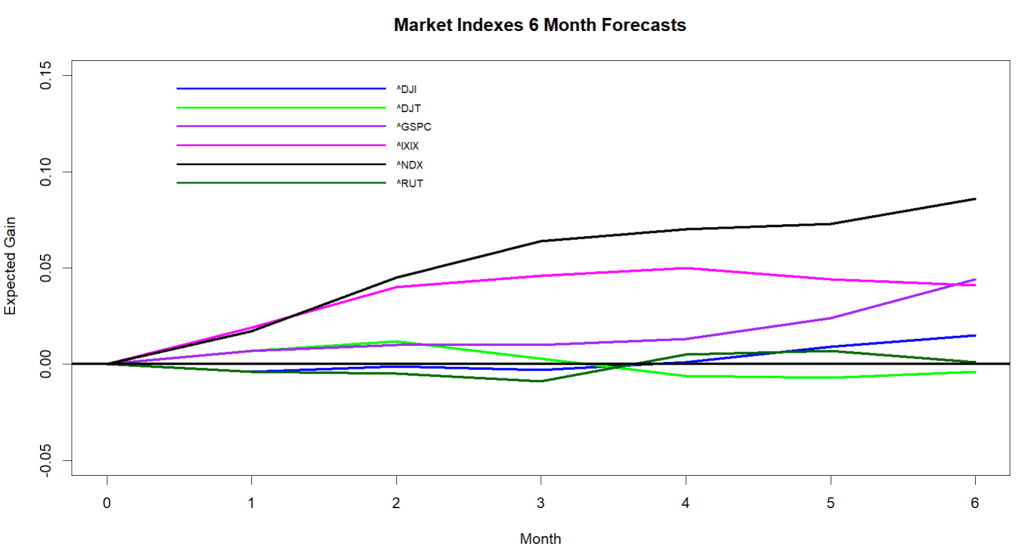
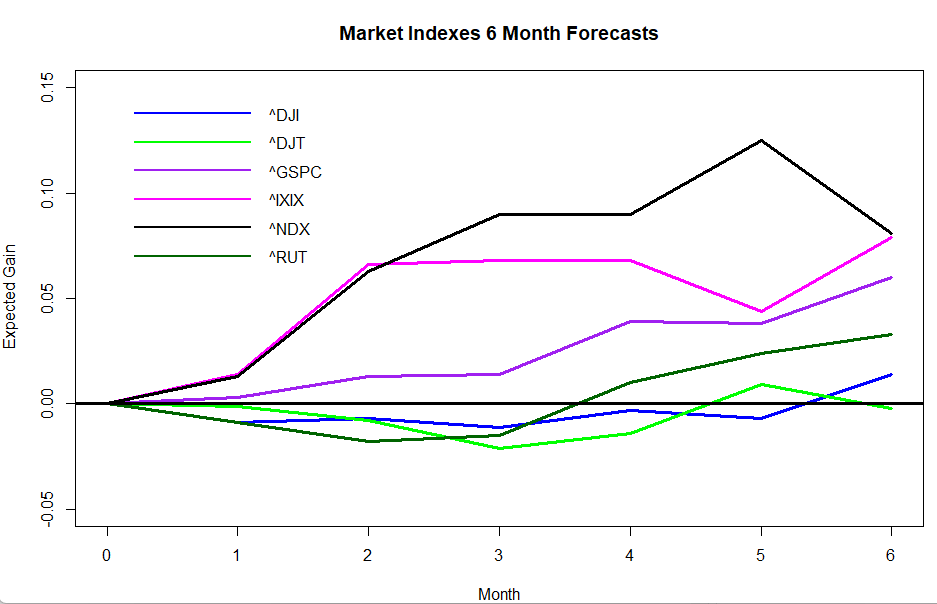
For months, these stock market forecasting models have posted mildly negative short-term forecasts — and sadly, they have been correct. With most flavors of market indexes down roughly 10%, the models appear ready to turn up — perhaps, 1% in November, but then up roughly 8%-9% over the next 6 months. (Of course, not all the market models agree, but, looking at the spaghetti plot above, it does look like things are finally turning up. ) All in all, the next 6 months expect stock market performance to be distinctly above average. Probability of at least breaking even is about 98%.

Unless the Republicans in the House of Representatives shut down the U.S. Government or a broader war spreads in the Mideast.

As far as my forecasting models are concerned, the most pressing economic problem is that long-term interest rates have shot up. Most other economic variables have remained strong. As the Federal Reserve jacked up short-term interest rates, the 10-year borrowing rate stayed quite low. The bondholders seem to have given up now, and long-term interest rates have risen. Interest rates are likely to stay higher longer. Statistically, that is a negative factor for corporate profits and then for stock market prices. Overall, higher interest rates point to lower market PE ratios and a lower stock market. But, for now, my models expect things to get better. Happy Thanksgiving.!

As has been the case for months, the overall stock market situation is that the Federal Reserve is tightening the purse strings, but Federal Government spending remains in heavy stimulus mode. The result is like driving a car while pressing both the brake pedal and the accelerator. It works. The car keeps moving. But, it is hell on the equipment. I don’t expect things to change much until the next presidential election. By then the traitor Donald Mussolini may be in power and things might be very bad.

October thru March 2024: Better after a month or so

Value Line Arithmetic Average VALUA  +4% (Normal)
Dow Jones Industrial Average ^DJI +0.04
S&P 500 Index ^GSPC +0.05
NASDAQ Composite ^IXIC +0.04
NASDAQ 100 NDX +4%
Russell 2000 ^RUT 0.01
Next 3 Months:  VALUA looks fine, other indexes weak for the next couple of months
VALUA Probability of at least breaking even in 6 months: 95% (86% to 98% — better than average)

ETFs Alpha Test posted HERE

September was a weak month for the stock market; about what these forecasts had forecasted. The predictive models are divided at the moment, but overall they expect some continued weakness during October. The market then should become generally positive, a bit better than average.

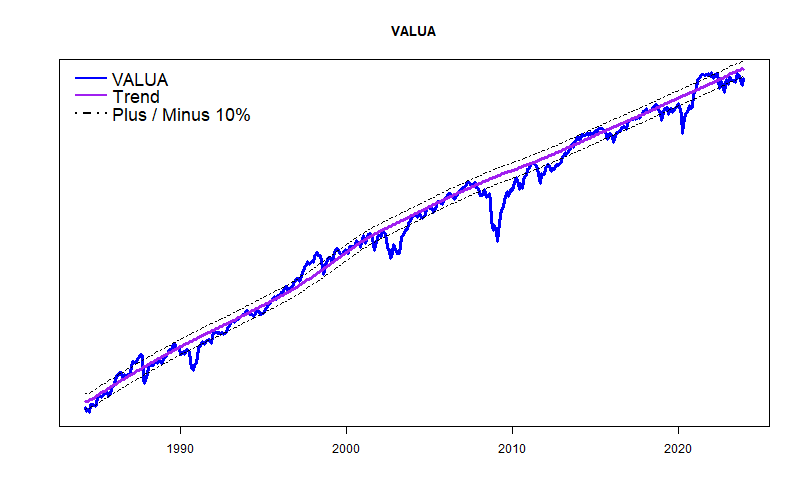
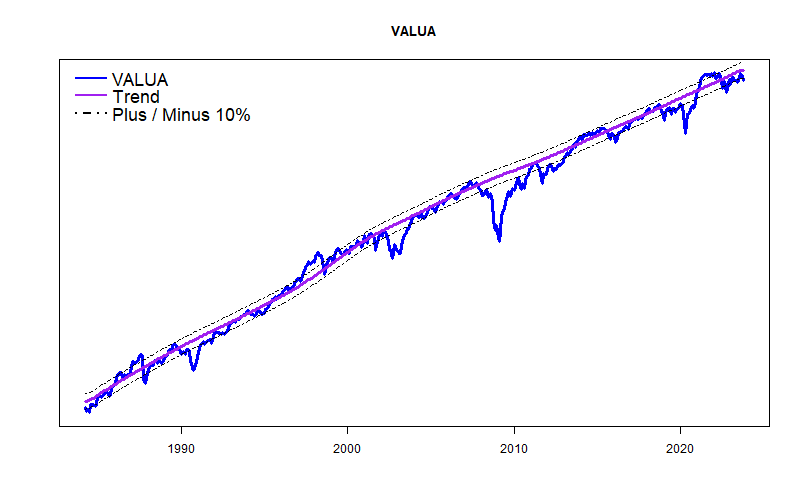
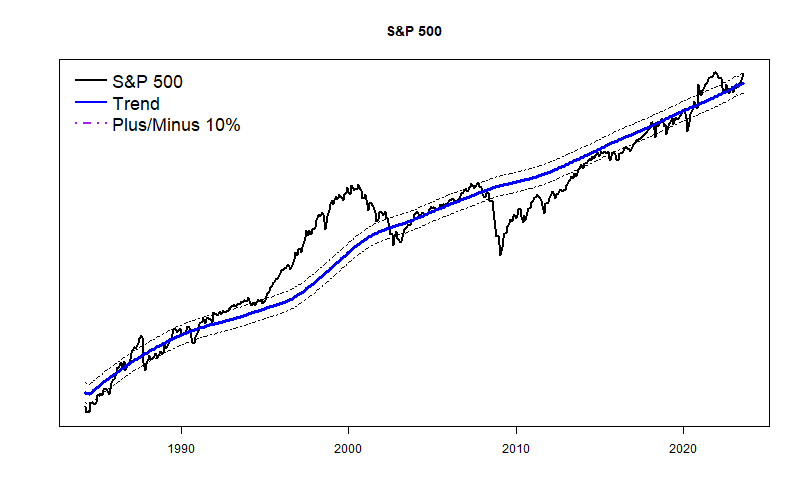
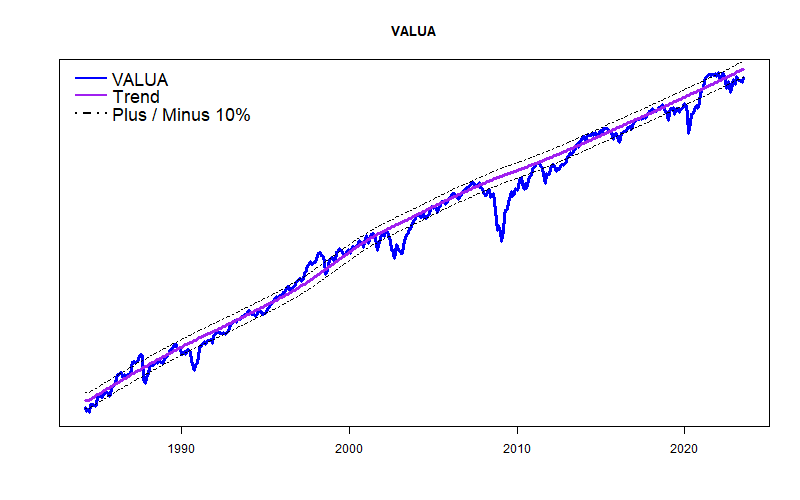
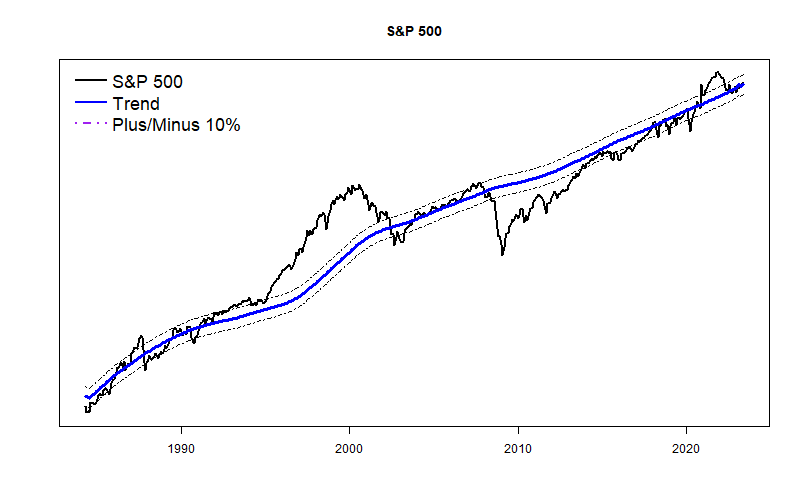
The stock market usually stages its big moves when it has strayed far from its long-term trend. Frothy prices bring a downdraft and a panic crash quickly turns into a recovery. As shown in the graph below, both the ValueLine Arithmetic Average and the S&P 500 are very near their long-term trend lines. Unless something drastic happens in the world, a major stock market move is unlikely. Looks to me like the Federal Reserve has indeed achieved a soft landing.

September thru February 2024: A bit weak. Don’t gripe; it could be a lot worse.

Value Line Arithmetic Average VALUA  -2% (Weak)
Dow Jones Industrial Average ^DJI +2% (-0.04 to +0.07)
S&P 500 Index ^GSPC +3% (-0.04 to +0.09)
NASDAQ Composite ^IXIC +0% (-.0.07 to +0.08)
NASDAQ 100 NDX +3% (-0.06 to 0.11)
Russell 2000 ^RUT -2% (-0.17 to +0.12)
Next 3 Months:  VALUA still looks mildly negative.
VALUA Probability of at least breaking even: 50% (46% to 57% – Well below average

ETFs Alpha Test posted HERE

Agonizingly slowly, the Federal Reserve’s relentless campaign of using higher interest rates to slow inflation continues, while high deficit spending by the Federal Government works in the opposite direction to stimulate the economy. The net result remains a very gradual slowing of the economy. The economy appears to be on the final approach for what hopefully will be a soft landing, happening without a stock market crash.

My forecasting models tell that same story. Prospects for the broad U.S. stock market stay slightly below normal, a tad worse than last month. My primary bellwether is the Value Line Arithmetic Average VALUA: equal weighting of about 1700 companies representing about 90% of U.S. corporate activity. Since 1984 VALUA has gone up for 88% of all 6-month periods. In the next six months, the models only give it about a 50% chance of breaking even, and overall the models predict a 2 percent loss. (Range: +5% to -8%) The worst forecasts are for 3 to 4 months out and could be in the vicinity of -10%.

Sadly there lurks a chance of a major financial panic and collapse in the big-money long-term debt arena. Financial collapses during the Savings and Loan Crisis of 1985-1987 and the Great Recession of 2007-2009 were both instances of Federal Reserve interest rate increases that led to short-term interest rates being higher than long-term rates — an “inverted yield curve”. Today’s interest rate inversion is greater than previous inversions and has already lasted much longer than any other. Plenty can go wrong and it will play out over the next year.

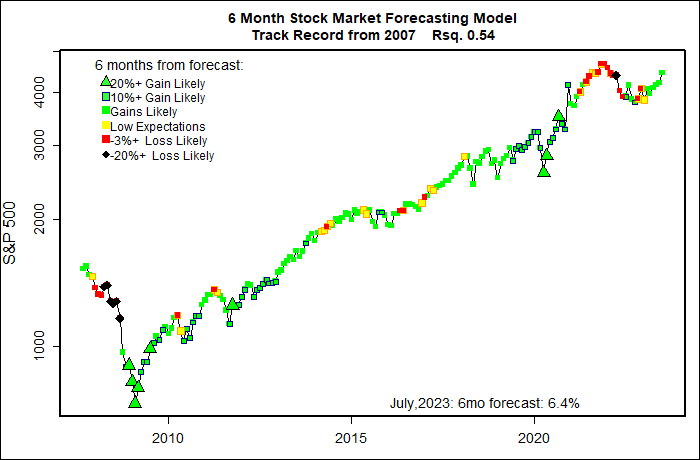
As shown in the graph below, my VALUA models have done well over the past decade in forecasting major turns in VALUA. Right now, they do NOT expect a major surge in prices and they DO NOT YET see a major price collapse. All the other major market indexes that these models assess have similar expectations: up or down a couple percent.

I have posted the second monthly update to my alpha test of Exchange Traded Fund forecasts. Hopefully, next month I can add 1 month to 5 month forecasts for the same group of ETFs.

August thru January 2024: Some Wavering

Value Line Arithmetic Average VALUA  +0.7% (BELOW average)
Dow Jones Industrial Average ^DJI +7% (-0.01 to +0.14)
S&P 500 Index ^GSPC +6% (+0.01 to +0.13)
NASDAQ Composite ^IXIC +10% (0 to +0.10)
NASDAQ 100 NDX +5% (-0.04 to 0.14)
Russell 2000 ^RUT +6% (-0.09 to +0.21)
Next 3 Months:  Rest of summer for VALUA still looks mildly negative.
VALUA Probability of at least breaking even: 50% (46% to 57% – Weakening )

ETFs Alpha Test posted HERE

The most tested of my forecasting models, for the Value Line Arithmetic Average (VALUA) are much less positive than just a month ago. The models expect the broad VALUA market gauge to stay flat or drop a bit through the end of the year. My more recent models for a large number of stocks still are more positive, especially for tech stocks. I trust the older models more than the new ones. Going forward, less optimism seems prudent.

The problem going forward is that the market has been so strong this summer — resulting in less probable gain going forward. The long-term S&P 500 graph makes it appear that prices are getting a bit frothy. Could be we are seeing a new market bubble develop.

As noted above, I finally have started posting 6-month forecasts for a large number of Exchange Traded Funds. I am cautiously optimistic, but I want to emphasize that these forecasts have not been tested in real-time. They may be dead wrong. Please email me any comments or questions you may have at TomTiedeman@gmail.com. With time we will see if any of these pan out.

ETF Forecasts Begin in August

Each month starting in August, I will post 6-month performance forecasts for several dozen Exchange Traded Funds (ETFs). The forecasts will be on a separate page at SixMonthStockMarketForecast.com, not part of the monthly blog email. This will be a true test in public view. Do not use any Alpha Test forecasts for any investing decision. They are still unproven.

Simultaneously, a much broader test begins, documenting performance results for approximately 650 market indexes, ETFs, and major common stocks including nearly all stocks in the S&P 500 and the NASDAQ 100. These forecasts are proprietary and will not be published here.

Actual Forecasts to Date My first stock market forecast in September 2007 used economic and other data going back to 1984 to guess what would happen to the Value Line Arithmetic Average (VALUA) six months later in early 2008. The expected accuracy was an R.square score of 0.64. (R.square=1.0 is perfect) In nearly 200 forecasts since then, the actual average score achieved is about 0.54, fairly close. The graph below shows how those forecasts lined up with reality. Not too bad considering that Technical Analysis methods that many gurus peddle have an abysmal tested R.square of 0.0.

Back Test Results The back-test of my expanded forecasting set has wrapped up. It followed the same approach as my original forecasts: use data from as far back as 1984 to make estimates “as if” the actual results were unknown. That testing led to over 100,000 “as-if” forecasts. For 2/3 of the stocks tested the approach was largely successful with R.square ranks from about 0.3 to 0.9. For the other third of the stocks tested the modeling approach was essentially a failure. Large company stocks that mirrored the overall economy did best. Young highly volatile technology companies without much history were least predictable. Many stock estimates grew better over time as more and more data became available.

Expected R.Square Matters The graph below shows the results of the back-test of 100,000 “as-if” forecasts, plotting forecasted gain/loss versus what actually occurred. Points are color-coded based on the expected R.square – given existing data, how accurate the resulting forecasts were most likely to be.

Points with an expected R-square of around 0.3 landed like a shotgun splatter: they are generally in the right direction, but they are not accurate. Points with higher and higher expected R.square get increasingly near to the desired one-to-one match between forecast and actual.

The only real test of a forecasting methodology is what happens in real-time in the future with new conditions. But, the back-test was pretty encouraging.

July thru December 2023: Positive

Value Line Arithmetic Average VALUA  +6.4% (Above average)
Dow Jones Industrial Average ^DJI +6% (-0.08 to +0.11)
S&P 500 Index ^GSPC +6% (+0.01 to +0.13)
NASDAQ Composite ^IXIC +8% (-0.02 to +0.37)
NASDAQ 100 NDX +7% (-0.03 to 0.23)
Russell 2000 ^RUT +4% (-0.01 to +0.09)
Next 3 Months:  First part of summer still looks mildly negative, but then so did June.
Probability of at least breaking even: 80% (72% to 97% )

The stock market clearly enjoys the mild economic tightening of the Federal Reserve Bank combined with continuing economic stimulation from Federal Government deficit spending. For several months the market has exceeded the forecasts from my models and it seems likely that will continue.

June market performance was excellent, but that causes my one-month market forecast to expect a balancing drop of a percent or two — not a big deal. If the market decides to turn negative, the worst 3-month loss my forecasts expect would be just about 6%.

Posting ETF forecasts will need to wait another month or so to allow for more testing and validation.

June 2023: Pressing Both Brake and Gas Pedals

June thru November 2023 stock market forecast:
Value Line Arithmetic Average VALUA  +4% (near average)
Dow Jones Industrial Average ^DJI +1% (A bit weak)
S&P 500 Index ^GSPC +3%
NASDAQ 100 NDX +8% (Stronger than average)
Russell 2000 ^RUT -3% (Distinctly weak)
Next 3 Months:  First part of summer still looks blah.
Probability of at least breaking even: 89% (Good, somewhat above average. )

New Forecasts My forecasting models now cover over 600 stocks, ETFs, and market indexes. As an Alpha test, I will begin posting forecasts for additional major U.S. stock market indexes.

I have been posting 6-month stock market forecasts for the Value Line Arithmetic Average for about 15 years giving me considerable confidence. These additional index forecasts, however, deserve skepticism. They stem from the same 40-year historical economic database, so I expect them to prove useful. There is much overlap among the stocks in these indexes, so it would not be a good sign if they differ too much. Time will tell. No surprise, the tech stocks of the NASDAQ 100 (NDX) are projected to keep climbing faster than the other indexes.

Deficit/Budget Deal Extends Ststus Quo Congressional Republicans and the Biden administrration have compromised over the federal deficit and spending. Both sides claim hard fought victory while actually changing next to nothing. The Federal Reserve will continue to modestly clamp down on the real economy while federal spending will remain highly stimulative. To me it is as it the Fed is steadily applying the brakes while the Treasury is still pumping the gas. It is not the best of all worlds, but it should continue to hold back inflation while (hopefully) not crashing either the economy or the stock market. Couldda been worse I guess.

Is the Broad Market Fading? The S&P 500 Index has stayed right at its long-term trend for months, but the Value Line Arithmetic Average has been wallowing about 10% below what I calculate to be the long-term trend. Coupled with the weak forecast for the the Dow and Russell 2000 Index, this is starting to be something to worry about. Tech stocks continue to soar, but the real economy has been feeling the impact of the Fed’s higher interest rates: corporate profits have fallen a bit; producer prices are down; building permits are lower; and the Philadelphia Federal Reserve Survey of Professional Economists remains unusually concerned about recession.

May 2023: Positive, unless Republicans…

The statistical stock market forecasting models say:
May thru October 2023:  +7.8% (above average)
Next 3 Months:  Positive but weak. Both positive and negative alternative forecasts.
Probability of at least breaking even: 92% (Range from 80% to 95% . Strong. )

The U.S. stock market forecast continues to brighten, and prospects are now distinctly above average. There probably will be gains over the next couple of months, but they are expected to be mild. In the later part of the summer, the models show some real strength. My concern is mainly focused on Republicans in the House of Representatives. They say they want a fight over the federal deficit, which will probably happen sometime over the summer. If the fight threatens government operation or the credibility of U.S. Treasury debt a sharp and probably temporary stock plummet would occur — I can’t predict that possibility. If they significantly reduce Government spending without a proportionate tax increase, the stock market will decline next fall or earlier. Federal spending is still stimulative (i.e. unusually high). If that economic joy-juice is taken away the stock market will certainly soften.

It is important to appreciate where we are starting from. Both long-term market trend graphs (below) show that the market is at or below trend. No bubble needs bursting (as opposed to cryptocurrency scams). Continued higher interest rates and less government spending potentially will dampen the market indefinitely.

April 2023: Remaining mildly positive

The statistical forecasting models say:
April thru September 2023:  +6.9% (above average)
Next 3 Months:  Unclear. Both positive and negative forecasts.
Probability of at least breaking even: 94% (Range from 86% to 99% . Strong. )

In recent months the market forecasts appear to be steadying out and are becoming more positive. This is a bit surprising. Typically, a stock market boom like we had over the pandemic begins with a decline that develops into a precipitous crash. Then, a characteristically sharp rebound occurs. That is not what has been happening and has not been what my models have been predicting. Put briefly: the Federal Reserve appears to be pulling off a smooth landing. Considering the scale of federal intervention that was required to keep the economy afloat during the pandemic confinement, the relatively smooth pullout that appears to be happening is nothing short of miraculous.

There will be further economic fallout as federal stimulus continues to ease. The bank failures of last month probably show how things will play out. Same for the significant round of staff layoffs that have been coming from big businesses. The inflation rate has been declining, but it is still much higher than the Federal Reserve considers acceptable. There still are plenty of problems in commercial real estate that have not fully come to light. Very real and very large economic problems are still at hand. There will be more pain and tightening. But, I remain amazed that things have been working out so smoothly. (Also, I don’t mind that my forecasting models have been unusually accurate.)

The primary market average that I track, the Value Line Arithmetic Average, is still moderately below trend. That is excellent news — there was no market crash and there is room for the market to rise further.

The S&P 500 average is almost exactly at it’s long term trend (at least, as I calculate it). I have been waiting for some sort of panic that would send the S&% 500 below-trend. The fact remains that it has held strong.

Considering that every other round fo Federal Reserve interest rate tightening has led to a significant stock market panic, I am still not breathing a sigh of relief. But, so far, so good.

March 2023: Landing may be delayed

The statistical forecasting models say:
March thru August 2023:  +3.7 (Slightly below average)
Next 3 Months:  0%  (Flat.)
Probability of at least breaking even: 85% (Range from 55% to 85% . Meh. )

Hard landing? Soft landing? How about a delayed landing? The Federal Reserve mandate is to assure a stable monetary system and simultaneously to promote high employment. So far, so good. Unemployment remains down near a record low and inflation continues to fall slowly. The general expectation is the Fed will notch a couple more 1/4 percent interest rate increases, will pause, and see what happens, eventually starting to lower rates back down somewhat. Most market pundits fret whether the economic slowing will be mild (soft landing) or painful (hard landing).

The data I watch and my market models seem to be saying that this is going to be a drawn-out process — the economic landing is going to be delayed. This also should postpone a major market fall (unless World War 3.1 occurs, congressional Republicans really want to default on Federal debt, or another Black Swan pops up)

In 2022 with a series of 3/4 percent increases in the Federal Funds rate, the Fed sent an unmistakable message that it was acting to reduce troubling 9% inflation. Now, with inflation at roughly 5%, the message is equally clear that a slower pace of rate increases has begun. Simultaneously, the Fed has stalled increases in the money supply. But, this tightening remains very conservative.

Federal Government spending, however, is the other major factor affecting inflation and economic expansion. And federal spending will remain highly stimulative until at least the end of the current fiscal year, September 30. During the pandemic the federal annual deficit ran as high as 15% of GDP — no surprise inflation developed. Now it is down to about 5% of GDP, much less, but still strongly stimulative, and not coincidently about the same as the inflation rate.

With the presidential election round just starting, my bet is that neither party wants to be blamed for bringing on a recession. Both will posture that they want to do the right thing (whatever that is). But, both will hold tight to the populist creed of high spending and lower taxes.

Will the Fed be forced to tighten up to an extreme level? Or, will it hold off some until the election silly season passes? Don’t know, but this is a question for next fall or beyond.