Six Month Stock Market Forecast September, 2014 to March, 2015

According to my forecasting models, the remainder of 2014 and the start of 2015 promise above average returns for the U.S. stock market as measured by the broad-based Value Line Arithmetic Index.  But first, there remains a strong probability of some mild weakness in the next couple of months.

Probable market gain from 9/1/2014 to 3/1/2015:  7%  (Average 6 months since 1984: 4.8%)
Probability of at least breaking even :    74% to 80%  (Average for all months since 1984: 73%).

(Click on image to enlarge.)

So far this year the stock market has performed slightly higher than the models had forecasted.  For the most recent completed 6 month period (March through August) the models had expected no gains, but the market rose 3%. 

There is always a possibility that the market could move sharply lower, at this stage most likely caused by world events.  That said, the models remain positive primarily because the economy still has not fully recovered from the Great Recession.   When the economy has everyone smiling, these forecasting models will turn negative.  In the meantime, most likely for the next couple of years, the models are likely to forecast continuing modest gains for the U.S. stock market.

August, 2014 Six month Stock Market Forecast

(Ignore the small stuff. Please read the disclaimer that follows this post.)

The next six months finishing 2014 and starting 2015 should be significantly better than average for the stock market. At least, that is what my stock market forecasting models say.

Why are the models optimistic?  It is mainly because there is room for the economy to improve: GDP is still below it’s potential;  construction activity remains subpar; unemployment and under employment are still too high; the chance of a recession is remote; and the Federal Reserve continues to apply low interest rates and  massive amounts of newly created money.

Today was pretty grim for the U.S. stock market — and there is nothing like a rotten day to make the forecasts coming from my stock market model brighter!  When things are bad they can get better, but when all is well, the only way to go is down. A further drop in the next month or so is still likely.

Here is the model’s stock market forecast for the tail end of 2014 and the start of 2015:

Probable market gain from 8/1/2014 to 2/1/2015:  8%  (Average 6 months since 1984: 4.8%)
Probability of at least breaking even :    84%  (Average for all months since 1984: 73%).

For the past year or so the stock market has been performing roughly 5% better than the models had forecasted. You can’t complain about a strong market, but the model suggests that investor optimism has been building up and some sort of pullback remains likely.  Beyond that the broader prospects for the U.S. stock market are better than average.

(Click on image to enlarge.)

(Disclaimer: Please do not pay much attention to these 6 month stock market forecasts until there is a great big forecast coming from the models that completely contradicts how the market is currently moving. When you feel the forecast is crazy, that is probably the time to give the models’ forecasts some real consideration.   Until then, not so much.  The’ noise’ of normal market vibrations is probably greater than the ‘signal’ coming from economic fundamentals. Yes, the market can be very crazy in the short term and the models simply are not that accurate. The forecasting models presented here are not precise and the losses that come through high taxes on short term capital gains will kill any real gains coming through short term market maneuvers.)

Three reasons the stock market may not peak before 2016 or 2017

Many commentators say today’s stock market is seriously overvalued. I do not disagree, but three major factors indicate that the bull market will probably continue for well over a year, probably until 2016 or 2017.

First, the skeptics. Either the market cynics are right, or they are creating the greatest Wall of Worry that I have ever seen. There are many shouts of warning, but I will just point to two of them. Mark Hulbert at MarketWatch.com cites six factors that indicate the current market already is priced higher than the vast majority of prior market peaks.  The factors are: price/earnings ratio; price to 10-year cycle price/earnings ratio; price/book ratios; price/sales ratio; Tobin’s Q ratio; and relative dividend yield. Neil Irwin in the NY Times goes further, writing “Welcome to the Everything Boom, or Maybe the Everything Bubble.”  Few of the naysayers are pointing to an imminent market crash, instead they generally stress that high current valuations point to disappointing overall market growth over the next decade or so. 

So, when will the over-priced stock market come crashing down? Hopefully, my stock market models will scream warnings a month to six months ahead of the eventual market collapse. Or, at least, hope of an early warning is the main reason I created forecasting models in the first place. In the meantime the models have not turned seriously pessimistic.

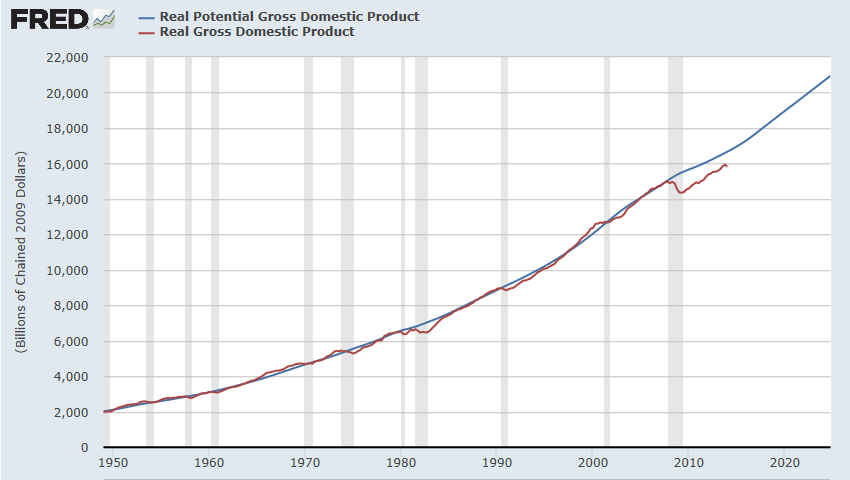
The economy still has not fully recovered from the Great Recession.  As shown in the graph below Real Gross Domestic Product suffered the worst decline in several generations during the recession.  It has been recovering, but it still has not equaled Real Potential GDP.  The Congressional Budget Office has generated the Real Potential GDP calculation for many years and the match with actual GDP results has been incredible — the Coefficient of Determination, R-Squared, is greater than .99! That is amazingly close. Maybe everything truly is different this time, but more likely, GDP will ‘regress to the mean’, reaching its potential before the next market crash. Increasing employment by increasing GDP, after all, is what the massive intervention of the Federal Reserve has been trying to accomplish.

Three things need to happen for GPD to reach potential: employment needs to increase, both for the unemployed and the millions of workers currently underemployed;  business investment must rise.; and world trade needs to get back to normal, meaning that the rest of the world needs to recover from the recession as well. At best, it will take a couple of years before GDP (i.e. the economy) is back to normal performance.  There is still plenty of slack in the economy leaving room for stock prices to grow.

(Click on image to enlarge.)

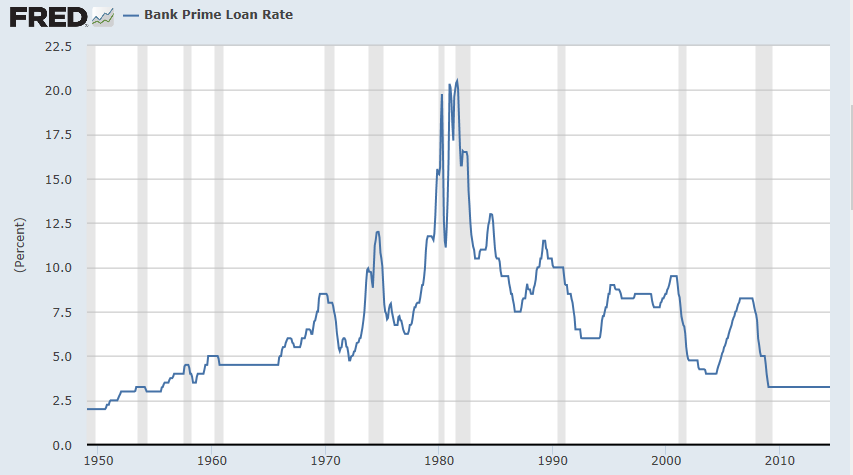
Interest rates need to rise 3% or more.  The Federal Reserve and other central banks promote economic growth by lowering interest rates and increasing the money supply. Raising interest rates and limiting lending cools down the economy, often dramatically.  The graph below shows the U.S. bank prime lending rate from 1950.  The overall story of the graph is that raising interest rates by 3% to 5% above the previous low point is enough to slow the economy and bring on a recession.

Typically, the Federal Reserve takes a year or more to increase lending rates enough to slow the economy. Then, the impact of higher interest rates takes roughly a year before it shows in the real economy.  The Fed already has indicated that it is unlikely to start increasing interest rates for another half year.  Once the rate increase process has started it likely to proceed very, very slowly.  Otherwise, trillions of dollars in outstanding long term loans will plummet in value, exposing the world to a financial crisis similar to 2007 – 2008.  Overall, it seems unlikely that interest rates will increase in the next 2-3 years enough to slow the economy.

(Click on image to enlarge.)

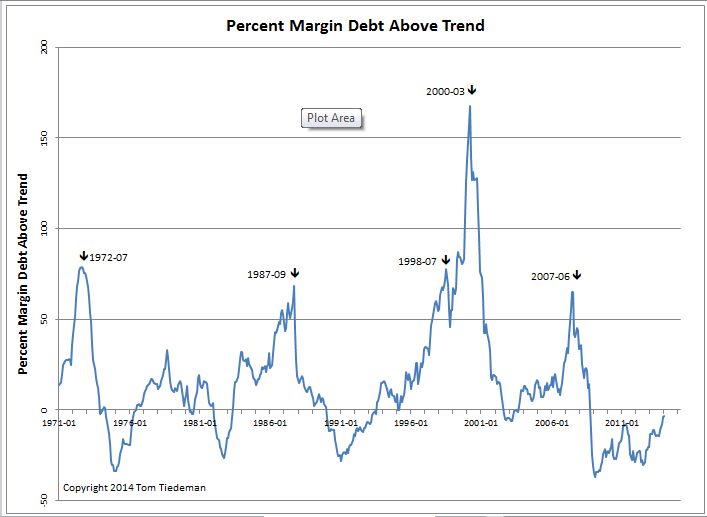
Speculative fever needs to build.  Margin Debt, is money that investors/speculators borrow from their brokers to use to buy more stock.  As such, the Margin Debt level is a solid measure of investor optimism. Margin Debt has a long record of fairly steady increase as the total capitalization of stocks has increased. In fact, Margin Debt follows a path of simple compounding growth extremely closely. (R-squared = .99).  But, the match with simple exponential growth is not perfect.  The graph below shows New York Stock Exchange reports of margin loans, but the factor of steady growth over time has been removed. The result is a chart showing how margin levels at any point in time compare to the base value of regular steady growth.  The general picture is that in the case of most significant market collapses, margin debt increases for a period of several years prior to a crash.  The last few months usually see margin debt shooting up as speculation reaches frenzy levels. Generally, margin has grown to a level of 50% above trend before the speculative bubble bursts.  Current levels of margin debt have not even reached the long term trend level.  If the current market cycle is in any way typical, margin will increase for a couple of years or more before getting to a breaking level.

Stock Market continues to beat forecasts

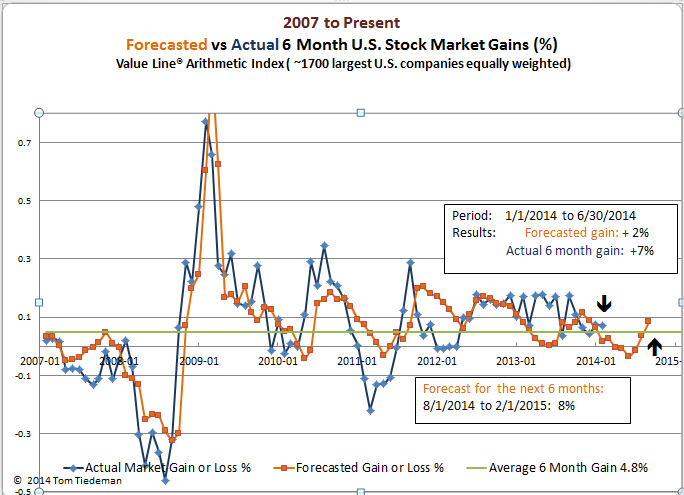
Six months ago my stock market forecasting models predicted that the first half  of 2014 would be nearly flat — just a 2% gain.  Instead, the market (as measured by the broad based Value Line Arithmetic Index) rose a quite respectable 7%.

Why is the market beating the models’ expectations? My best guess is that the it is perfectly clear to all that the Federal Reserve has no intention of letting the economy stall in the near term.  So much the better!  It looks like it will be a long time before the Fed takes the punch bowl away from this party.

My 6 month stock market forecast for the second half of 2014 is slightly more positive than last month. The prediction remains muted, a bit worse than the long term average. 

Probable market gain from 7/1/2014 to 1/1/2015:  2% to 4%  (Average 6 months since 1984: 4.8%)
Probability of at least breaking even :    65%  (Average for all months since 1984: 73%).

For the past year most of the surprises have been positive, so I would not be surprised if that happened again.

(Click on image to enlarge.)

Did these models correctly forecast major bear markets?

The U.S. stock market suffered major pullbacks in 1987, 1990, 1998, 2001, and 2007.  This post looks subjectively at how well my forecasting models previewed those market traumas and the subsequent market recoveries.  They did surprisingly well with the possible exception of the brief 1990 decline.

(Note that the model forecasts for 2007-2009 were made in real time, but earlier dates are evaluated with back-testing data. Also, the market data below refers to market prices at the start of the month and may not match exact market highs and lows that appear in daily market data.)
 

1987 Crash – A big win for the model

On “Black Monday” October 10, 1987, world stock markets crashed. The Dow Jones Industrial Average lost 22% in one day.  Though most of the crash happened in a few days during mid-October, markets had started to roll over as early as August and damage continued into November.  All told, the S&P 500 lost 24% from August through November and the Value Line Arithmetic Index (VALUA) lost 31%.

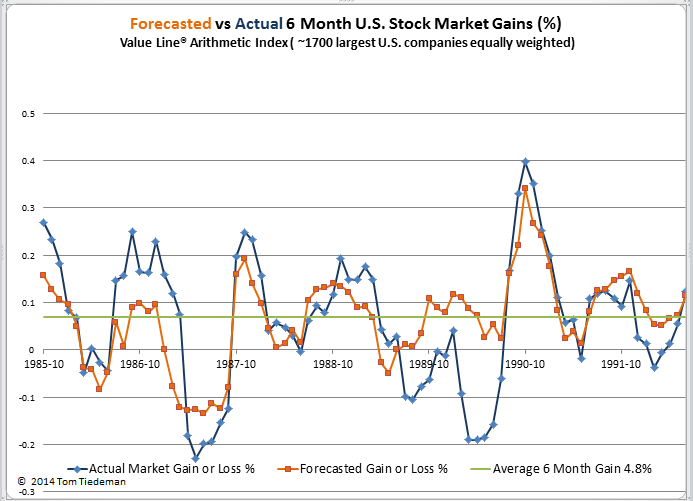
As shown in the chart below, my stock market forecasting model turned sharply negative in March 1987 – seven months before the main crash. During those spring months of 1987, markets were soaring, reaching one new high after another, but the model, correctly, saw major storm clouds forming.  Then, with the market still crashing in the darkest days of October and November, the 6-month forecasting model turned strongly positive, correctly foretelling the market rebound.
(Click on image to enlarge.)
1990 – Missed the correction, caught the rebound

From May through October, 1990 the S&P 500 lost 15% and VALUA lost 24%.  The forecasting model was issuing weak forecasts prior to the sharp correction, but it did not foresee the scale of the correction.  On the other hand, the models did accurately forecast the remarkably rapid market recovery.

1998 correction

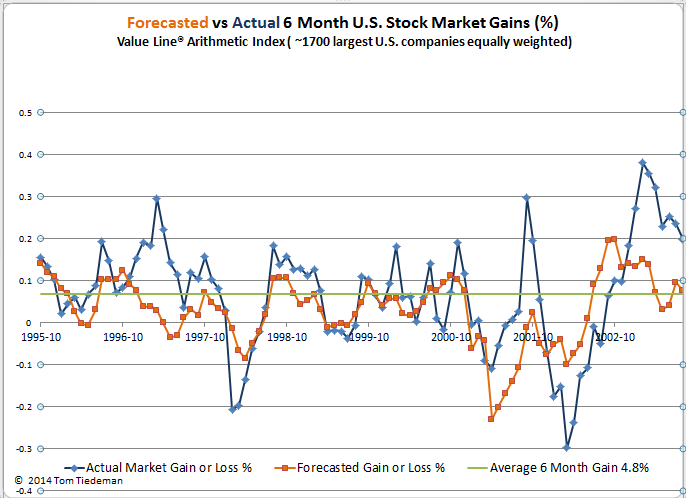
During the short lived market correction from April through August 1998, the S&P 500 lost 15% and VALUA lost 24%. The models issued forecasts in March and April of 7% to 8% losses in the months ahead.  The actual losses that followed were approximately twice as bad as forecasted.  The models got the timing of the subsequent market correction correct, but underestimated the 6-month market gains.

 
(Click on image to enlarge.)
2000 – 2002 Dot Com Bubble
The DotCom Bubble was a speculative buying binge focused on technology stocks – not the entire market.  In total the NASDAQ Composite fell by 78%, the S&P 500 by 46%, but the VALUA suffered only a 20% drop initially.  While the NASDAQ drop was nearly continuous from 2000 to 2002, the VALUA had a rebound through 2001 followed by another 26% drop in 2002 as the U.S. real economy fell into recession.
As shown in the chart above, the models’ forecasts generally matched the timing of the double-decline of VALUA during the period.   The model did not expect the 2001 rebound to be as strong as it was and did not expect the second dip in 2002 to be as bad as it turned out to be. Overall, the model predicted the timing and direction of the VALUA fairly well.
 2007-2009 The Great Recession
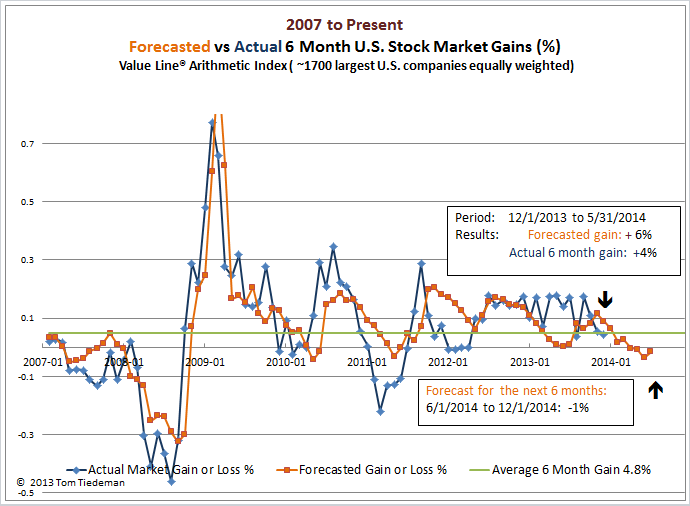
Stock markets worldwide were traumatized by a series of financial panics and steep recessions.  Between October, 2007 and February, 2009 both the S&P 500 and VALUA lost 52%. The collapse started slowly with the bulk of the market destruction occurring in late 2008 and very early 2009. Overall, the model forecasted the market well.  It issued weak forecasts through 2007, but by April 2008 it was forecasting a massive 25% decline in the market, well before the steep part of the decline actually began. Likewise, in early 2009 while the market was in the steepest part of the crash, the model issued dramatic positive forecasts for the coming months, forecasts that accurately predicted the subsequent rebound of the market.
 
(Click on image to enlarge.)
Summary
Though the stock market models’ forecasts of these major market disruptions were far from perfect, except for the correction of 1990, they did anticipate the correct timing and general magnitude of the severe market corrections and their following recoveries.
A lesson to learn from this review, however, is that the models truly are future oriented. They do not have much value in assessing how the stock market will behave in the next few weeks. (In August you know that the weather is going to get cold by January, but that is no reason to put on your winter coat in August.)  In general, the models start warning of market disasters months before actual destruction occurs, and they get highly optimistic months before markets finish their crash phase.


Stock Market Probably Flat Through November

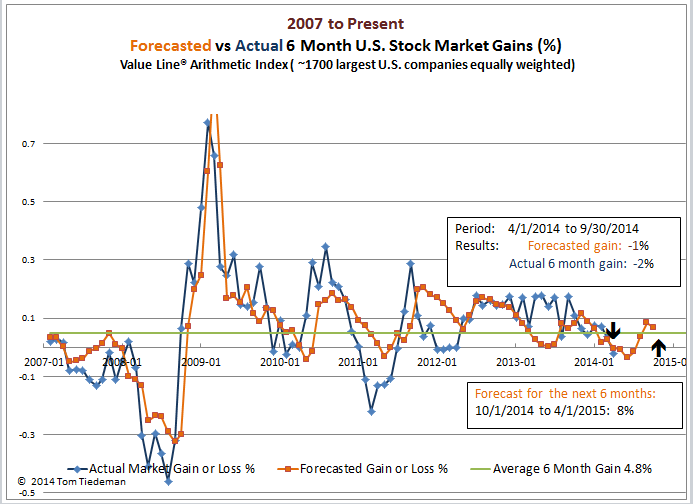
My econometric models for the U.S. stock market for the second half of 2014 do not expect any significant change between June, 2014 and the end of November, 2014.   The models forecast that the market will perform like a typical summer period — maybe a minor loss and  somewhat worst than average chance of at least breaking even.  The good news is that this is a slightly better forecast than the models made at the start of May.

The stock market models might as well just suggest that we take a summer vacation and pay attention to other things in life.

Probable market gain from 6/1/2014 to 12/1/2014:   -1%  (Average 6 months since 1984: 4.8%)
Probability of at least breaking even :    50% to 58%  (Average since 1984: 73%).

(click on image to enlarge)

The market models  are a mathematical expectation that the U.S. stock market will react as it typically does to changing economic conditions.  When the forecasts are drastically off, that’s a strong sign that something else — perhaps some sort of  ‘black swan’ — is  moving the market.

Based on the difference between the forecasts and reality for the past half year or so, it doesn’t appear than anything strange has been in play.  In the most recent completed 6 month period, the models expected the market to start cooling off.  Back in December the models forecasted a 6% increase for the Value Line Arithmetic Index  by June 1, and the actual performance was a 4% gain. Pretty close.

The market is moving into the summer months making it probable that the market will weaken mildly.

May 2014 Forecast — A small step down

The summer months are here and the forecasting model expects the U.S. stock market to perform distinctly below average, declining slightly from May through October 2014.

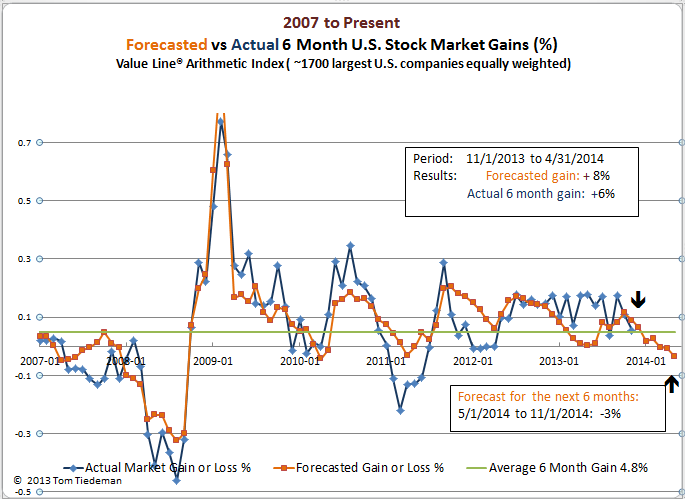
Probable market gain from 5/1/2014 to 11/1/2014:    -3%  (Average since 1984: 4.8%)
Probability of at least breaking even :    46% to 57%  ( Average since 1984: 73%).

(Click on image to enlarge.)

For the most recent completed forecasting period, September through April, the model did well. It had forecasted an 8% gain in the market (measured via the Value Line Arithmetic Index) while the actual gain was 6%.  For the past year the market has generally turned in better than forecasted gains.

Hopefully that strong relative market performance will continue.  Unfortunately, in the past few months the market has stalled as the model had expected.  The overall market has been flat, but the key technology and cyclic sectors have turned south.

Possibly the best free stock market valuation guide

The Morningstar.com  Market Fair Value graphs , updated daily since 2001, provide an objective assessment  whether the U.S. stock market is over-priced or underpriced.  What’s more, there is no charge to view the graphs and they appear to have a remarkable track record.

(Click on image to enlarge. Copyright Morningstar.com)


Morningstar. com describes their proprietary Fair Value assessments as follows:

” At Morningstar, our analysts estimate a company’s fair value by determining how much we would pay today for all the streams of excess cash generated by the company in the future. We arrive at this value by forecasting a company’s future financial performance using a detailed discounted cash-flow model …  that factors in projections for the company’s income statement, balance sheet, and cash-flow statement. The result is an analyst-driven estimate of the stock’s fair value.”

The Morningstar.com Market Fair Value graph sums up the individual company ratings  several ways:

  •  All rated stocks
  •  Sector
  • Super sector
  • Industry
  • Fair value uncertainty
  • Index (NYSE, NASDAQ)

I use a simple reading of the Morningstar.com Market Fair Value charts. I concentrate on the “Max” time setting for “All rated stocks” in order to get an overall perspective of market valuation over the past few years and months.  If the current rating is near fair value (1.02 today) I go back to drinking my morning coffee.  If the rating is more than about 1.05 I worry that the market is getting pricey, and above 1.10, I think seriously about cutting back on stocks.  A rating below  0.85, which seems to occur every few years, gives me good confidence that stocks are in “buy” territory.

Anticipating Summer Stock Market Blahs

(I will be on vacation for a couple of weeks, so I am posting this stock market forecast early. New data in the next few days might nudge the model’s  6 month stock market forecast a bit, but probably not by much.)

According to the econometric model I developed, the U.S. stock market from this April through September should perform a little worse than average. The model forecasts the market nervously ending up right where it is. Intuitively that seems reasonable for what is statistically the worst part of the year. The chance of the stock market at least breaking even is roughly 50% — distinctly worse that the normal 73% prospect of surviving intact.

For months and months, the good news for the stock market has been that the economy remains in tough straits, still needing a level of stimulus from the Federal Reserve that was unheard of before The Great Recession.  It got named The Great Recession for good reasons. As long as the economy is in tough shape it has room for improvement which is good for stock prices. Don’t fight the Fed!

The bad news for stock market gains is that the economy and the stock market have improved tremendously from the depths of March 2009 — so there is much less room for improvement than has been the case for the past several years. The net result is that the model expects the stock market to mark time or stall for a while.

Probable market gain from 4/1/2014 to 10/1/2014:    0%  (Average since 1984: 4.8%)
Probability of at least breaking even :    46% to 57%  ( Average since 1984: 73%).

This blog is about testing the econometric model in real time and in plain sight. So, how is the model faring? The forecast from October, 2013, the most recent 6 month period, was for a six month stock market gain of 11% which was almost exactly what occurred. (Measured using the Value Line Arithmetic Index as the standard.).  Sometimes the model just gets lucky. :o) For all forecast results since 2007 look at the graph below.

(Click on image to enlarge.)

Margin debt level is not too high — yet

Recent articles such as this one or this one make the case that the level of  stock market margin debt today is at a dangerously high level. (Data on New York Stock Exchange Margin Debt is available with a two month delay here. )

The articles focus on a chart of NYSE Margin Debt like the one shown below.  The sharp peaks on the graph correspond to the Dot-Com crash of 2000 and the financial panic market collapse that got underway in 2007.  The graph gives the impression that the current spiking of margin debt must be pointing to another market crash coming sometime soon.  Or does it? Maybe the graph isn’t showing the real story.

(Click on image to enlarge)

Margin debt, like the stock market, has a long term trend of growing several percent year after year. Because of this fairly steady growth rate you can get a more helpful view by changing the vertical axis to a logarithmic scale, making the same data look somewhat less scary.

(Click on image to enlarge)

Look at a longer time period (since 1980) and add in a trend approximation line and an entirely different picture emerges — current margin debt is not outrageously high. It may even be a bit lower than the historical trend.

(Click on image to enlarge.)

Even this graph may be making margin debt levels appear more worrisome than they are. In 1987 at the time of the crash margin debt was 68% greater than the historical trend.  In June of 2000 margin reached 130% above trend! And in 2007 margin debt was 67% above trend.  Today, in sharp contrast, margin debt is about 3% BELOW trend.

There are countless things about investing that might be worth fretting. But, today’s level of margin debt doesn’t deserve to be very high on the list of worries. In a couple of years margin debt levels may be worth your attention.