Falling Margin Debt: Good or Bad Sign for the Stock Market?

Total Margin debt as reported monthly by the the New York Stock Exchange has fallen about 4% over the past 7 months.  Depending on how you want to look at the long term record, this could be a very bad omen, a pretty good one, or just a non-event.  I tend to see it as probably a positive sign, but nothing of immediate importance.

Margin debt is money that investors borrow from their brokers at fairly high interest rates in order to buy more stock than they otherwise could. As such it is a good indication of investor enthusiasm.  In a stock boom speculators buy all the stock they can and total margin debt shoots up. In a bear market those same speculators sell out in panic, the brokers get paid back, and margin debt levels plummet. Falling margin debt shows a drop in investor enthusiasm and optimism so it is hard to regard it as bullish.

Here’s the scary view reported by Mark Hulbert at MarketWatch.com as a wake-up call on the bull market.   Since 2000, every time the level of margin debt has dropped below its 12 month moving average the stock market has been in a bear market. With the newly released January data, margin debt is now below the 12 month average — and so that must be very bad news.  Right?

Taking the opposite view, the drop in margin debt may well be a very healthy sign for a continuing bull market.

Looking at the NYSE data going back to 1970 margin debt has shown an amazingly steady rate of growth.  Comparing actual margin debt to a constant rate of growth yields a pretty close fit. (Rsquared = 0.96)  That is not much of a surprise as the overall economy and the stock market have also had relatively steady long term growth. We all tend to focus on all the ups and downs, but overall the bumps of the economy and the stock market are dwarfed by long term, multi-decade growth trends. The same is true of the growth of total margin debt over time.

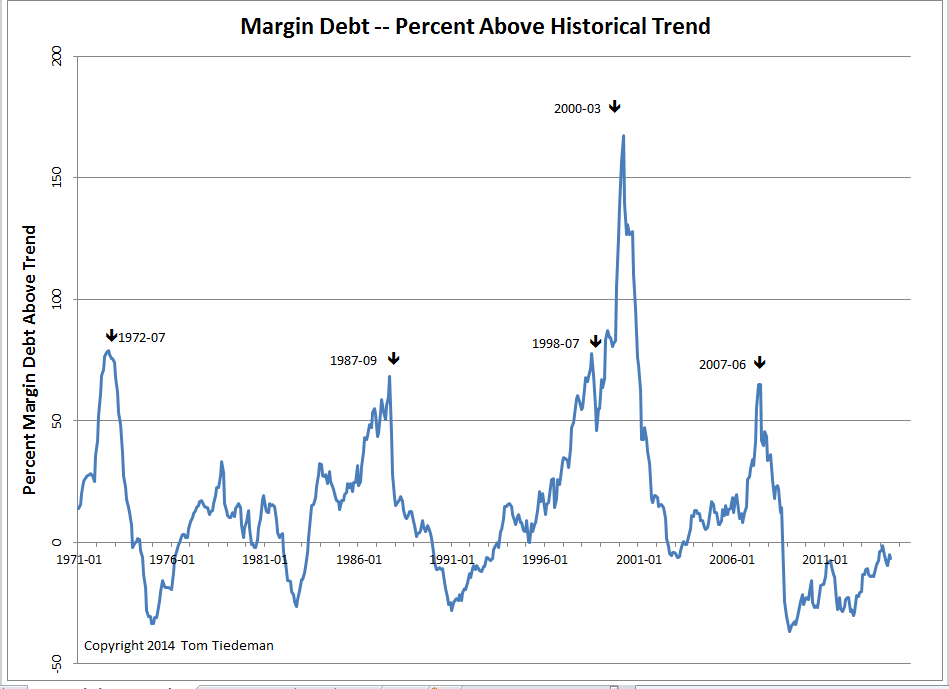
The graph below shows detrended margin debt over time — relatively how much actual margin is above or below its historical growth pattern. The graph pattern is clear: in a boom the relative level of margin borrowing shoots up, perhaps 50% or more above the historic trend. Then the bubble pops and margin debt collapses even more quickly during any sort of market crash.  The dates of the margin spikes match the start of the most significant market disturbances over the past several decades.  The warning sign is clear — when the relative level of margin debt shoots up to  roughly 50% above trend a market bubble is due to implode.

But what about now?  Margin debt has been growing in fits and starts since the catastrophic bottom of early 2009.  The rise doesn’t resemble any sort of spike and is still well below its long term trend.   Rather than pointing to an imminent bear market, this chart of margin debt appears to indicate that the market is far from being in the middle of a speculative bubble. If history is to play out in a typical way, it may well be a few years before a speculative bubble shapes up.  If it does, the slow moving growth of margin debt should scream our a warning when it spikes up.

March, 2015 U.S. Stock Market Forecast

U.S. Market Forecast (Value Line Arithmetic Index):
Probable stock market gain 3/1/2015 to 9/1/2015: 3.5% (Avg. 6 mo. gain since 1984: 4.8%)
Probability of at least breaking even : 73%  (Average for all months since 1984: 73%

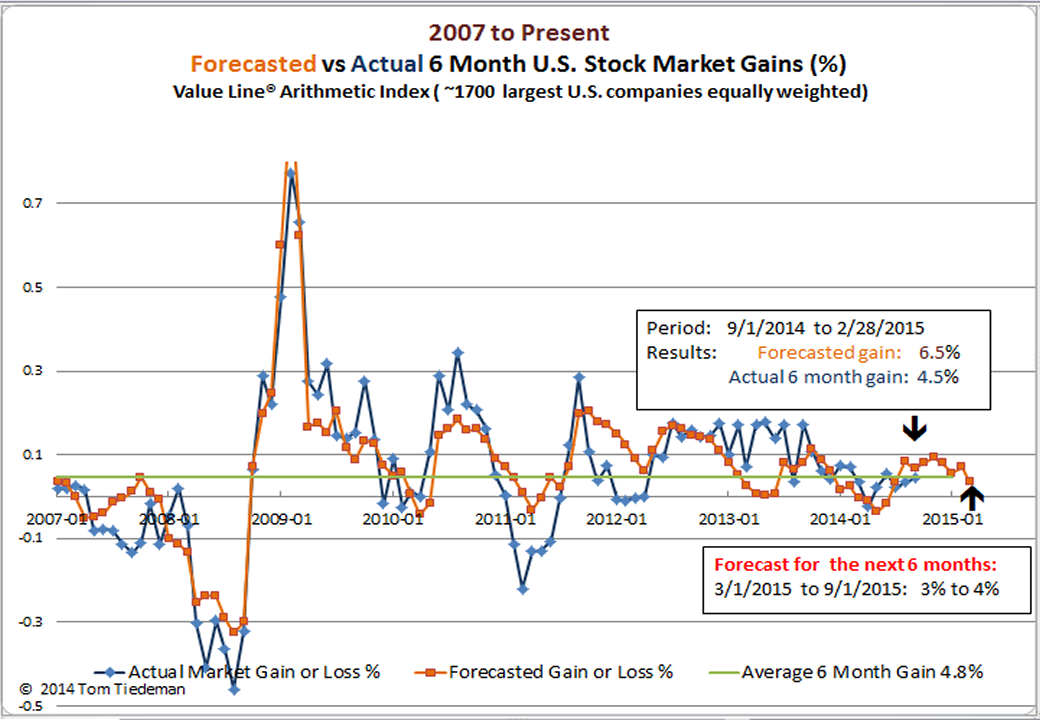
Coming off a strong 5% gain during February, the prospects for further stock market gains over the next half year are subdued: positive, but below average price gain of 3% to 4% and average probability  (73%) of at least breaking even. Looking at the progress graph below, the model would expect gains to continue for a few months followed by a bit of weakness during the summer months as is typically the case.

(Click on image to enlarge.)


The model has been anticipating the stock market pretty closely for the past year or so.  In the last completed 6 month period the model had predicted a gain of roughly approximately 6% and the actual gain turned out to be about 4%. Close enough.

The overall U.S. stock market situation has stayed roughly the same for a couple of years:

  • U.S. stocks generally are somewhat over-priced.
  • Historically low interest rates, however, prop up these high stock prices.
  • Further real economic growth is necessary before stocks can rise much.
  • Room for growth remains as the economy is still performing below its long term potential.
  • Based on the amount of outstanding margin debt and continuing economic recovery a price bubble does not appear to exist.
  • In the near term international economic disruptions do not seem likely to severely damage the U.S. economy. (e.g. Greek debt questions, low oil prices possibly unbalancing several countries)
Taking all of this into account, a major stock market decline does not appear to be likely for at least a year or so.


February, 2015 Six Month U.S. Stock Market Forecast

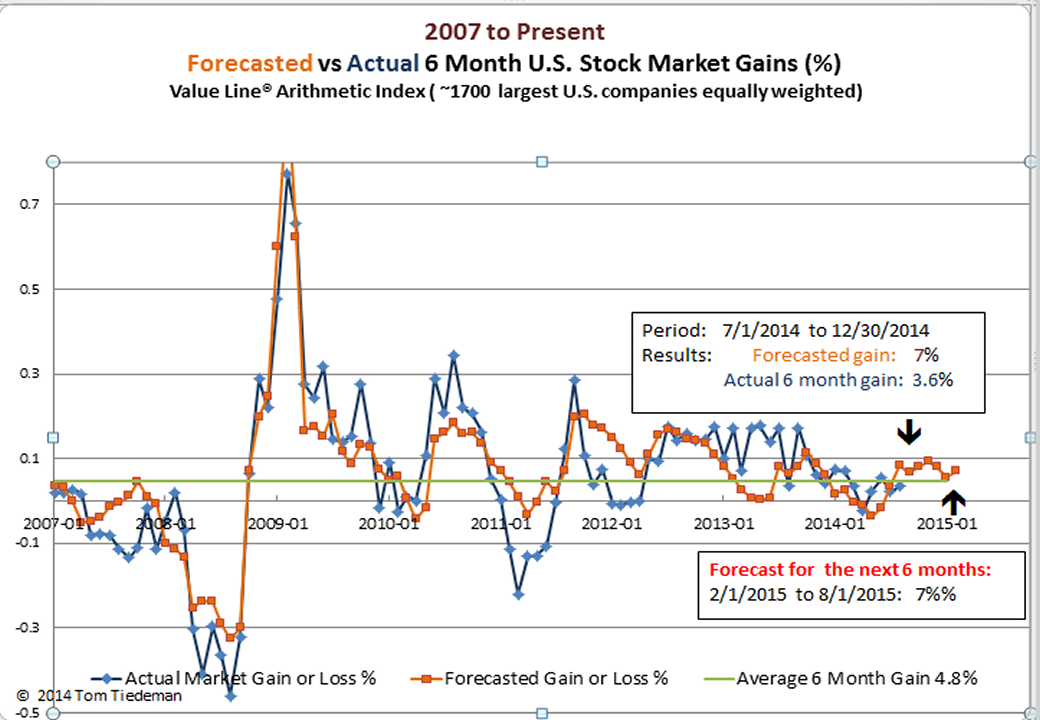
2015 has gotten off to a weak and volatile start with the S&P 500 off about 3% during January. Volatility is back — the market has fallen and worked at recovering 4 times in just this first month. Despite this weakness, the macroeconomic mathematical models reported on here expect slightly better than average market gains for the next 6 months.

U.S. Market Forecast (based on the Value Line Arithmetic Index):
Probable stock market gain 2/1/2015 to 8/1/2015:  7%  (Avg. 6 months gain since 1984: 4.8%)
Probability of at least breaking even : 80%  (Average for all months since 1984: 73%)


The U.S. stock market has tapped nearly all of the quick gains that came with recovery from the Great Recession.  From here on the gains are likely to be about average and depend on solid gains in the real economy.  With the scale of probable gains getting smaller the relative importance of market volatility grows.  Translation: Look for a very bumpy ride with fairly low pay-off.

Keeping track of how well these models are performing, over the past 6 months the market (using the Value Line Arithmetic Index) gained 3.5% while the prediction had been for roughly a 7% gain.  I’ll call that a win: the model expected relatively modest market gains and that is what occurred.  The models used here are not expected to be highly accurate.  Their sole purpose is to give early notice of major market gains or losses, hopefully several months in advance.  Time will tell if the models can do that.

2015 U.S. Stock Market Forecast: Climbing the Wall of Worry

2015 should be a thoroughly average year for stocks.  My macroeconomic models predict modest stock market growth through 2015, and see no reason the path during the year to be any smoother or more volatile than normal.  Negative market surprises, if they hit, will most probably be during the second half of the year.  A boring year would be wonderful!

The stock market, of course, will do what it ‘wants’, regardless of these predictions. That said, the model has performed well since 2007, so its forecasts may be worth paying attention to.

The tremendous multi-year stock market recovery from the depths of  “The Great Recession” is almost complete. More years of strong double-digit gains grow less and less probable.  On the other side of the coin,  serious action by the Federal Reserve to damp down the economy is still about two years away. Until then, a routine bumpy upward path for the U.S. stock market is the most probable future.

U.S. Market Forecast (based on the Value Line Arithmetic Index):
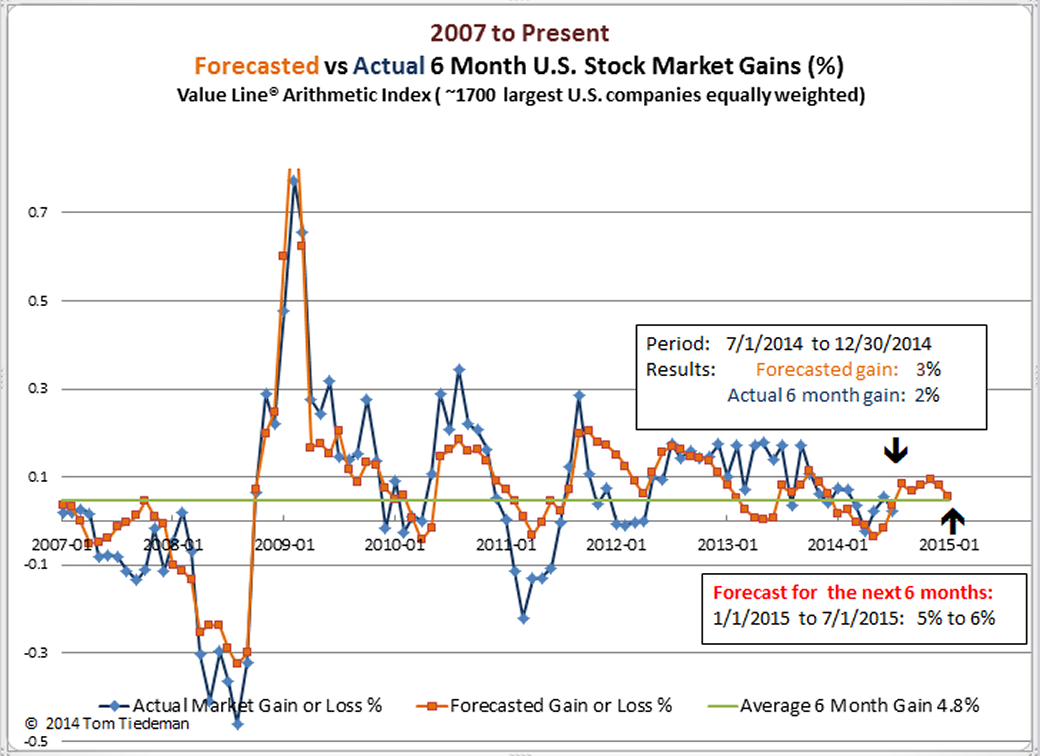
Probable stock market gain 1/1/2015 to 7/1/2015:  5% to 6%  (Avg. 6 months gain since 1984: 4.8%)
Probability of at least breaking even : 75%  (Average for all months since 1984: 73%)

(Click on image to enlarge.)

What drives this typical stock market prediction?

Regression to the Mean: The Value Line Arithmetic Index that my models follow includes over 90% of U.S. corporate activity, but because of the way companies are weighted, it is much less influenced by speculation than more popular indexes like the Standard & Poor’s 500.  As a result, it follows a much steadier growth pattern than other indexes. The  Value Line Arithmetic Index is now near its long term trend making growth at normal rates very probable. The next 3-5 years should also yield typical market growth.

Continuing Moderate Economic Growth:  The 3rd quarter of 2014 produced surprisingly strong economic growth.  That may well be an exception caused, perhaps in part, by dramatically falling oil prices.  The longer term growth trend has been fairly slow and GDP remains below potential.  There is  room for economic growth.

Small Chance of Recession:  The stock market responds poorly to economic disruption. The metrics I track show few impending tornados on the economic horizon. Eventually, of course, the Federal Reserve will bring on the next recession by sharply raising interest rates. However, a large increase in rates is probably 2 – 4  years away.  Interest rates are still at historical lows and the Fed is only expected to make its first interest rate increase in mid-2015.  My expectation is that when the rate increases begin they will move very slowly.  So much long term money has been borrowed at current very low rates, a sudden increase would destabilize the economy much more than the traumatic shocks of of 2006-2008.  I wouldn’t be surprised if mid-year the Governors of the Fed intentionally try to deflate markets a tad with some hawkish comments. Certainly they would rather do that than to cause actual serious disruption to the ‘real’ economy.

Plenty of Gray Swans Floating Around:  A true black swan can always appear on the world scene. But, that is a rare event (by definition).  Instead, there are plenty of major potential economic positive and negative possibilities.  The ones that I see developing do not appear likely to bring major disruption in the near future.  There are countless observers following each of today’s gray swans.  As a result, major sudden surprises become less likely.

Speculation Has Not Exploded Yet:  Historically, margin debt has proven to be a reliable indicator of stock market speculation.  So far, it is nowhere near the level that typically flags collapse of a speculative bubble.

(Click on image to enlarge.)
Best wishes for a happy and prosperous New Year!

2014 Stock Market Forecast Results

Well, how far off were my model’s stock market forecasts for 2014?

Not too shabby. During 2014 the forecasts from my macroeconomic stock market models matched reality pretty well. Overall, the stock market performed a bit better during the year than the model had expected. No complaints there.

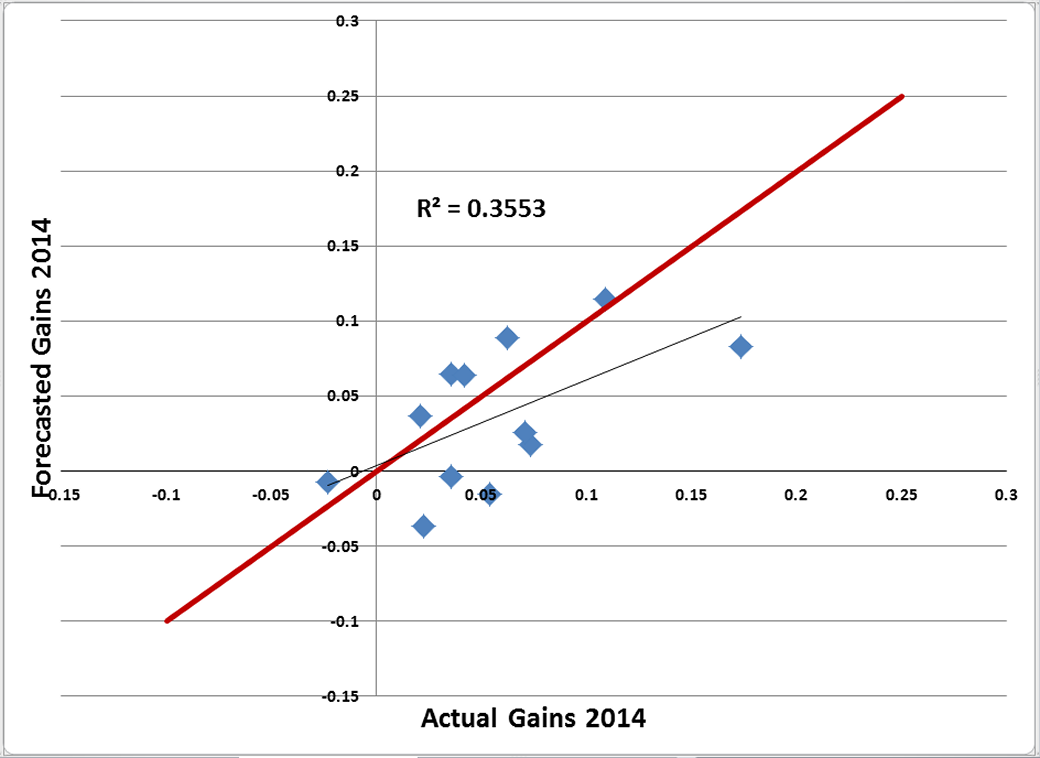
During 2014 actual market performance could be checked for 12 monthly forecasts.  The first of these forecasts was made at the start of August, 2013 with a forecast for the end of January, 2014.  The last forecast that can be checked was made in July, 2014 with a forecast for stock market performance through the end of December, 2014.  A graph of the forecasts vs actual results appears below.

In statistical terms the comparison of actual and forecasted results showed an R-squared measure of 0.35.  That corresponds closely with the long term back-tested results for the model.

But, that doesn’t mean that the model was “right” only 35% of the time.

In more descriptive terms, for most of the 6 month spans of the year the model expected the market to rise moderately and that is generally what the market actually did.  Four times during the year the model forecasted that the market would either be flat or fall less than 5%. One of these forecasts was spot on, but for the other three cases the market rose under 5%.

To my mind what matters is that the model did not make any really bad calls and mainly the stock market performed roughly as expected.  I’ll call that a win.

Happy New Year!

(Click on image to enlarge.)

Incredibly Accurate, Incredibly Simple Multi-year Stock Market Forecast and Why That is Only Modestly Helpful

Forecasting the stock market 3 to 5 years into the future can be straightforward and fairly accurate if three basic concepts are followed:

1.  Long term multi-year forecasts are inherently more accurate than short-term forecasts.
2.  Estimating the collective future of thousands of companies gives more success than forecasting just a few.
3.  Avoid forecasting areas where speculative money is dominant.

In brief, trying to forecast the near term future of just a few companies that are the focus of huge piles of fast-moving hot money is just begging for failure.

This translates to a single rule: Do not attempt short-term or single year forecasts of the Dow Jones 30 Industrial Average, the S&P 500 or the NASDAQ composite, or at least, don’t expect great accuracy if you do.  The calculation of each of these indexes is dominated by just a small number of huge companies.  Each is followed closely by millions of nervous investors all trying to beat the market and usually failing.  And speculation in each of these indexes is cheap and simple using exchange traded funds. All the makings of a frustrating forecast. Most market forecasters make their annual predictions using these popular averages, and not surprisingly, most of these annual forecasts end up being shown up as wildly inaccurate.

So what’s left?  The rest of the stock market, all the thousands of other companies whose names are not household words and people really don’t know or care much what they do.  Prices of these thousands of companies — much of the rest of the economy — collectively tend to move in a much more predictable way. They follow a path of constant moderate growth very closely over the span of several years. Not month-by-month, or year-to-year, but over a multi-year time span.

What explains this steady long term appreciation? The Law of large numbers. Millions upon millions of people work for these companies.  They go to work 5 days a week or so and they try pretty hard to do a good job regardless of whether the stock market is up or down.  Even in a severe recession most all of these workers are still plugging away at their jobs. The result is a rather predictable rate of overall corporate growth.

Like the more speculative parts of the stock market, prices of the less-speculative stocks go up and down with each bubble and recession.  Their collective price swings, however, are less dramatic and are more closely tied to economic fundamentals.

How predictable is ‘the rest of the market’?  Statisticians use a measure called R-squared which evaluates how far, on average, forecast points differ from what actually occurs.  R-squared of 1.0 is a perfect match.  R-squared equal zero or negative means the model is essentially worthless.

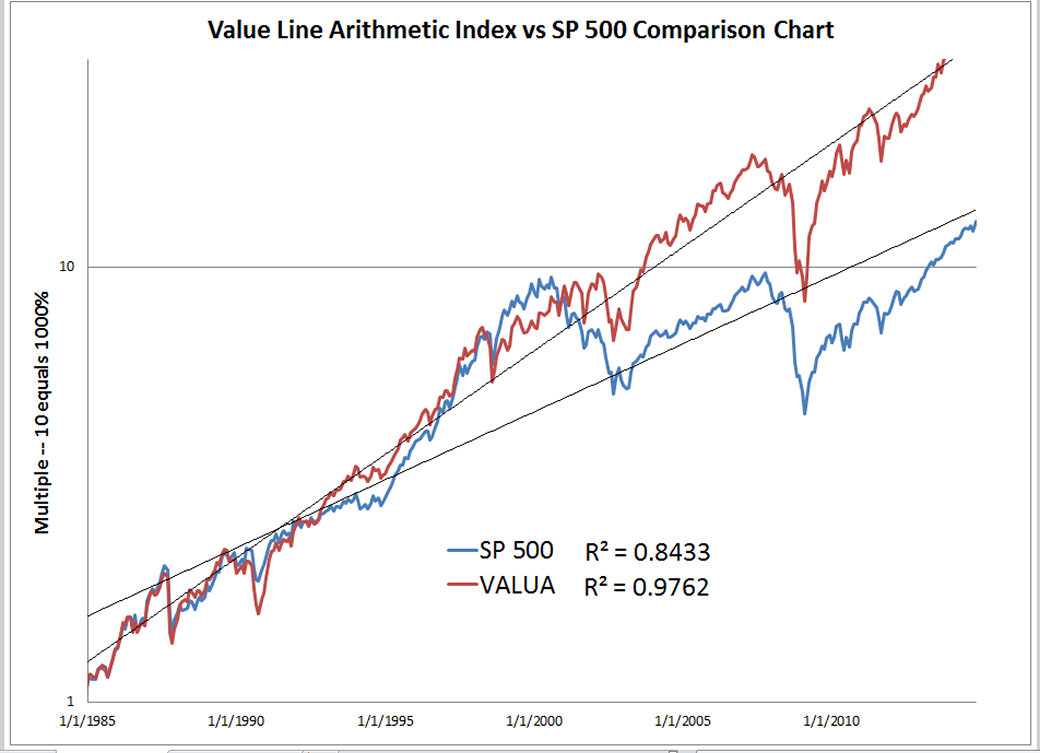
Since 1984 the S&P 500 has followed a somewhat constant rate of growth with R-squared = .84, actually pretty good. Simply put, buy and hold investing makes sense: over the long haul the index grows at a somewhat steady pace — except for all the speculative crashes and bubbles along the way.

I follow the Value Line Arithmetic Index  (VALUA) which focuses more on ‘the rest of the market.’ VALUA gives equal importance to each of the 1,700 or so stocks that the Value Line Investment Survey tracks. No company is treated as more important than any other in calculating the index.  VALUA  follows a constant growth rate with an R-squared value of .98.  Not perfect, but very good. An ETF near-equivalent is the Guggenheim S&P 500 Equal Weight ETF (RSP)

`
(Click on image to enlarge.)

Looking at the graph above it is obvious that neither VALUA nor the S&P 500 follow their long term steady growth trends exactly. But, even over just a 3 to 5 year time span, the growth of VALUA has matched the steady growth trend very well: R-squared = .96.

So what? — stock indexes tend to follow their long term growth paths if you look from a multi-year perspective. Whoopie! Not news to anyone.

A more important and useful observation, however, is that VALUA has a very strong tendency to ‘regress to its mean’, to move back in line with the long term growth trend.  If the VALUA is above the long term growth trend the likelihood is that the next few years will show sub-par appreciation.  But, if the index is at or below trend, as is the case now, then average or somewhat better than average price appreciation is probable.  When the average is near the long term trend line a tremendous price gain becomes less likely. If prices do shoot up, a severe correction looms in the future.
Six Month Forecast for the U.S. Stock Market: December, 2014 to June, 2015

My macroeconomic models predict strong gains for the U.S. stock market for the first half of 2015 — not fantastic, but decidedly better than average. (Based on the Value Line Arithmetic Average)

Forecast:
Probable stock market gain 12/1/2014 to 6/1/2015:  8%  (Avg. 6 months since 1984: 4.8%)
Probability of at least breaking even :   80%  (Average for all months since 1984: 73%)

As the models assess the situation, the underlying factors that have propelled the U.S. stock market upward since 2009 remain in place.  The economy is still under-performing, but is improving. Interest rates remain incredibly low. Composite macroeconomic leading indicators are OK, but not great. Chances of a near-term recession are generally assessed as very low.  While stocks are not at bargain-prices, the odds favor continued gains.  With all the normal bumps, potholes and surprises along the way.

(Click on image to enlarge.)
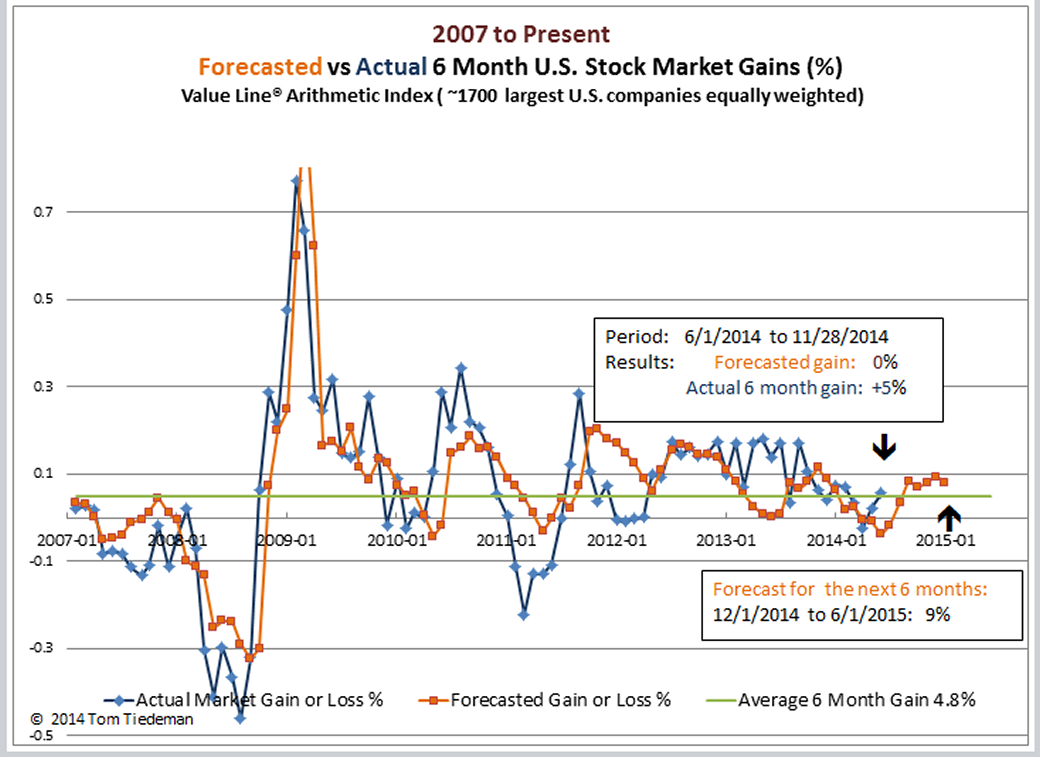
Based on the most recently completed 6 month period (May through November, 2014) the stock market has been beating the expectations of the model somewhat.  The model had predicted flat performance, but the strong rally from October has netted a 5% gain.  Hopefully, this better-than-expected performance will continue into the new year.


Six Month Forecast for the U.S. Stock Market — November 2014 to May 2015

Forecast:
Probable stock market gain 11/1/2014 to 4/1/2015:  9%  (Avg. 6 months since 1984: 4.8%)
Probability of at least breaking even :   85%  (Average for all months since 1984: 73%)

The macroeconomic models are nicely positive for the coming 6 months with a decidedly better-than-average expected gain of about 9% and an 85% probability of at least breaking even over the period. (Based on the ValueLine Arithmetic Index, a 1700+ index of most of the U.S. largest corporations equally weighted.)

Despite the end of the Fed’s Quantitative Easing program, borrowing costs are still incredibly low.  Though the economy has shown a strong 3.5% growth rate over the third quarter, there is still considerable room for economic growth — GDP is still significantly below normal and underemployment remains a serious problem.

(Click on image to enlarge.)


Checking back, the six month market forecast made last April was right on target — basically flat performance. The forecast had been for zero growth for the ValueLine Arithmetic Index. Through October the Index was a few percent below the forecast. However, thanks to a sharp recovery over the past couple of weeks, the Index closed the forecasting period with a gain of 2%. For the past year the stock market has performed nearly as the model had expected, giving a mild assurance that the stock market is behaving normally.

Six Month Forecast for the U.S. Stock Market October, 2014 to April, 2015

There is some current weakness in the stock market as forecasted months ago by my models.  But, looking forward, these macroeconomic models expect the U.S. stock market to perform better than average for the close of 2014 and the winter months of 2015.

What’s driving the market?  The story hasn’t really changed in the past couple of years:  The U.S. and the rest of the World continue to slowly recover from the Great Recession.  Most economies are still weaker than normal.  Unemployment has gotten better, but is still unacceptable.  Inflation remains low. Gross Domestic Product remains below its long term trend.  Interest rates, forced down by extraordinary measures  put in place by central banks remain near historic lows. Stock valuations are high by several common measures such as Price/Earnings ratios.  There is, however, no correlation I have been able to find between P/E ratios and near term stock market prospects.

As long as the economy remains relatively weak, the stock market probably has reason for optimism.

Here is the current forecast:
Probable market gain from 10/1/2014 to 4/1/2015:  8%  (Average 6 months since 1984: 4.8%)
Probability of at least breaking even :   80%  (Average for all months since 1984: 73%).

(Click on chart to enlarge.)
In the most recent 6 month period (April through September) the model had expected the market, as measured by the Value Line Arithmetic Index, to drop 1%.  The actual 6 month change was -2%.
As you can see from the chart, forecasts for the next couple of months are weak.  After that, hopefully the market will rebound nicely.


Is Ebola a Black Swan for the Stock Market?

There is a non-zero probability that  fallout from the current Ebola outbreak will crush world stock markets in the next few months. I have no idea what that probability actually is. Maybe the chance is incredibly small and perhaps the risk is large. The experts do not appear to have a clue either.

My stock market models focus on changes to the real economy and would probably be blind to the onset of a panic-based market crash. Investor feelings are not part of the models. These econometric models, however, probably would foresee a later stock market crash that might arise in the small chance that the virus outbreak eventually destroys the world economy. Now that’s a cheery thought.

According to published reports the Ebola virus outbreak in West Africa began with one person last March and now, roughly half a year later, it has spread to an estimated 5,800 people.  So far, most of the world and certainly the stock market have brushed this off as a minor event.  Today in a major policy address to the United Nations the President of the U.S. emphasized the seriousness of the current Ebola outbreak.  This emphasis was scarcely mentioned in press reports and the stock market was up nicely for the day.

By January 20 the United States Center for Disease Control gives a best case estimate that the Ebola disease will affect 11,000 people, and in the worst case estimate the disease will devastate 1.4 million people by mid-January. Currently, 70% of those infected die from Ebola.

In the highly unlikely event that the worst case scenario further develops unchecked, (a one-to-one-million yearly growth rate) the entire population of the Earth would be affected in the following year. In the current best case scenario, Ebola would become endemic and would saddle the world economy with significant costs for the foreseeable future entailed by efforts to prevent infection and ameliorate the disease.

It seems to me that between now and January the world will see if the best or worse case scenario is developing.

Almost nobody reads this blog. That is fine with me.  But, should a well-read market commentator write a panic article about Ebola — Watch out!  Stock market valuations are lofty and there is plenty of room to fall. The market reaction from a national fear story could be sudden and severe. No commentator will want to bear the responsibility of being the first to panic. Should one signal fear a stampede could follow.