Stock Market Forecast July 2016 through December 2016:Below Average

My forecasting models expect some market weakness for the next few months, but project that the market will do somewhat better in the closing months of 2016.  Overall, the models forecast a gain of just 1.3 percent between now and the end of 2016.  The probability of at least breaking even over the coming half year is about 70%  — very close to the market’s long term average.

(Click on chart to enlarge.)

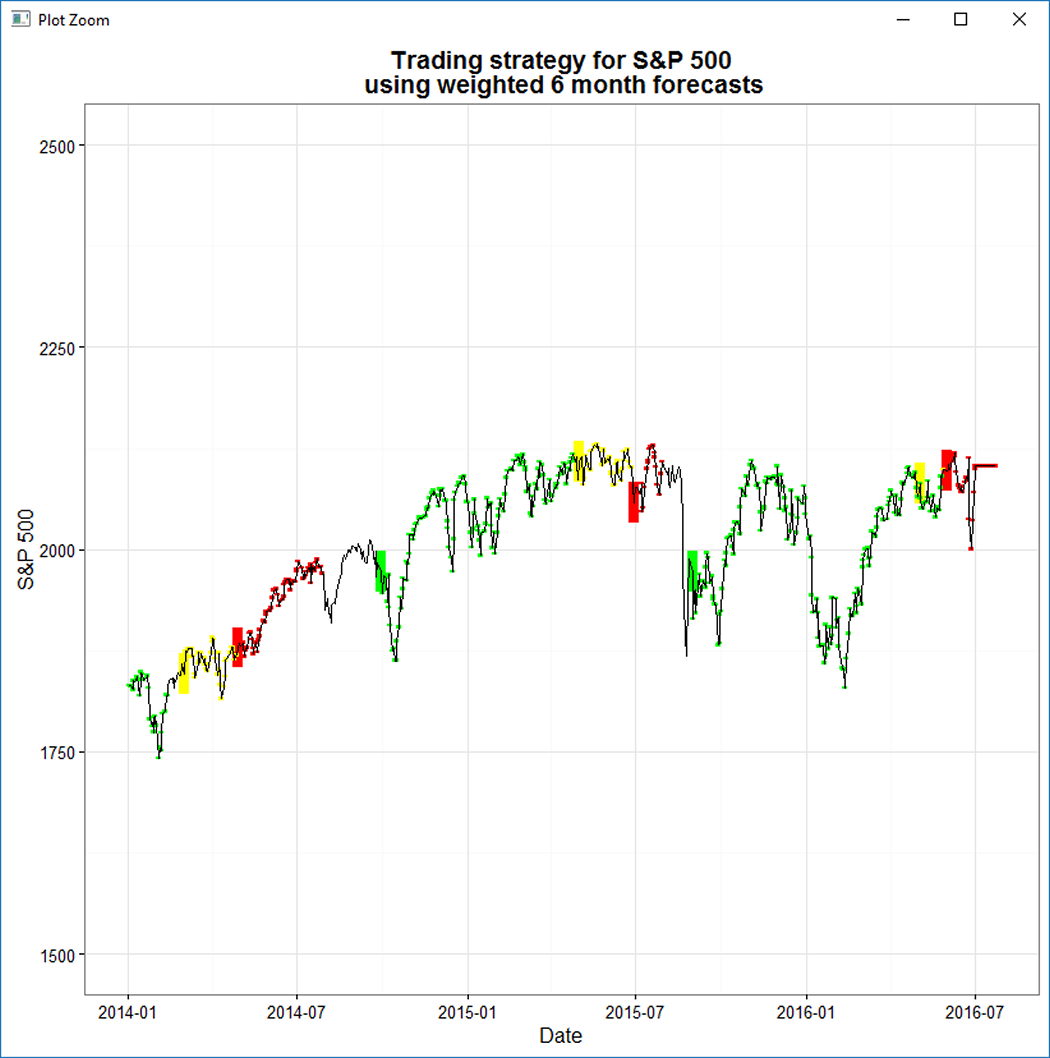
The short term market forecast remains negative.  The model turned negative at the start of June and remains mildly negative.  The model is not likely to issue a buy signal in August either.

(Click on image to enlarge.)

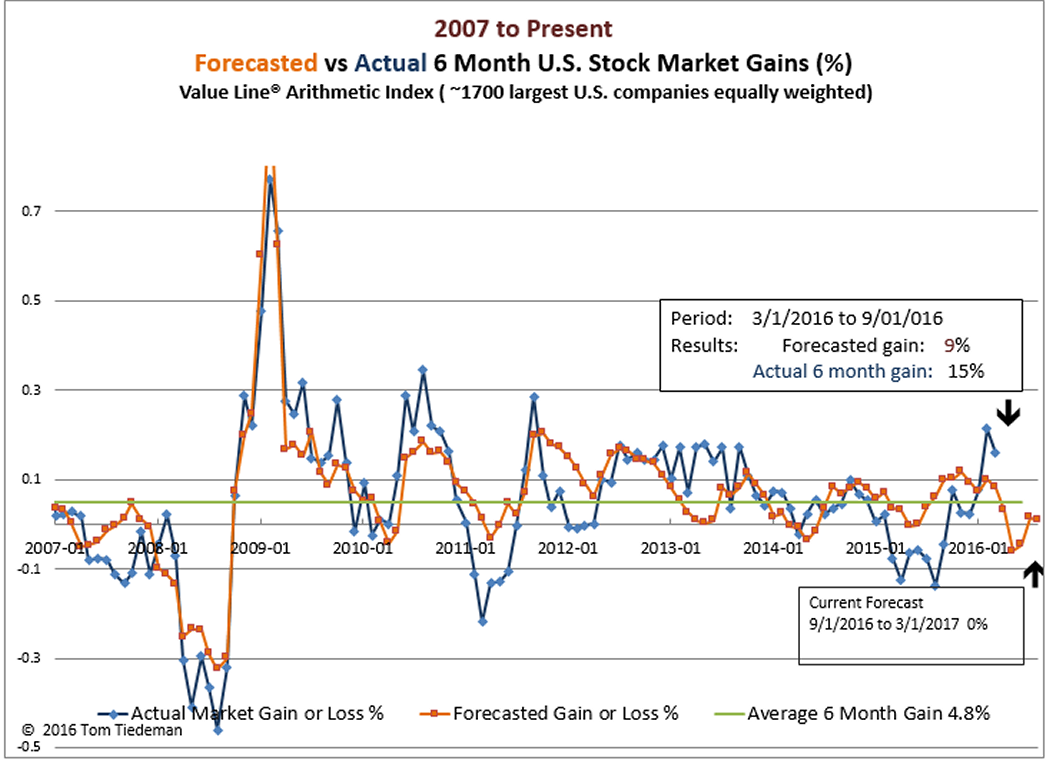
Overall, the U.S. stock market has been behaving fairly close to the models’ expectations.  In January the model had projected a 7.3% market gain in te first half of 2016 and the actual market gain was exactly the same 7.3%.  In June the one-month trading model turned negative — ahead of the brief Brexit market tumble.

On the whole the market seems to be normal, reacting about the same as it usually does to the economic variables that typically foretell market direction. If that continues, we can expect a couple more weak months before prospects improve.

Stock Market Forecast June 2016 through November 2016:Negative

My near term stock market indicator has now turned red. My models do not predict a large stock market drop soon, but they do project that over the next few months the market is more likely to fall than to rise. This negative market outlook is likely to remain for at least the next several months.

(Click on image to enlarge.)

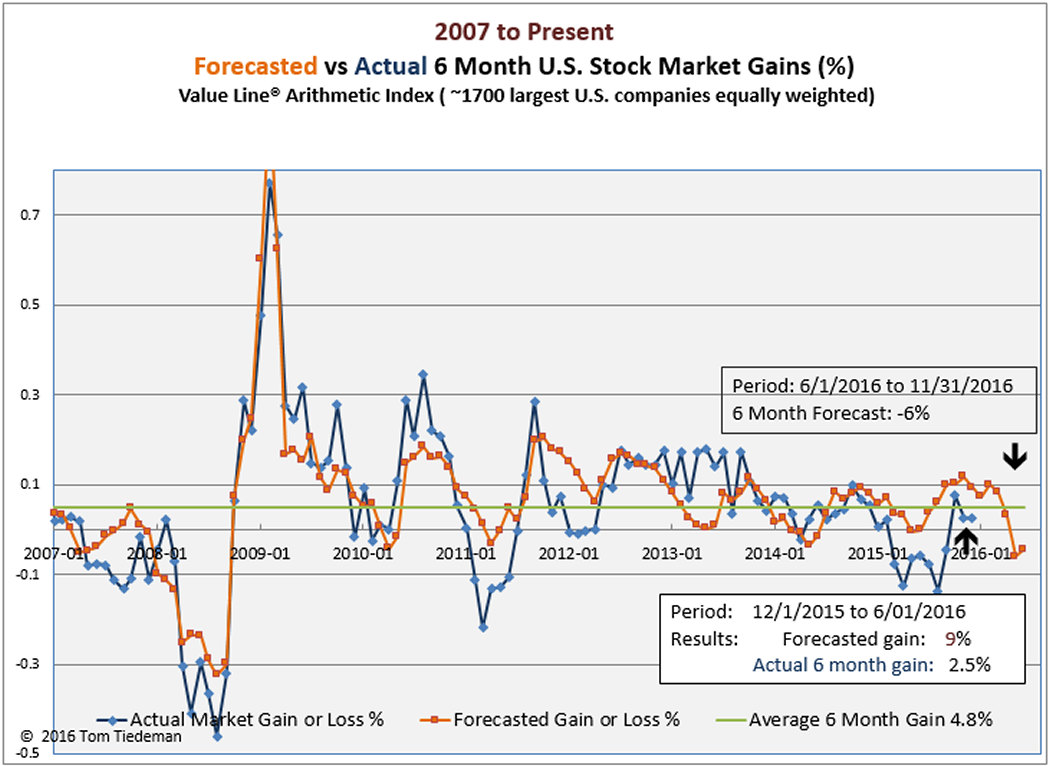
This is the second month that my econometric models expect the U.S. stock market to drop over the next 6 months — by about 5%.  I calculate that there is about a 40% chance the market will break even in the next half year, versus a 74% chance on average.  For the past year or so the market has steadily performed worse than my forecasts so it wouldn’t surprise me if the actual results come in somewhat worse than my pessimistic forecast. Something outside the scope of my models is causing the market to perform poorly.

What’s behind this negative 6 month stock market projection? Typical seasonal market weakness is part of the reason: on average, but not always, the stock market performs worse during summer months than the rest of the year.  The bigger problem, however, is that as far as my model is concerned, there is little reason for the market to go up.  The market is near fair market pricing, leading economic indicators are weak, and interest rates appear more likely to go up a bit rather than falling.

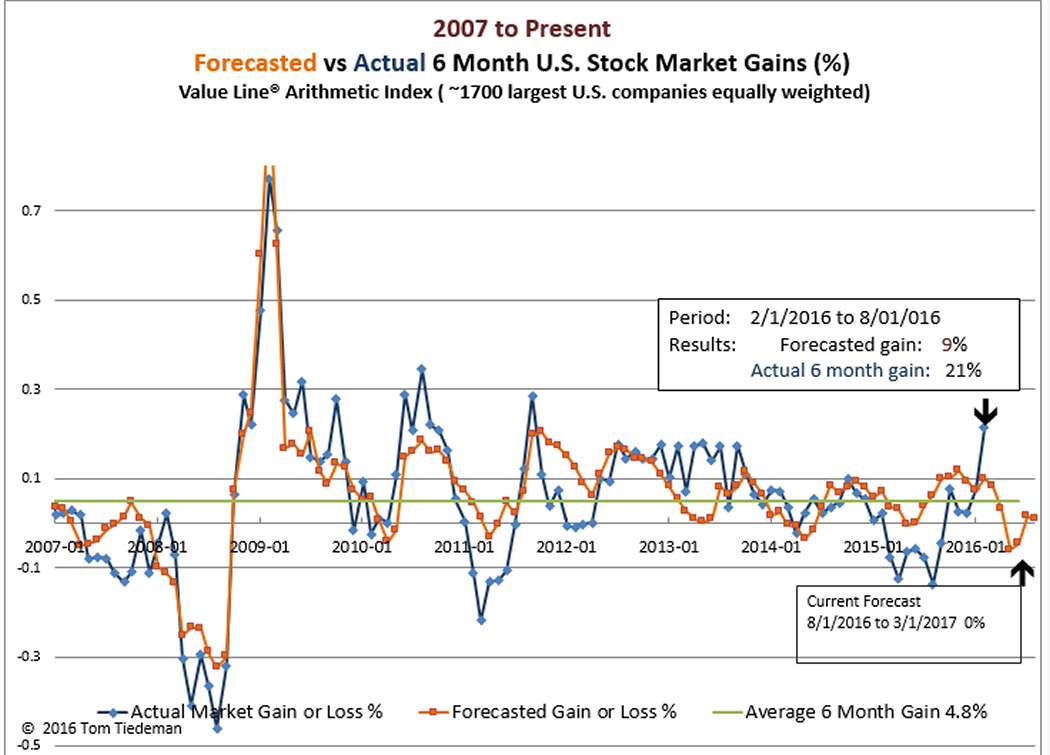
As I noted above, the stock market has been performing somewhat worst than my models had expected.  Looking at the graph below, the market does appear to be following a normal seasonal pattern — the colder months of the year are generally more favorable to the stock market than warm months.  Overall, however, actual market changes over 6 month periods have been distinctly worse than the models had predicted.  Over the past 6 months, for example, the market rose about 2.5%, but my models had forecast a much stronger 9% rise.  As always, the market will do whatever it ‘wants’ to do, but my models are getting gloomy.

(Click on image to enlarge.)

Stock Market Forecast May 2016 Through October 2016: Looking bad

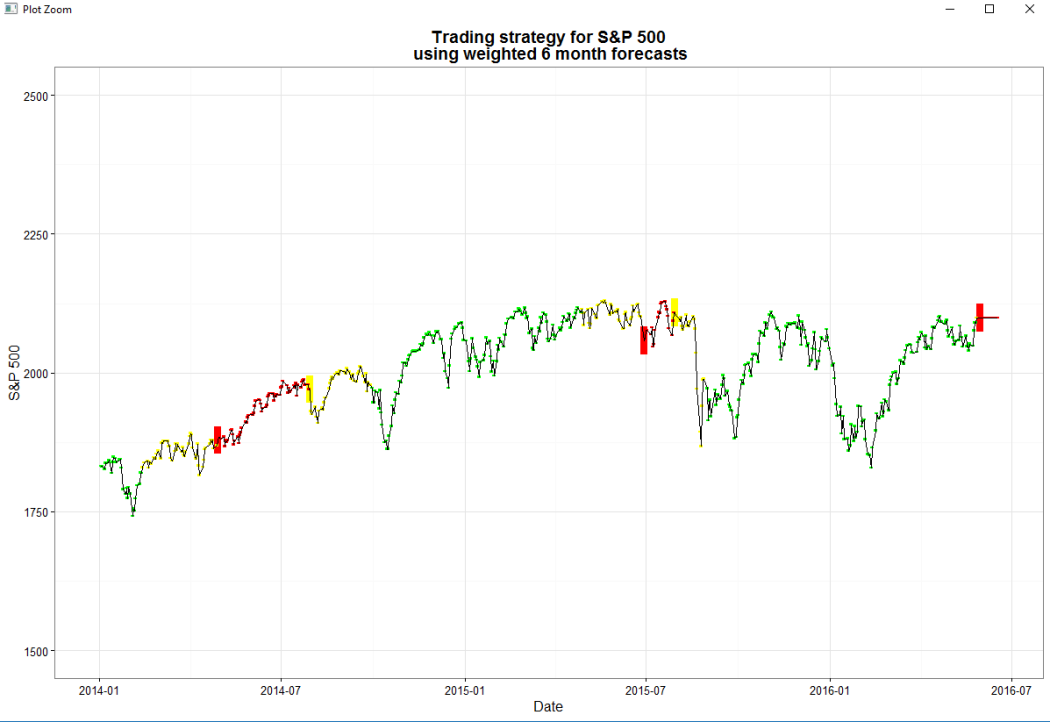
May 2016 through October 2016:  Watch out. The six month stock market forecast is bad and the near term forecast is flashing yellow.  Next month the short term forecast will almost certainly turn red. My forecasting models expect the U.S. stock market to fall significantly over the coming half year; and that doesn’t factor in the presidential election which is likely to create additional volatility.

The models predict that the stock market will decline about 6 percent from now through the end of October. The probability that the market will decline over the period is high.  The odds that the market will fall by at least 8% at some point over the next six months are high — about 1 in 4.

As shown in the graph below, the stock market has performed below the expectations of the model for more than a year. If that continues, actual market results in the next six months could be significantly worse than the bleak forecast now given by the model.

(Click on image to enlarge.)

The immediate prospects for the stock market, however, are much less clear and are not as bad as the longer term forecast.  As shown below the short term forecasting model is now flashing a warning.  Based on the current negative 6 month forecast next month the short term forecasting model will probably be flashing a sell signal.

(Click on image to enlarge.)

Stock Market Forecast April 2016 Through September 2016: Below Average

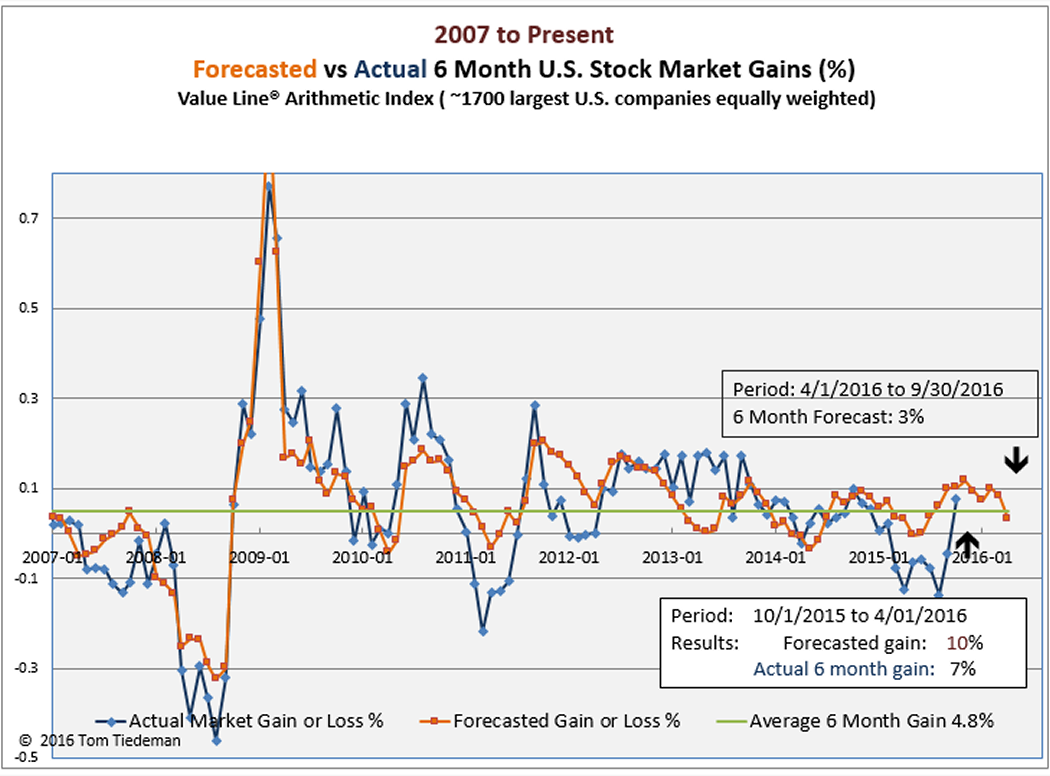
April 2016 through September 2016: My forecasting models expect positive, but below average market gains over the next 6 months. (roughly 3% gain, 70% chance for break even with 73% being the long term break even probability.)

Spring flowers are just starting to come up where I live, but my stock market forecasting models are already anticipating that stock market gains over summer months will be weak following a normal seasonal pattern. The model says that 3% projected gains through the end of September will be below long term stock market price appreciation.  My models know nothing about politics, but personally I will bet on some sort of market stumble as the Republican and Democratic presidential conventions get underway.

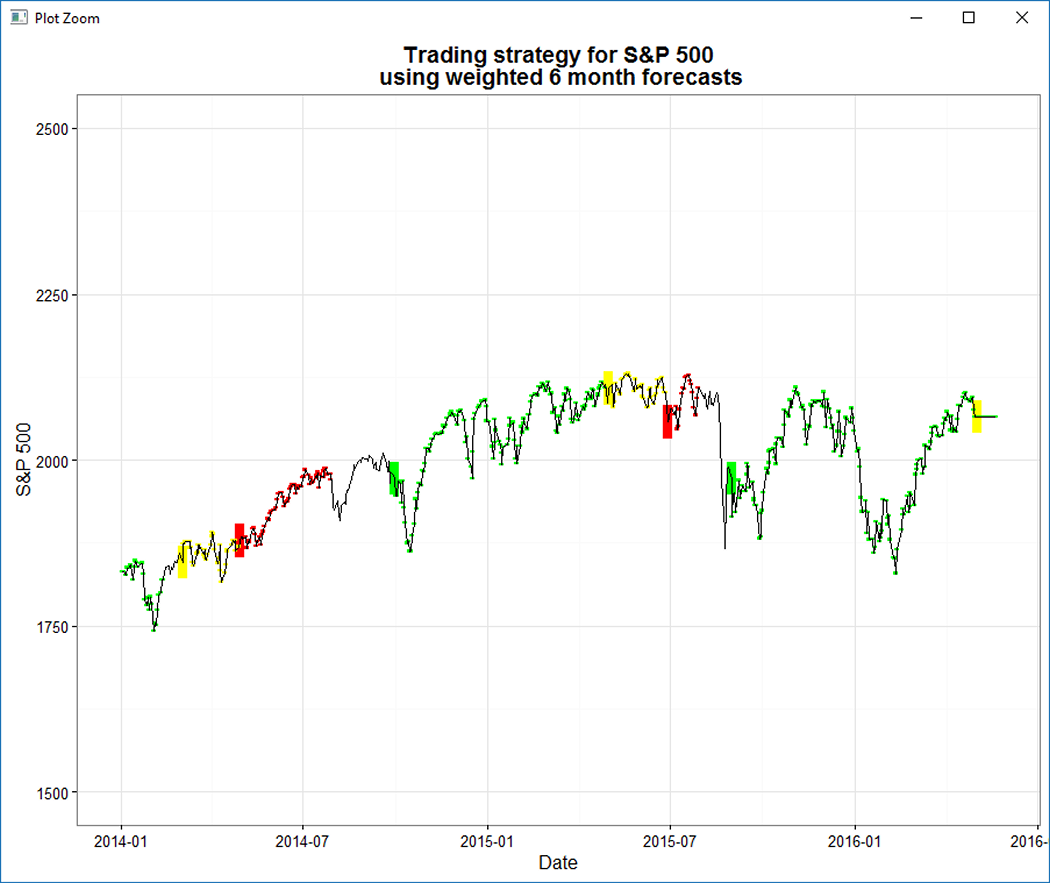
That said, it is still springtime so April, and probably May will likely produce better than average results. The second graph below shows that a time lagged forecast using my models remains bullish.

(Click on image to enlarge.)

(Click on image to enlarge.)

Stock Market Forecast March 2016 Through August 2016: Above Average Gains

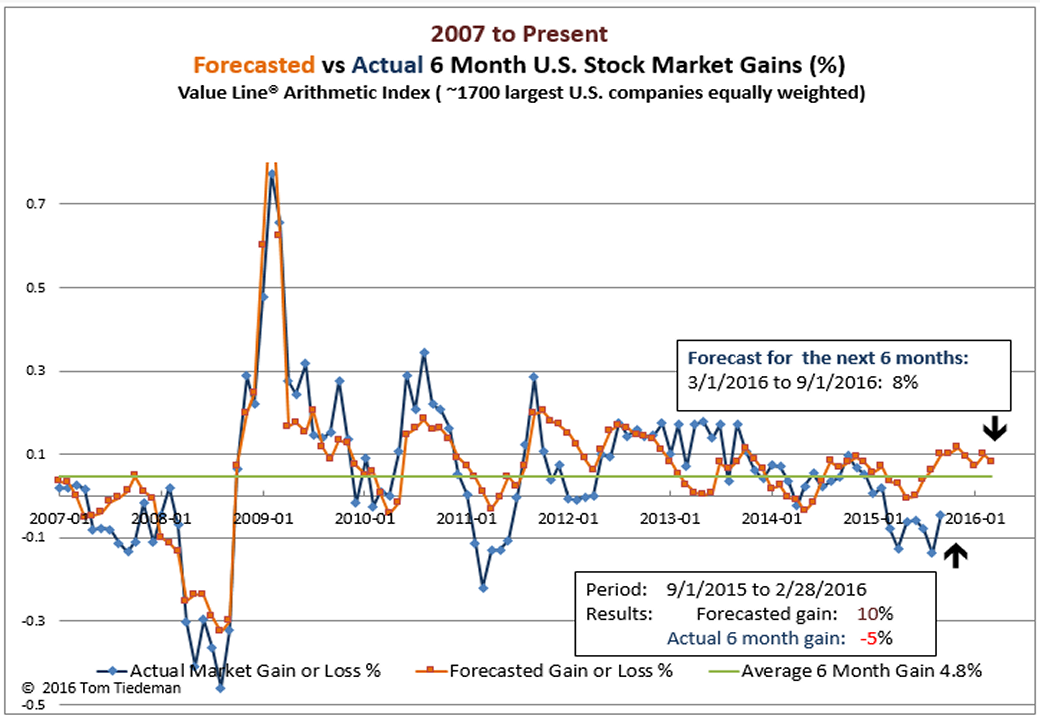
March 2016 through August 2016: Above average gains (roughly 8%, 85% chance for break even)

The stock market continues to lag the models’ forecasts, but the gap appears to be closing. The model is saying that once again the market has predicted a recession that didn’t happen. Current forecasts from the model remain optimistic — nothing beats a crazy stock downturn for making the market future look brighter.


(Click on image to enlarge.)

Stock Market Forecast February 2016 Through July 2016: Above Average Gains

February 2016:  U.S. stock market returns well above average
March 2016: U.S. stock market returns well above average
February 2016 through July 2016: Above average gains (roughly 9%, 85% chance for break even)


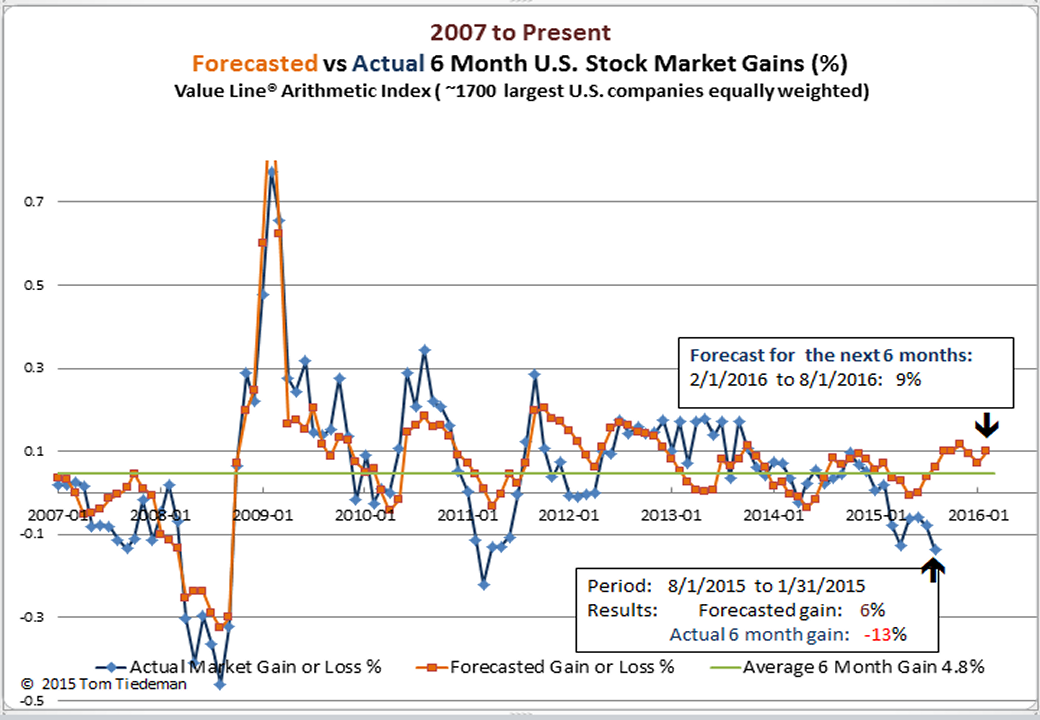
Last month the short term forecast from my forecasting model proved to be dead wrong. Looks like I have some explaining to do.

The prediction was strongly positive, but the U.S. stock market suffered it’s worst January performance EVER.  So, what does that mean?  Is the model junk? Or is something else going on?

My models focus on a small number of key measures of the economy that have proven over the past several decades to be leading indicators for the broad U.S. stock market.  Together these factors forecast about one-third of the actual variation in the market over 6 month periods. However, that also means that about 2/3 of 6-month market variations are not predicted by my models. The goal here is not to be accurate, but rather to foretell the most likely general direction of the broad stock market

If the model is to be believed, the U.S. stock market should be heading upward fairly soon.

The chart below shows a multi-year plot of the S&P 500 index with buy/hold recommendations from the model in green. The current forecast is positive.

(Click on image to enlarge.)

The next chart displays actual 6-month changes in the stock market (blue) and predicted 6-month changes (red).  In the most recently completed periods, the market has performed significantly worse than expected. Note that in previous downturns the market has routinely performed worse than expected.

(Click on image to enlarge.)

Stock Market Forecast January 2016 through June 2016: Above average gains

January 2016:  U.S. stock market returns well above average
February 2016: U.S. stock market returns well above average
January 2016 through June 2016: Above average gains (roughly 7%, 80% chance for break even)

I have more-than-normal confidence in this month’s forecast. My short term (1 to 2 month) stock market forecasting models have been anticipating the timing of market shifts pretty well for the past couple of years. The most recent call for a change in market direction (Buy) was made at the end of August.  The forecast was matched by a market turn around starting in September that now has produced a gain of roughly 7%.  

Looking forward, the short term models remain quite bullish for the first months of 2016. While my longer term models are already starting to worry a bit about market slow downs in May and June, the short term models are optimistic.

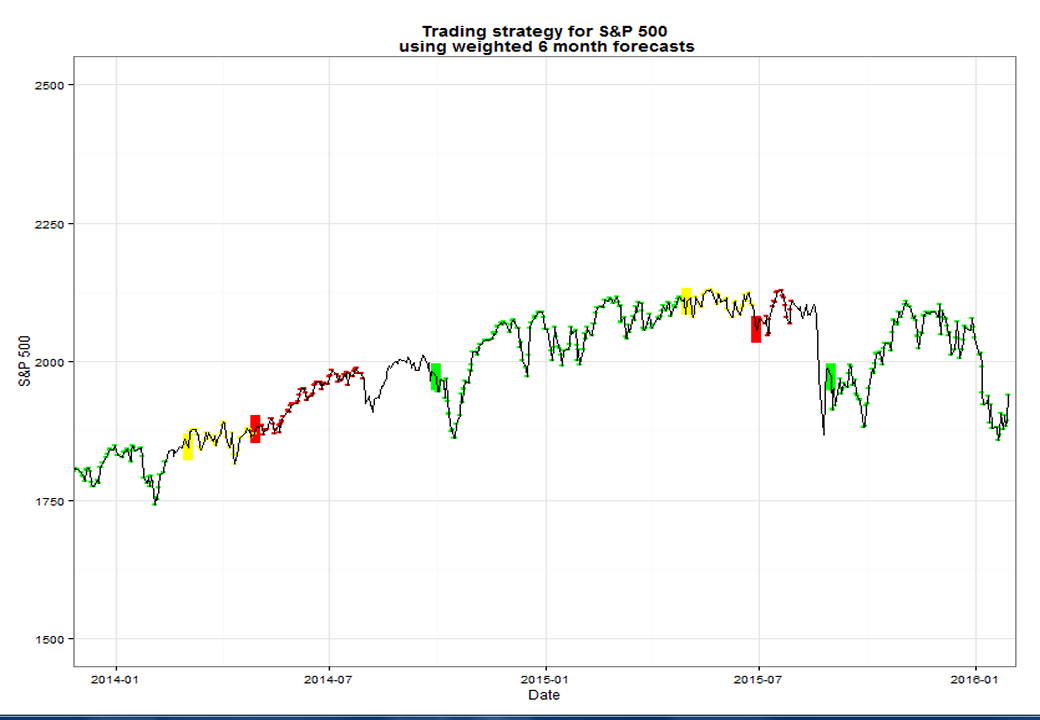
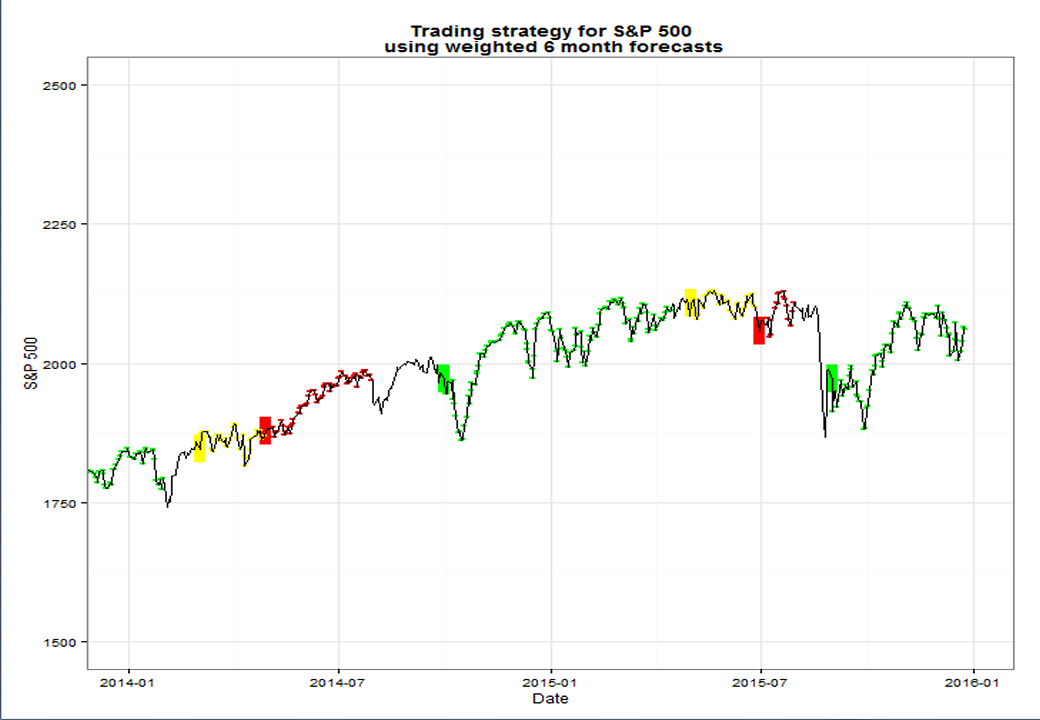
The buy/hold calls of the short term model (green) and the sell/avoid calls(red) for the past two years are shown in the chart below.  The model  turned green at the start of September and the market has risen about 7% since then. For January the model remains bullish. It suggests “Buy/Hold”.

(Click on image to enlarge.)

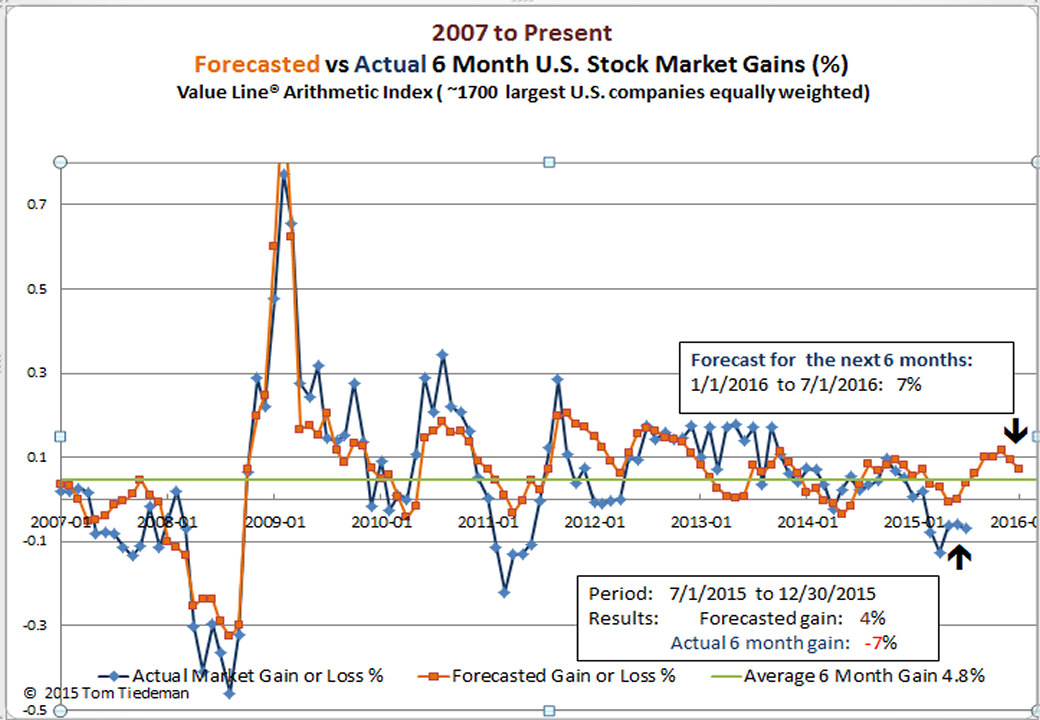
Let’s shift to the longer 6 month forecast.  For the past year or so the stock market generally has been following the same course that my 6 month macro economic models had predicted six months months in advance.  On the whole, however, the stock market has come in somewhat below my econometric models’ expectations. Last July, for example, the model expected below average gains for the second half of 2015, but the actual result in the 6 months since then was significantly worse, a loss of about 7%.  I am not too concerned about this difference — as you can see in the chart below, it is more the rule rather than the exception that actual market performance is more extreme than my models had predicted.

(Click on image to enlarge)


Happy New Year!

Stock Market Forecast December, 2015 through May, 2016: Very nice

Summary:
Current prospects for the U.S. stock market are very good: 9% gain over the next 6 months with an 85% probability the the stock market will at least break even.  Immediate prospects are fine (more on this later.)  Maybe the whole world will blow up next week. I don’t know. But, based on roughly 40 years of stock market history, conditions for the U.S. stock market are likely to be favorable.

So, this is a pretty nice forecast– not as good as the fantastic forecasts that came with recovery from the Great Recession — but, still really good compared to long term averages and somewhat typical of this time of year. For this year, this is probably as good as it gets.

Enjoy your holidays and be nice to other people! I love both of my readers and wish them well in the coming year!

Detail:
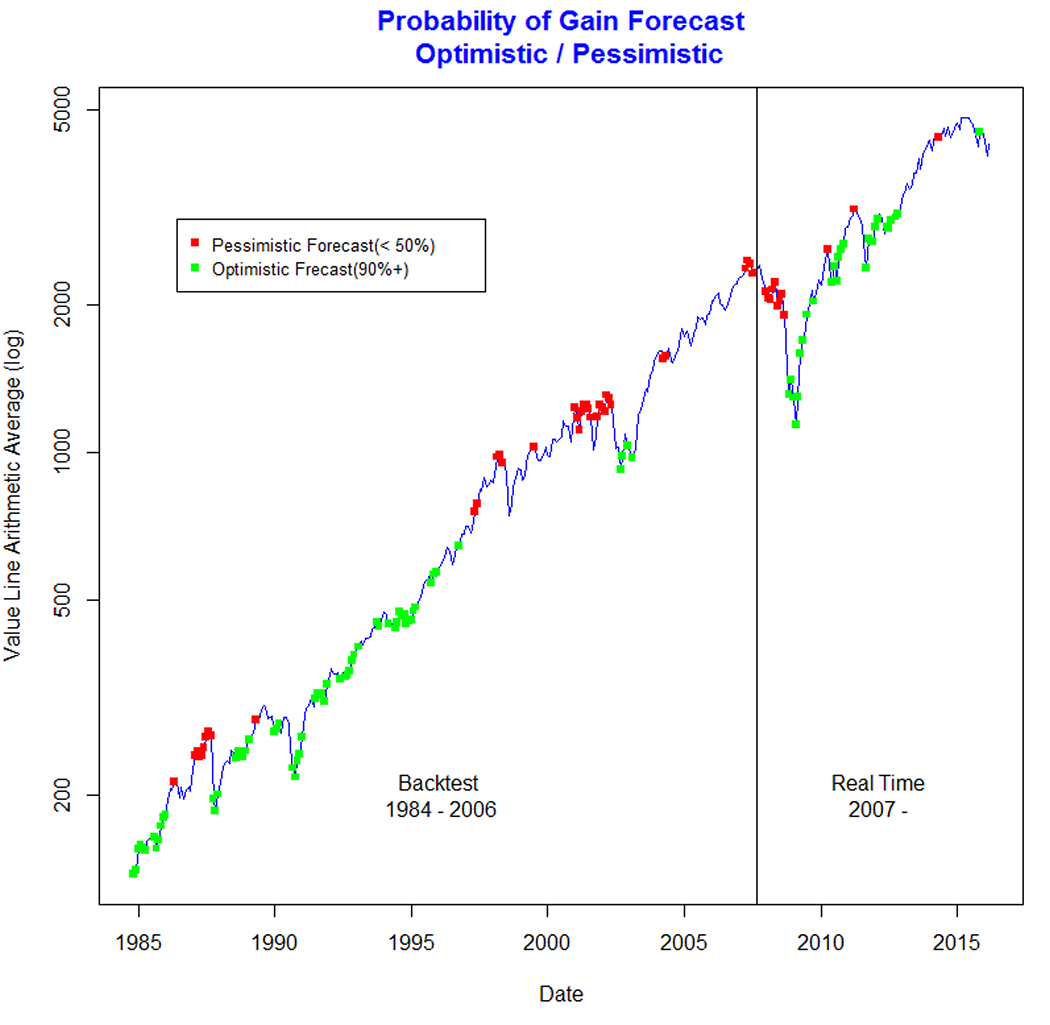
There is a graph below that, I hope, will become a regular part of this monthly blog. It shows day-to-day prospects for the stock market in the near future. (Please regard this graph of near term stock market prospects with some suspicion.  This is new stuff. The formulas need to prove themselves over time. Be careful with your money. )

Hopefully, what you will see going forward with future months of the graph is:  Two months, or more, before a ‘significant’ market trauma, a yellow marker should start to appear.  Then, (hopefully) a month or more before a market stumble, a red flag should start waving. There will also be an indication of how bad the next market tumble is expected to be.  The picture moves slowly so you shouldn’t need to hold your breath.

At least, that is how the scenario for this near term forecast graph played out this past summer. And, that is what our back-tests showed to often occur.

How can the chart ‘predict’ the future months of stock market behavior ahead of the fact? The answer is easy.  The model is simplistic. The model is almost exclusively based on a small number of long term economic fundamentals. It takes time for the gigantic world economy to actually show the results of either world events or government policy actions. But, investors are on their own time schedules. Historically, investors do not react initially to the full import of new developments in the real world.  Sure, there is a stock market blip to match every news event — but that is not the ‘considered’ view of millions of investors. Overall, investors tend to wait  for confirmation in ‘numbers’ coming from the real world (with a reporting time delay)  to see what is going to happen next.  So, typically, investors react late, and they all react together — resulting in a sharp crash or some other market perturbation.  The model, on the other hand, being too ‘stupid ‘to listen to stock market pundits or ponder over either astrology or ‘technical analysis’, assumes that what is “probably going to happen” actually will happen, and happen when it typically happens  And, surprise!  The typical result usually does happen just about as it usually does.

What the chart, hopefully, shows is that in the past summer a fairly small correction was expected, and that is what occurred. There was plenty of notice for those following this chart. Right now, things look pretty good.

(Click on image to enlarge.)

So, let’s turn to what is likely to happen to the market in the next six months. Here is what is coming up. The models’ 6-month U.S. stock market forecast: (much better than average)
U.S. Stock Market Forecast (Value Line Arithmetic Index):
Probable stock market gain 12/1/2015 to 6/1/2016: 9% (Avg. 6 mo. gain since 1984: 4.8%)
Probability of at least breaking even : around 85%  (Average for all months since 1984: 73%

My reason for writing this blog is to track how well my econometric stock market models actually perform. (It has been about 8 years so far. At the start I was considered to be crazy, but now that case isn’t so clear.)

So, how have the models’ forecasts been matching reality in the past half year? Judging from the graph below, it appears that the forecasts this year have basically been on-track.  The forecasts from December through May, had been for a weak first half of 2015. Well, the market did weaken, but  the market fell more than the models had forecast.  Look at the graph below and you will see that this happens frequently — the models expect seasonal weakness, but, to compensate mathematically for those infrequent years with super summer performance, the models dial back their average forecasts.
Here is the lesson: as a rule, the market will usually perform worse than the models negative forecasts and will perform better than the models positive forecasts. At least, that is the way I see the graph below.

(Click on image to enlarge.)

Stock market trading based on 6 month stock market forecasts – So what?

Why pay any attention to the stock market forecasts from this forecasting model? It looks like a buy/sell strategy may significantly boost investing returns.

In my last post I introduced a stock market trading strategy based on my 6 month market forecasts. It turns out that the forecasts consistently lead the market by a couple of months, so actual trading works best not by following the most current forecast, but by using a lagged forecast that weights forecasts from a few prior months.  The buy/sell periods called by that strategy are shown in the plot at the end of this piece. That plot shows the strategy produced just a handful of handful of buy/sell points in the period since mid-2007 when I started posting forecasts for my models.

So what?  A few correct buy/sell decisions can have a huge impact on investing returns. In particular, the forecasts of 2008 through early 2009 screamed of likely 6 month market losses of  17%  or more, months before the crash took place.  They turned out to be right. They were worth paying attention to.

A back-test applying the buy/sell strategy to an S&P 500 index fund is shown below running from mid-2007 to the present.  In the stock crash of 2007-2009 the S&P 500 took a big hit, but overall for the period the average has had a 4% annualized rate of growth. The strategy using the 6 month stock market forecasts, however, had an annualized growth rate of 14%, roughly 3 times better.

(Click on image to enlarge.)

The big market call of major likely declines made for most of the difference in performance.  Since the bottom of the financial meltdown the strategy has had only a few brief sell periods. So, for mid 2009 to the present the S&P 500 index has had a great rise and has only slightly under-performed the strategy.

The chart below shows the buy/sell calls produced by a strategy based on using a weighted average of 6-month market forecasts.

(Click on image to enlarge.)

Stock market trading based on 6 month stock market forecasts

I am adding a stock market trading strategy to my monthly blog posts, a Buy-Sell-Hold  model for the U.S. stock market based on a weighted average of my forecasts from prior months.

From the start, there has been a problem making use of my six month stock market forecasts:  what’s going to happen in the stock market six months from now has very little correlation with what the market is going to do in the next few days and weeks. (Just because I know it is going to get hot next summer, that’s not much help in knowing whether I need to wear a coat outside in mid-November.)

The solution I have come up with is to develop a stock market trading strategy based on a statistically weighted average of my 6 month stock market forecasts from prior months, not the current prediction.

Below there is a plot of the Buy/Sell calls from the model for the S&P 500 index over the past several years.  Most of the time the strategy yields a clear Buy/Sell opinion, but there are a few spans of time when the model had no real opinion.

(Click on image to enlarge.)