Boring, Boring, Boring, Crash

It has to be more fun writing for a stock market web site like MarketWatch.com.  Seems like every day they have a column suggesting  an imminent stock market crash, and at least one other column talking about likely explosive growth in stock prices.  Both can’t be right, but you’ll seldom see an article with a title like: “Wow, we were dead wrong 6 months ago! “

Stock market news sites also seem to carry few articles expecting the market to go up or down a measly few percent over the next half year — even though that is what usually happens.

So, please give me a few ‘pity points’  for posting quite boring ,mildly positive forecasts month after month.  They have been pretty accurate, but still boring. Add a few more pity points because the economic factors I look at suggest a couple more years of boringly positive stock market behavior.

Worse still, when these 6 month stock market forecasts eventually turn sharply negative, both of my loyal readers will almost certainly think I have gone nuts.  Most likely the stock market still will be surging up, but my six month forecasts will be screaming that the sky will soon be falling. Month after month.  I expect to appear quite foolish.

Then, thud.

Coming 6 months slightly better than average for stocks

October, 2017 expected gains 1.8%.
October, 2017 through March, 2018: Probable 5 percent gain.

The consensus of my forecasting models is that U.S. stock market will rise over the coming half year.  The likelihood of at least breaking even is about 97% — That is significantly better than the long term market track record of breaking even 74% over all 6 month periods since 1984.  The projected 6 month market gain is about 5%. That’s nice, but only slightly better than the long tern average gain over any 6 month period of 4.8%.

The models’ forecast of very strong gains in the coming month (1.8%) is unusually positive.

The wild cards, however, are any changes to the U.S. tax code which may get pushed through the Republican-majority Congress.  These models cannot figure what, if any, positive or negative impacts tax changes could mean for business.  Passing major tax law changes isn’t easy. The last major restructuring of tax law occurred in 1986.

(Click on image to enlarge.)

Without any major positive or negative catalyst, my models expect the stock market to just keep chugging along. Financial markets are generally calm. We are moving into the winter months which have historically been better for the market than summer months. Recession is unlikely soon.  Interest rates remain historically low. The Federal Reserve intends to raise interest rates only very, very slowly. Inflation is still steady and low.  All of these are positives for the stock market.  But, there is very little reason to expect any big jump in stock prices, as valuations are lofty.

6 Month Stock Forecast September, 2017 through February, 2018

(Note: The October market forecast will be a few days late.)

My models expect another month of weak results for the U.S. stock market, but then things should get back to normal.  For September, the models see a likely stumble of less than half a percent — no big deal.  For the next half year the models predict a net gain of about 5% (slightly better than the average gain of 4.8% since 1984).  Surprisingly, the models see the probability of at least breaking even as 98%.

(Click on image to enlarge.)

The forecasting models have been very accurate so far this year. (Better than my long term testing would have expected.)  The graph below shows, month-by-month the actual gains of the Value Line Arithmetic Average (black) and the results for the same period that my models had predicted 6 months earlier (red).

(Click on image to enlarge.)

Why not forecast the Dow Jones Industrials or the S&P 500?

The Standard & Poor’s 500 Index and the Dow Jones Industrial Average are the best known stock market indicators, but the way these averages are calculated make them hard to forecast accurately. So, I base my forecasts on the Value Line Arithmetic Average which is much more closely tied to the overall economy and business conditions.

Most of the time, most all stock market indexes give the same basic picture of the stock market. They go up and down at about the same time and by about the same amount as each other.  For general purposes most any stock market index will provide a reasonable view of where stocks have been heading. But, to get a more accurate understanding of market behavior, the exact way that the index is calculated makes a real difference.

Articles I spotted  this week in the New York Times and the Washington Post  show dramatically how just two stocks, Boeing and Apple, have caused much of the price rise in the Dow and the S&P 500 this year.  But, not in the same way.  The impact of Boeing has been about 15 times as big on the Dow as on the S&P 500.  Apple was responsible for about 14% of the rise in the S&P 500, but for only about 8% of the Dow’s gain.  Why has Boeing dominated the Dow, but Apple has dominated the S&P 500?  Because of the way the indexes are calculated.

The original  Dow Jones Composite was based on a simple calculation — add up the closing prices of 30 great big companies, and follow that sum day by day. Over time the calculation has become more complicated to account for a changing mix of companies, but it remains totally based on price.   Boeing at $237 per share today is a very expensive stock. Entirely because of its high price Boeing, up 50% for the year, is responsible for 25% of the rise in the Dow.  But, here’s the magic — if Boeing were to authorize a 2-for-1 stock split, its price would be cut in half and its impact on the Dow Jones Industrial Average would be sliced in half.  A stock split of Boeing at the start of the year would have significantly reduced the Dow’s gains this year. Crazy!

The S&P 500, in contrast, is calculated based on the total market capitalization of each stock in the average: multiply the stock price by the number of shares of the company.  The idea of following market capitalization is that what happens to huge companies is more important to investors and the economy than what happens to a smaller company.  In the S&P 500, Apple Inc. is about 260 times more important than, for example, Chesapeake Energy Corporation.

Reliance on market capitalization makes the S&P 500 and similar averages like the NASDAQ Composite, prone to bubbles.  As the Dot.Com bubble showed dramatically, soaring prices of a relatively small number of stocks does two things — besides raising the index price directly, the increased prices raise the market capitalization of those stocks and therefore increase the amount that each bubbling stock counts in calculating the index.

The Value Line Arithmetic Average is calculated differently, and that makes a huge difference in predictability.  The Value Line Arithmetic Average tracks the average percentage gain day-by-day of about 1700 very large U.S. companies.  Changes in Boeing, Apple, Chesapeake Energy and many smaller companies all count equally.

Since 1984 the S&P 500 Average has matched a steady rate of growth about 86%.  Yes, despite all the bumps and bubbles, the S&P 500 shows a “relatively” steady long term growth rate.  But, the Value Line Arithmetic Average matched a steady growth rate with about 98% accuracy — it gives a much less bumpy investment ride. (The Value Line Arithmetic Average is not available as an investment fund, but RSP, the Guggenheim S&P 500 Equal Weight ETF, has very similar performance.)

By using the Value Line Arithmetic Average as the basis of my forecasts, the predictions are much less vulnerable to the somewhat random  price movements of a very few huge companies. It would hardly budge, for example, if simultaneously Boeing and Apple had major product flops.  The Dow and S&P 500 would be tanking post haste.

For most purposes, most of the time, my forecasts for the Value Line Arithmetic Average will apply fairly well to other indexes like the S&P 500 and the Dow Jones Industrial Average.

As always, even though my forecasts for the past decade have been pretty good, at most, they should be only one of the factors an investor considers.

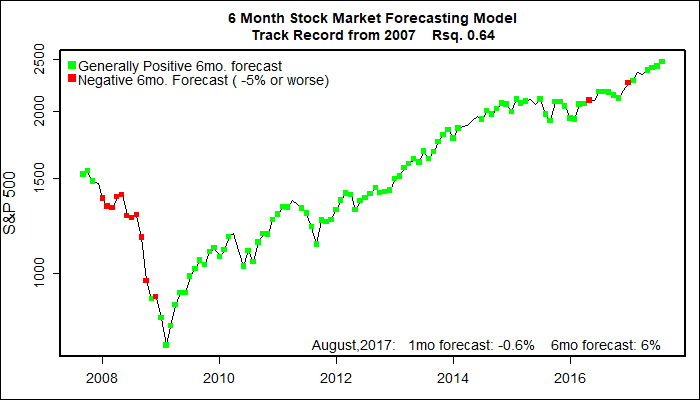
Stock Market Forecast August, 2017 through January, 2018: Weak start, good finish

Out of the  countless economic statistics available, relatively few factors actually foretell stock market changes.  Usually, the hyper-sensitive stock market is a much better leading indicator for other economic variables rather than the other way around.

Fortunately, most of the time-tested leading statistics don’t  usually change quickly. So, not surprisingly, the my models’ expectations for the U.S. stock market have not changed much from last month.

The models say that the summer is likely to show relatively weak performance for the next month — maybe a slight loss of about half a percent.  But, for the rest of 2017 stock prices should strengthen, ending with a net gain of slightly below 6% by the end of January 2018.

Long term, the U.S. stock market has risen about 73% of all 6-month periods. Pretty good!  For the coming 6 months the prospect of at least breaking even is well above average as a bit above 90%.

Enjoy your summer!

For now, I suggest you save your worries for something other than the market.  My models don’t see huge and avoidable problems cropping up in the near future.  That doesn’t mean that Earth won’t be hit by some huge asteroid tomorrow destroying nearly everything.  It just means that my models that match U.S. stock market performance pretty well over the past 35 years don’t see huge storm clouds on the near horizon.  Never put all your eggs in one basket.  But, f you need to carry some eggs, put them in a basket that is fairly trustworthy.

(Click on image to enlarge.)

Stock Market Forecast: July through December,2017: Slightly above average

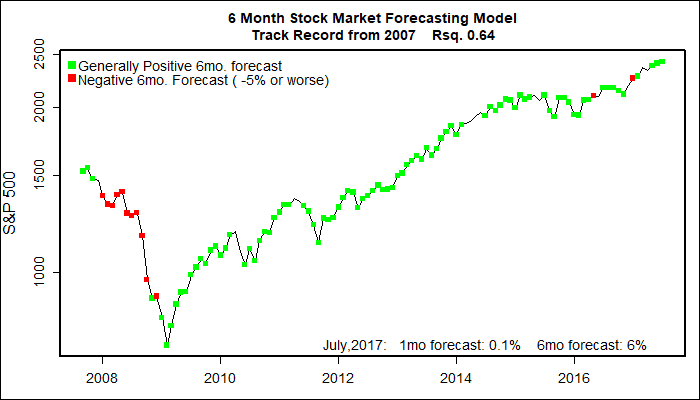
The forecasting models continue to predict a typical weak/flat stock market during the summer months followed by a good upturn in the fall.  The one month forecast is for a gain of just 0.1% for July and nearly a 6% gain following through the end of December.  The model gives the probability of at least breaking even over the period as slightly over 90% — decidedly better than average.

The stock market started off this year strong — much better than my models had predicted. More recently the actual and predicted market performance have been close.  The typical causes of a stock market crash seem to be taking the summer off.  Be grateful for small favors.

(Click on image to enlarge)

Stock Market Forecast June through November, 2017: Looking Better

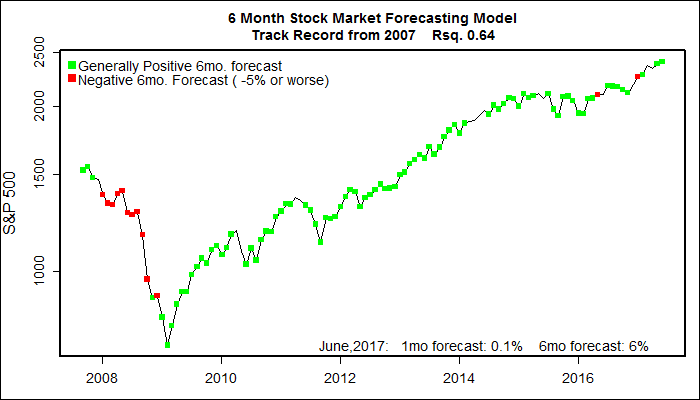
My 4 semi-independent six month stock market forecasting models are in general agreement.   The one-month forecast is for a negligible gain of just 0.1%.  Once the weather starts cooling, the outlook improves. The composite prediction is a gain of roughly 6% from June, 2017 through November, 2017.  That is better than the average gain of 4.8%.

The likelihood of at least breaking even over the next six months is around 90%.  Historically, stocks break even or rise about 70% of the time over all 6 month stretches since 1984.

My models still do not know how to read newspapers so they can’t account for any of the political foibles are are now playing out in Washington. Wish I was so lucky.

Have a nice summer.  It doesn’t look like anything really bad is on the horizon.

Stock Market Forecast May through October, 2017

The current six month stock market forecast for May through October, 2017 is nearly flat  — a sub-normal 1% gain over the coming half-year, and no gains during May.  The likelihood of the market at least breaking even over the next half year is 0.71, slightly less than average. Meh.

According to MarketWatch.com the Dow Jones Industrial Average has had record gains (14%) from the election through President Trump’s first 100 days in office — best returns for the start of a president’s first term since WWII.  My prediction models didn’t see that coming.

The models anticipated flat market performance for most of the past half-year.  So, either my models were just plain wrong, or more probably the stock market was propelled not by economic data, but by hope of wonderous Trump-promised gains in corporate profits.  The ‘Trump Bump, however, may have stalled — for the past two months the market has been flat.  I would not be surprised if the stock market stumbles if the hopes of huge profit gains vanish as Trump’s version of tax reform flounders in Congress.  Either way, the basic economic data does not presage a huge market move up or down.

Stock Market Forecast April through September, 2017: Start to worry

My U.S. stock market forecasting models expect a flat or weak stock market for the coming month and the next six months — not too surprising as the second half of the year tends to be weaker than the first half.  For April, the model expects a minuscule gain of 0.2%.  The next 6 months are projected to yield a loss of 1%.  The models are just a rough estimate of future results, so the current forecast is an expectation of little market change.

Forecasts from all of my semi-autonomous models have been declining for  several months.  If that continues, my forecasts and the market will get even weaker over the summer.  (Read below chart.)

The next graph shows, beginning in 2007, the actual 6 month return of the market (black) along with the projected return rates forecast by my models.  (I use the Value Line Arithmetic Average as my market index.) The red line is the composite projected by combining the forecasts of several of my models.  For the past several months the composite forecast and all the semi-independent forecasts have trended down.So far, there is no reason for alarm.

Stock Market Forecast March through August, 2017: Weaker

The six month stock market forecasts from my models range from a possible gain of 6% to a loss of -2%. The composite prediction is for a loss of roughly -1% with a probability of at least breaking even of 0.70, which is slightly below average.  Generally, the models do not see a basis for the sharp stock market gains since the election. The forecast for just March, however, is positive.

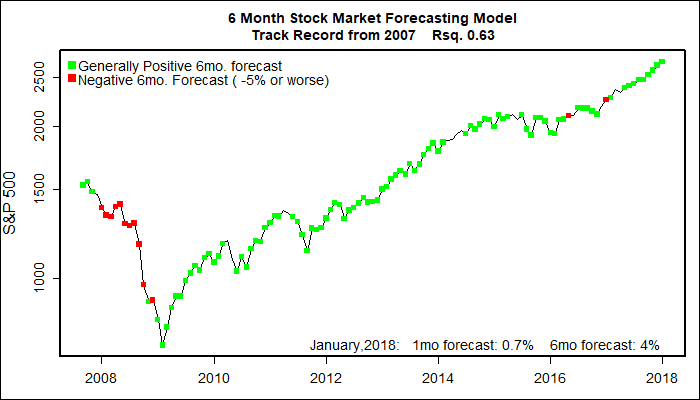
About the chart:  Each data point was an actual U.S. stock market forecast made in real time starting in 2007.  Red points were predictions that the market will fall -5% or more over the six months following the forecast.  Green points were positive or neutral market expectations for the coming six months.