Category Archives: Uncategorized

Exhuberance Meter?

Feel free to ignore this post. It does not include a new forecast and is horribly boring. Enjoy an eggnog instead.

We may be near a major turn in investor psychology.
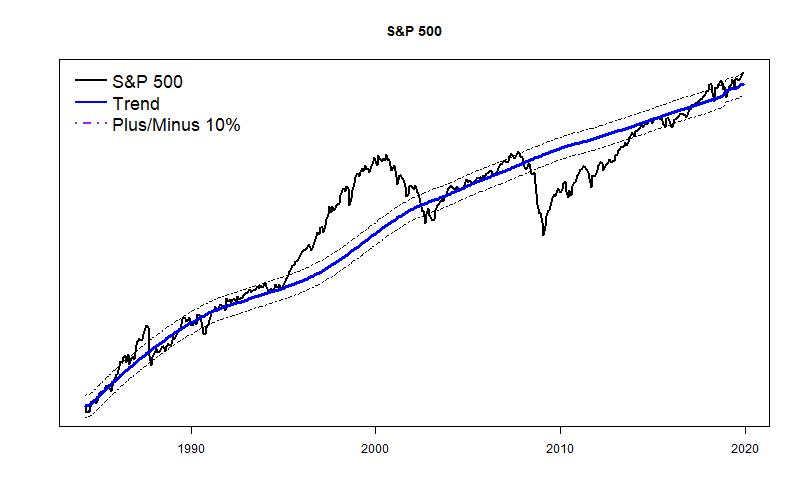
The S&P 500 average is currently about 10% above its very long term trend line.  The Value Line Arithmetic Average, my favorite market index, is roughly 10% below its own long term trend line. I have started plotting the divergence of these indexes, and it appears to show long term shifts in investor optimism.  I will start posting monthly updates of this graph of index divergence. Don’t hold your breath, but things might start to get interesting over the coming year.

What Divergence?
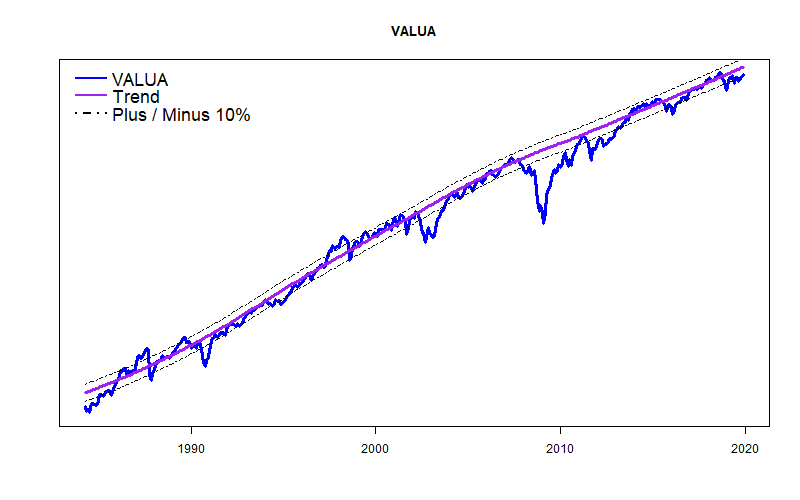
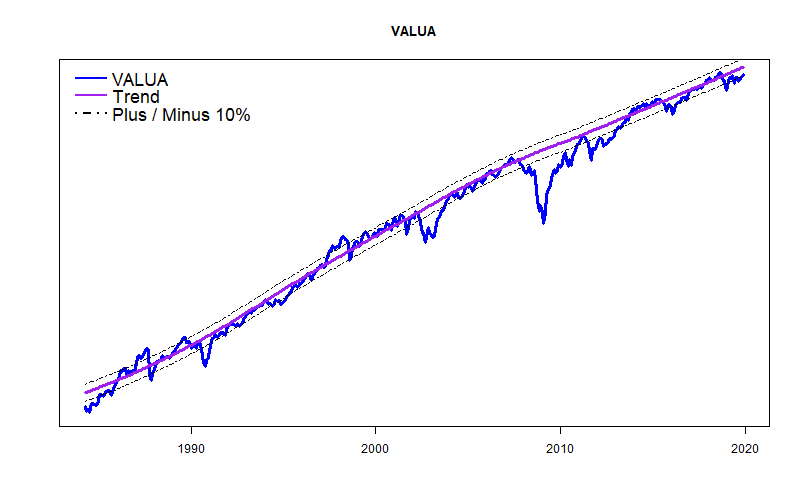
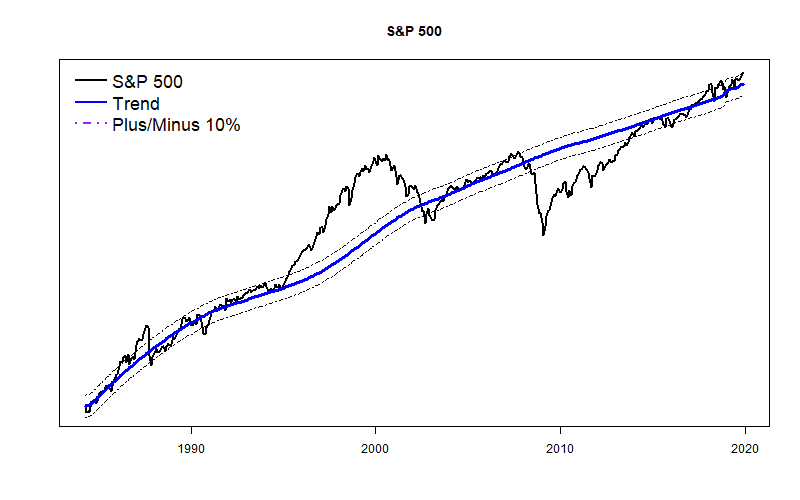
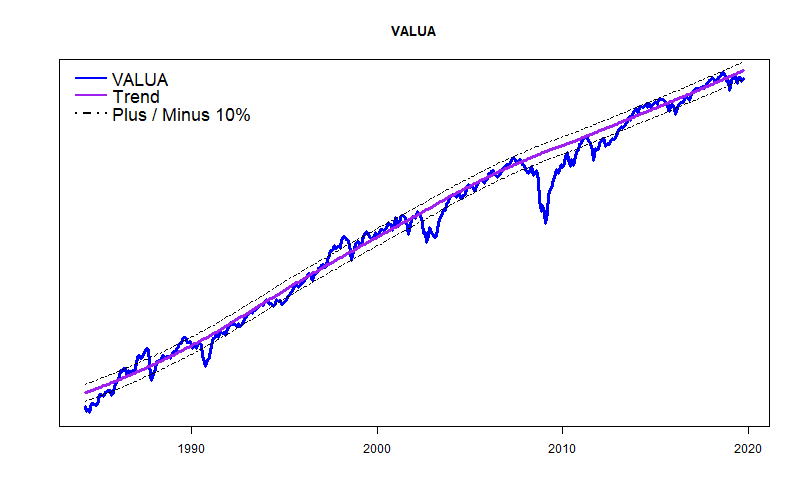
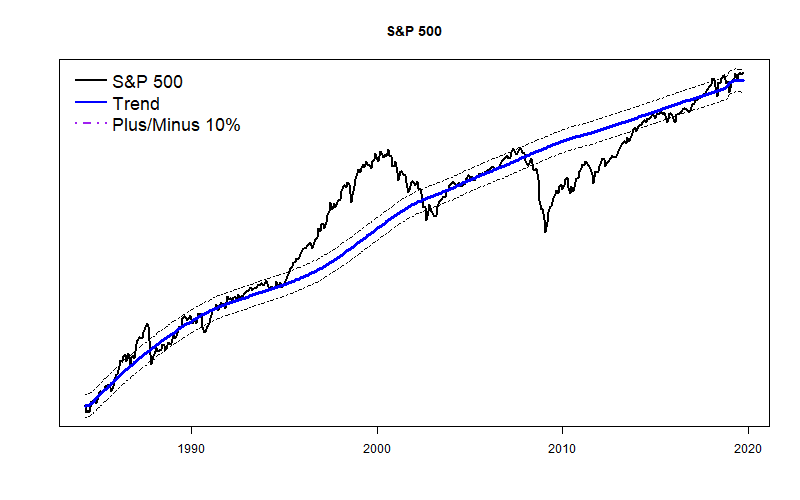
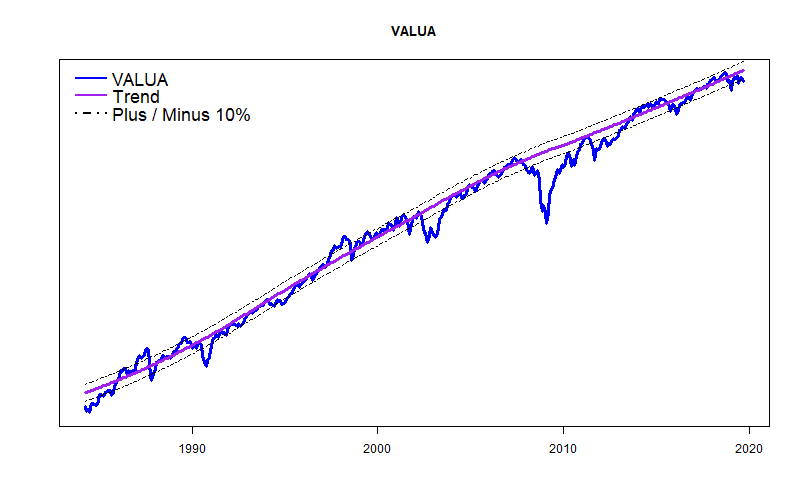
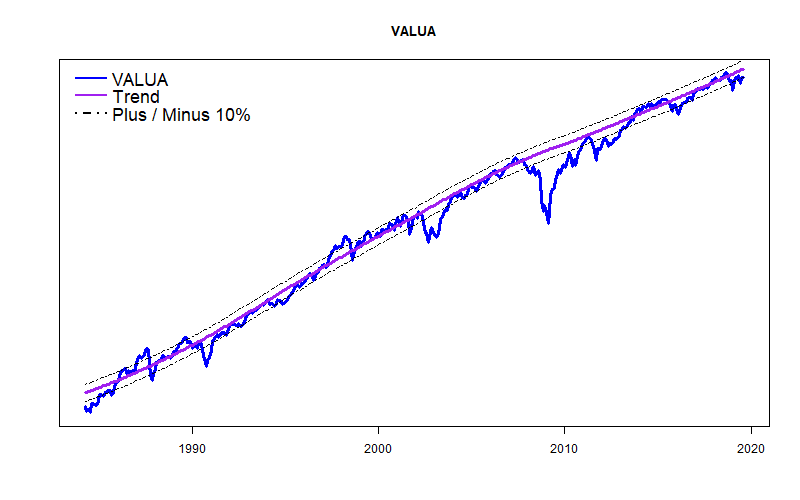
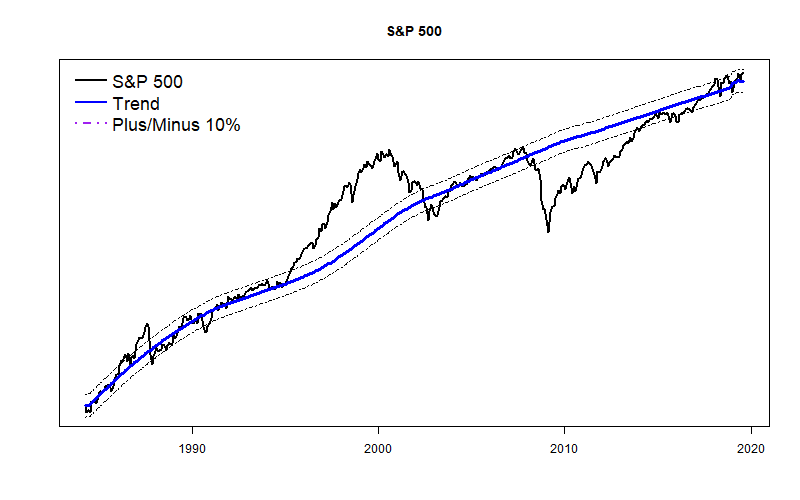
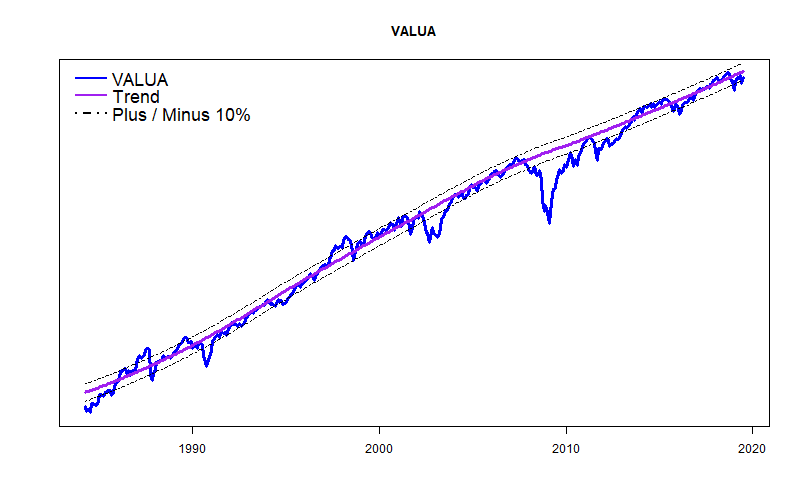
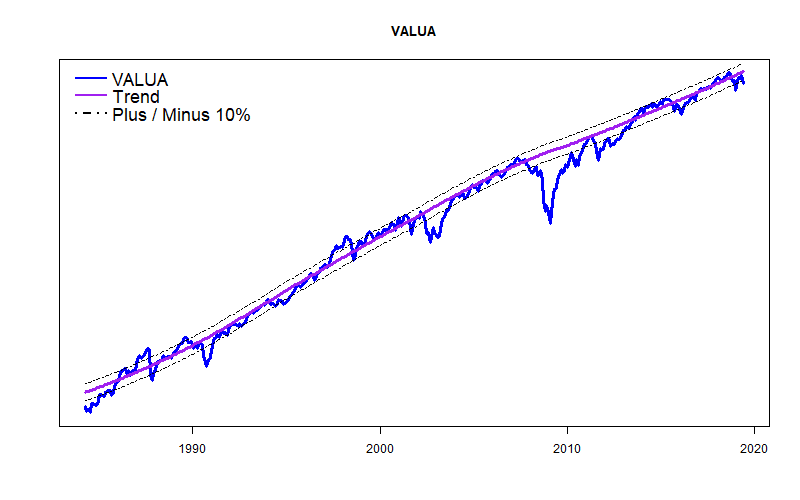
Nearly every month I post multiyear graphs of the S&P 500 and VALUA along with each of their long term trend lines.  The trend lines are described in detail under the tab “Long Term Model” at the top of the blog. For convenience, along with the actual long term trend I include dotted lines showing 10% above and below the trend line.

The market trend lines I calculate are not like the moving average trends you will see on most stock price graphs. As a quick overview, my trend lines are based on very long economic expectations: long term business growth, Real Potential GDP, and  smoothed interest rates on 10-year Treasury Bonds. Whatever the stock market has been doing over the past few years has nothing to do with where the trend line heads.  Except for when the stock market goes crazy, the actual VALUA values have stayed remarkably close to the long term trend expectations. The S&P 500 does not stay as close to its long term trend, and therein is the source of a divergence.

(Click on image to enlarge.)

(Click on image to enlarge.)

Generally speaking, nearly all stock market indexes go up and down together — hour-by-hour, day-by-day, and month-by-month. But…

Divergence may follow a pattern.
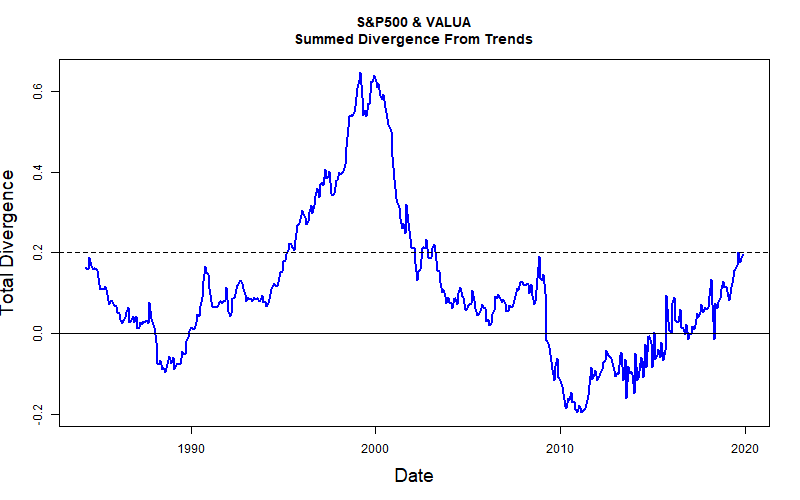
A remarkably steady multiyear shift occurs in the relative performance of the S&P 500 and VALUA.  The graph below shows the summed divergence of the S&P 500 and VALUA from their respective trend lines.  As I wrote above, the S&P 500 is now about 10% above its long term trend while VALUA is about 10% below its long term trend; these combine to a total 20% divergence.

(Click on image to enlarge.)

Here is how I view this 35 year graph.  Although there is plenty of seemingly-random variation month-by-month, there are also surprisingly steady long term trends going on over periods as long as a decade.  The big spike in the center of the graph is the story of the Dot-Com bubble.  From the mid-1990’s to 2000 the S&P 500 performed vastly better than VALUA. It was a truly incredible bubble!   The S&P 500 was flying way, way above its long term trend line. The broad market, as represented by VALUA really did not experience the full extent of the bubble. VALUA maxed at about 10% above trend.

By way of comparison, the period 2006-2009 leading up to the crash of the Great Recession did not show the same degree of stock market speculation as the Dot-Com fiasco.  All the crazy financial action took place in the world of real estate speculation, not the stock market. None the less, during the years leading up to the 2008 crash, the S&P 500 was performing better and better than the plodding VALUA. In 2008, the divergence peaked at about 20%.  (Just  like today’s level.) And then the market crashed.

At the pit of the crash, both the S&P 500 and VALUA were far below their long term trend lines, but the S&P 500 was in much worse shape.  It took about half a decade of recovery for the S&P 500 relative performance to match that of VALUA.

Today?
The  current 20% total divergence between the two indexes may or may not be near some sort of critical level. But, it is enough of a divergence to cause me to start to fret.

Based on all of the federal government stimulus (tax cuts, trillion dollar deficit, increasing money supply, low interest rates, FED bond buying), my best guess is that a stock market melt-up will continue to develop, causing the divergence to shoot up. The S&P 500 will probably far exceed VALUA gains. A melt-up of stock market prices would be well worth enjoying.

But, if divergence shoots up, we will have good reason to worry about a stock market crash happening sooner, rather than later. Maybe we can watch that setting up

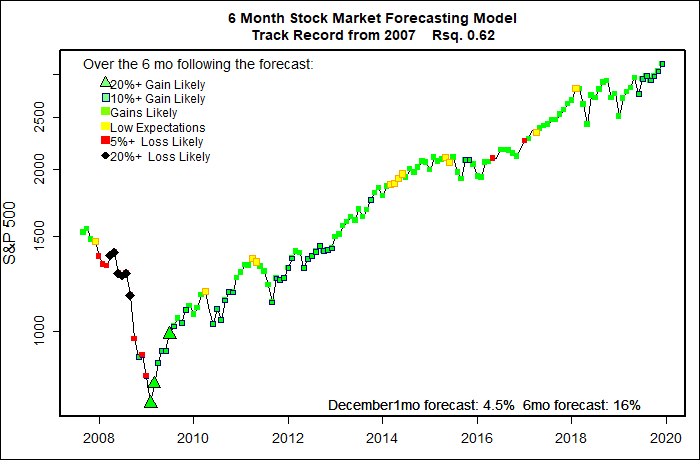
Stock Market Prediction December Thru May, 2020 – Strong

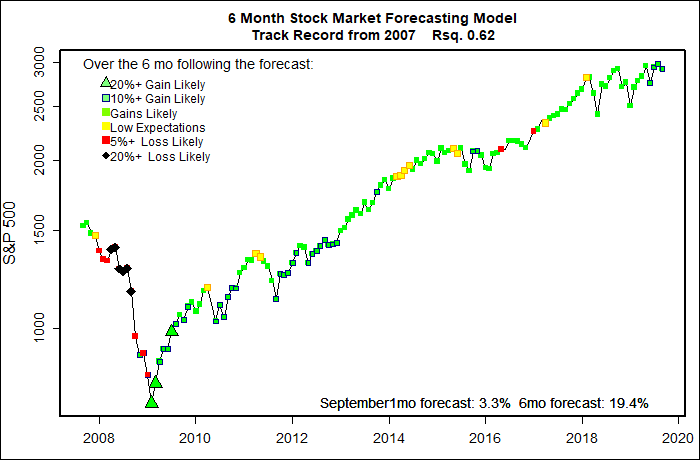
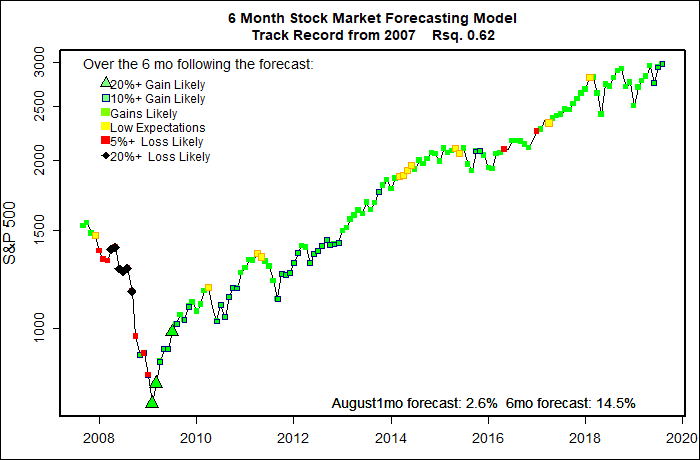
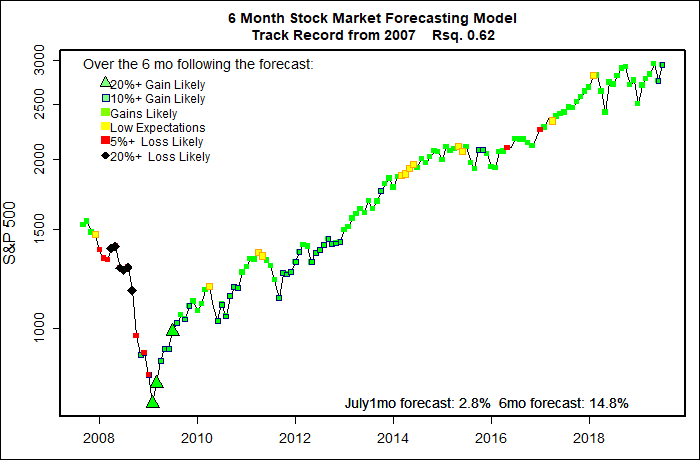
The statistical forecasting model says:
December, 2019:  +4.5% (Outstanding.)
Next 6 Months:  +16%  (Very high.)
Probability of at least breaking even: 96% – 99% (Excellent)
What am I doing? Fully invested since spring 2009.

The month-by-month string of positive forecasts coming from my computer models is getting boring, and it concerns me some.  The forecasts continue to be exceptionally positive; the market does go up; but the actual market increase is weaker than my forecasts.

The predictive models see that the federal government is injecting huge amounts of stimulus into the economy (low interest rates, corporate tax cuts, RAPIDLY increasing money supply, deregulation) but the stock market is responding less than typically would be expected given the amount of joy juice mixed into the punch bowl..

The situation is a bit complicated.  The mega-cap stocks of the S&P 500 are doing pretty well — they are performing roughly 10% better than their long term performance trend.  But, the less sexy stocks of the Value Line Arithmetic Average (the metric that my models are specifically designed to forecast) are dawdling along at roughly 10% below their long term trend line.  (Look for a mid-December post that will address this growing divergence between the S&P 500 and Value Line.)

(Click to enlarge.)

Long Term Trends
(See the “Long Term Model” tab above for a discussion of how the long term trend lines are created.)

For months the Value Line Arithmetic Average (VALUA) has been plugging along fairly steadily at about 10% below its long term trend line. That is not normally a big concern.  There appear to be plenty of instances in the past when average appears to “bounce” back up from that level. But, the few times when VALUA does not bounce — those have been major market crashes.

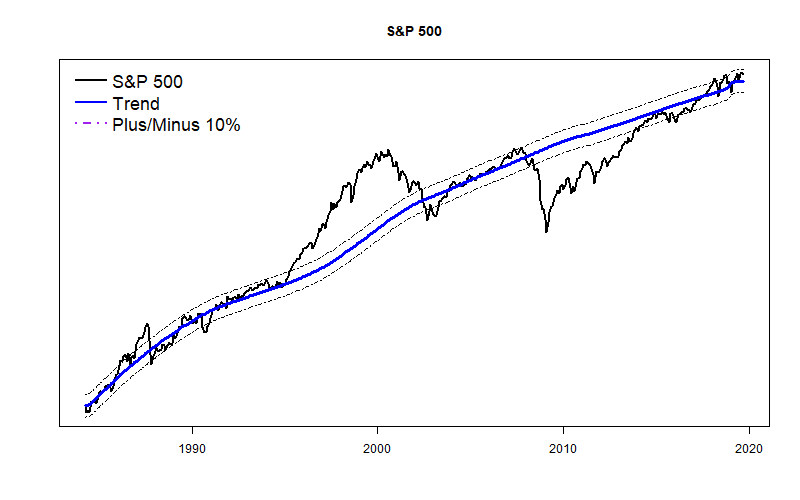
However, if you look at the performance of the S&P 500 compared to its long term trend line, the difference is clear:  unlike VALUA, the S&P 500 has been hugging a line at about 10% above its long term trend.

The total performance divergence between the S&P 500 and VALUA is now roughly 20%. Not an immediate cause for alarm.  But, if the divergence grows significantly, it will show that either: 1) the S&P 500 is moving into a blow-off market top, or 2) the market is heading into a major tailspin.
Don’t hold your breath, but this bears watching over the coming months.

Whatever happens, my money rests on following the predictive models. They remain highly positive.

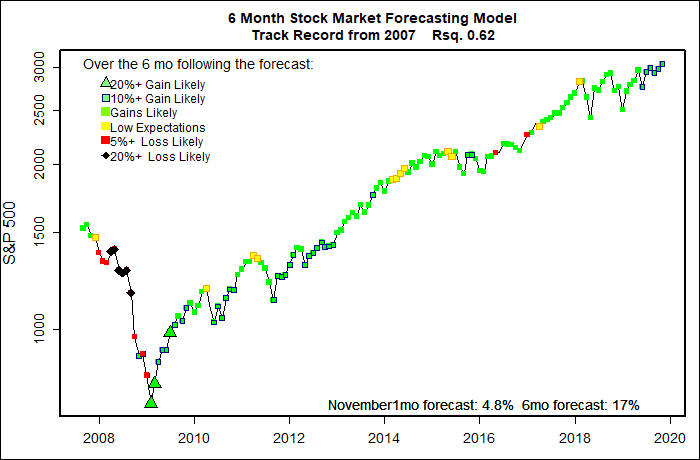
U.S. Stocks November thru April, 2020 Still Very Positive

The statistical forecasting model says:
November, 2019:  +4.8% (Outstanding.)
Next 6 Months:  +17%  (Very high again.)
Probability of at least breaking even: 96% – 98% (Excellent)
What am I doing? Fully invested since spring 2009.

Since mid-spring all flavors of these data-driven predictive models have been amazingly optimistic toward the U.S. stock market. The market had been down in late spring and rebounded since then, so the models were not wrong headed.   But, the market increase was not near as much as the models had forecast. So — what’s up?

First, I think the models are very aware that the Federal Reserve and the U.S. Treasury have turned financial stimulus up to near-full force using lowered interest rates, tremendous deficit spending, and a big injection of financial liquidity.  Interest rates were already low, but have declined further due to a string of 3 Federal Reserve rate cuts.. Deficit spending — dramatically upped by the Trump tax cuts — is at record rates — nearly a trillion dollars of deficit per year. That’s a significantly higher rate of financial stimulus than Congress permitted the Obama administration to dole out after the Great Recession that started under President Bush in 2007. Also thanks to the Fed, money supply expansion (MZM) has been turned up to a very high annual rate of 7.7%. 

These are the classic steps that Economics 101 would talk about for stimulating an economy.  Rather than sending the economy into inflationary overdrive, all of the stimulus has left inflation still remarkably low.  Economists of all stripes are scratching their balding scalps about this situation.  Why is inflation still so low? (Sorry, I don’t have a ready answer.)

The second reason for the market models’ optimism is that a recession is not clearly in sight.  It is normal for the Federal Reserve to start turning on the stimulus before a recession is formally logged, but usually there are clear signs of an imminent and serious downturn (like a stock market crash hitting). This time — not so much. Plenty of prognosticators are fretting about a coming recession, but so far they have been flat out wrong.

I use several sets of economic indicators, economic surveys, and business indicators to spot likely economic and business downturns.  So far, though, there are no serious warning signs. Two of my favorite indicators at the Federal Reserve Economic Data (FRED) site still show there to be a recession probability of just a few percent.

Taken together, heavy financial stimulus and the absence of an impending recession lead the models to remain highly optimistic about the stock market.

So why has the stock market lagged behind my rosy forecasts? I don’t have a solid answer, but here are some guesses. I think all the U.S. financial stimulus has not been as effective as normal because of several sorts of pervasive anxieties — trade war fears, good chances of Democrats soon reversing Trump-made changes, Brexit, continuing fears about the Middle East, etc. I personally fear that part of the reason behind low long term U.S. interest rates is that major amounts of foreign money has been fleeing to the relative safety of the United States. I feel there is a lot of fear out there, and it is not unfounded.

All of this will change, of course.  And most probably the change in the models forecasts will be sudden and dramatic.   Hopefully models will shout their warnings several months before the stock market decides to crash. Stay tuned.

(Click on image to enlarge.)

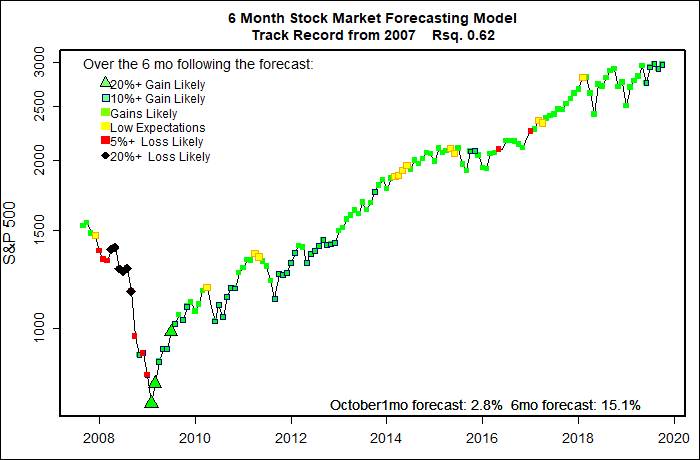
Stock Forecast October thru March, 2020 — Still Optimistic

The statistical forecasting model says:
October, 2019:  +2% (Outstanding, but one model now has doubts.)
Next 6 Months:  +15%  (Very high again.)
Probability of at least breaking even: 96% – 98% (Excellent)
What am I doing? Fully invested since spring 2009.

These probabilistic stock market forecasting models remain strongly positive, but for the past several months the market has significantly under-performed their expectations. 

Sadly, given stark and disparate fears among investors, I expect volatility to remain high — or increase — so I doubt that the models will be very accurate for the near future. Trump, Brexit, China trade, declining manufacturing, interest rate inversion — there are plenty of quite scary possibilities out there to worry stock holders.  No one really likes it, but volatility remains a good thing for the market.

Why do my models remain optimistic?  I use several leading indicators for recessions — in general they do not see a recession coming very soon.  I have several measures of financial market panic — they are not even twitching.  Market deviation from long term trends — nope, stock markets in the U.S. are following their normal long term paths.  Federal action to quiet the economy — with high deficit spending, increasing money supply, and declining interest rates the government at several levels is stimulating the economy.

Eventually things will turn bad. Sooner or later there will always be a re-balancing. But, my models do not think it will happen soon.

Long Term Trend Lines
Both the Value Line Arithmetic Average (smaller companies count as much as the giants) and the S&P 500 (emphasizing huge companies) are within their general long term channels.  The S&P 500 continues to be on the high side and the Value Line clings to the bottom of its normal range.  No big clues to future market performance.

Stocks September thru February, 2020 — Models Stay Strongly Positive

The statistical forecasting model says:
September, 2019:  +3% (Outstanding.)
Next 6 Months:  +19%  (Very high!)
Probability of at least breaking even: 96% – 99% (Excellent)
What am I doing? Fully invested since spring 2009.

How low can interest rates go? And stay low for how long?  Those are the big questions for the economy and the stock market.  I wish I had an answer, but I don’t.  Further declines in interest rates could spark a spectacular stock market rise, while rate increases could bring on the next big recession.  It feels to me like we are balanced on a knife edge.

My gut emotions about the stock market have a long and solid track record of being flat out wrong. Time and time again I misjudge the situation.  For example, I have been scared stiff for well over a year about buying long term bonds. I was sure that interest rates would have to rise sooner or later and that would send the value of long term bonds crashing.  But, so far this year long term bond funds are up about 25%.  Much better than the stock market! 

My lousy gut-level forecasts are why I built my stock market forecasting models over a decade ago. The models combine the most probable impacts of about a dozen economic / business / investor-emotion variables and arrive at statistical forecasts of what is most likely to happen next.  The effects of every factor I use have proven statistical validity since at least 1984. Most of them have been tracked since at least the 1960’s. Together they form a group of similar models that forecast what the stock market is most likely to do next.

The current contrast between my gut reaction to the market and my models is black and white!  My gut worries, but the models remain wildly positive about the path of stocks for the next half year. 

One thing I use to comfort myself is my faith that volatility is actually good for the stock market. Volatility makes it unlikely that the market will settle into a complacent trend that will take it far off the track that the economy would justify.  Given the reality show President we have, high market volatility is near certain.  Unpleasant as market volatility can be, it is probably a good thing for now.

(Click to enlarge image.)

Long Term Trend

The S&P 500 trend is well within its normal trend zone.  But, the much more predictable Value Line Arithmetic Average is right at the lower boundary — 10% below its many decade trend.  Good reason to be concerned.

(Click to enlarge image.)
(Click to enlarge image)


High Frequency Trading

This blog and my forecasting models have nothing to do with high frequency trading.  This short post explains the situation.

A major theorem of the mathematical field of statistics says that high speed or high frequency trading can be profitable — at least in theory.

The Central Limit Theorem is a cornerstone of conventional statistics. If you take a sample of some sort of group, say, the height of third grade students in a particular school,  you tend to get survey results that look something like a bell curve.  The heights of the kids will vary from tall to short, but most of their heights will tend to fall somewhere near the middle.  The Central Limit Theorem doesn’t say anything about how that initial survey comes out.  (Maybe the third grade class you sampled is made up of kiddie basketball recruits mixed with tiny gymnasts.)

But, the Central Limit Theorem says if you run multiple samples of the same population, the median of those samples will form a very tight normal distribution (bell curve).  The variance, the total difference (squared) of things from the true average) should be much less for all the surveys taken together than for just a single survey.

In the context of high frequency trading this means that if you make a zillion trades, you can bet against trades that are being made by other people far from the current strike price. If someone is willing to make a statistically unusual (i.e. ‘stupid’) trade you can make money by betting against them.  Make enough of these trades and you should be able to make money.  This is what ‘algorithmic trading’ is all about.  It should work.

But.

High Frequency Trading  Only Works Until it Doesn’t
Long Term Capital Management was a firm that practiced highly leveraged,  high frequency probabilistic trading from 1993 to 1998.  It attracted roughly $120 billion in capital and was wildly successful.  In 1998 LTCM was betting in a very big way on a rebound in the falling Russian currency. But, suddenly Russia defaulted on its government debt. LTCM went bankrupt nearly instantly, and quickly the world economy was on the brink of economic collapse. Algorithmic trading works until it doesn’t work.

Low Hanging Fruit Was Eaten Years Ago
High frequency trading has been around for years. It is no big secret anymore. I attended a graduate seminar on it nearly a decade ago.

What has happened is that over time the opportunity for new players to profit has shrunk.  In the early stages ‘high frequency’ would mean trading with a gap of a few seconds.  Even a decade ago the frequency of trade response had shrunk to the range of nanoseconds.  Players fought to get their trading servers as near as possible to the stock market exchange computers.

An individual investor swimming in the pond of high frequency trading is like a minnow swimming with a school of sharks.

Long Term Model

In Brief: 
This long term stock market model compares the current level of the U.S. stock market against its very long term trend.  The market has followed an exponential growth trend closely most of the time since at least 1871.  When it wandered off course in the past, things did not end well.

The model relies on 5 key elements:

  • Long term exponential growth history of the S&P 500 (adjusted) going back to 1871,
  • Factoring out major booms and busts when the market deviates wildly from its long term track. 
  • Congressional Budget Office  (CBO) Real Potential Gross Domestic Product model using GDP data back to 1949
  • 10-year Treasury bond interest rates
  • Contrast the S&P 500 with a market index that is calculated on an equal-weight basis, making it less influenced by financial speculation.

The model’s aim is simply to point out if stock market indexes are grossly distorted and are ripe for a major correction. The model does not say ‘when’ a correction will occur; that’s the purpose of my 6-month stock market model. But, the long term stock market model will tend to give a solid indication of the direction of the next major market move and some guidance on the likely magnitude of a coming correction.

From the Beginning
With a bit of distortion, the stock market reflects the economy, and from the dawn of civilization the world economy has been growing — not at a steady rate, but at an increasing rate.  The chart below from Wikipedia.org shows per capita GDP growth since 1500.  Data is available elsewhere showing that growth has been increasingly-increasing for the past half million years! More people, more accumulated capital and capacity, and advancing technology (very broadly defined) are the reason for this amazing growth.  It has been far from steady (e.g. the Black Plague, World Wars) but growth has been relentless.  The rest of this blog post shows that the same basic exponenetial-exponential growth rate is still intact.

(Credit: By Qwfp – Own work, CC BY-SA 3.0, https://commons.wikimedia.org/w/index.php?curid=7122503)

Increasingly Increasing Growth Since 1871
The Standard & Poor’s 500 Index is probably the most widely recognized index for U.S. stocks. It began as the Standard & Poor’s Composite Index in 1923 and assumed its present form in 1957.  Data is available, however, going back to 1871 that is based on the principles used to calculate the index.

Running a statistical regression analysis shows that the S&P 500 Index has grown at a fairly constant rate for that century-and-a-half period — despite booms, busts, wars, countless leaps in technology, a developing world, and innumerable changes in government, from when the U.S. had 13 fewer states and the “talking telegraph” (telephone) was invented.  It was not a random process. We know that too many factors to count do, indeed, impact the stock market day by day, week by week, and even decade by decade.  None the less, a simple, fairly steady growth curve describes roughly 150 years of stock market history remarkably well.  In the long run the stock market isn’t so crazy after all. Thank the Law of Large Numbers for that.

Stock market growth has not been perfectly constant.  Instead, the rate of growth of the S&P 500 has been slowly increasing.  Growth of the Index over time has been “increasingly increasing”.

Inflation has also been a factor in the increasing level of the S&P 500.  But, it is not entirely clear exactly how inflation should be factored into the equation. The erosion of the value of the dollar has been far from constant, and there also can be fair disagreements over how inflation gets measured, (For example, a very significant aspect of our recent low inflation has been the radical continuing decline in the price of personal electronics.  Does a faster cell phone actually decrease your real cost of living? Or do you just have a faster cell phone out of the deal?)  One way or another, though, continuing inflation is part of the picture of the increasingly increasing level of the S&P 500.

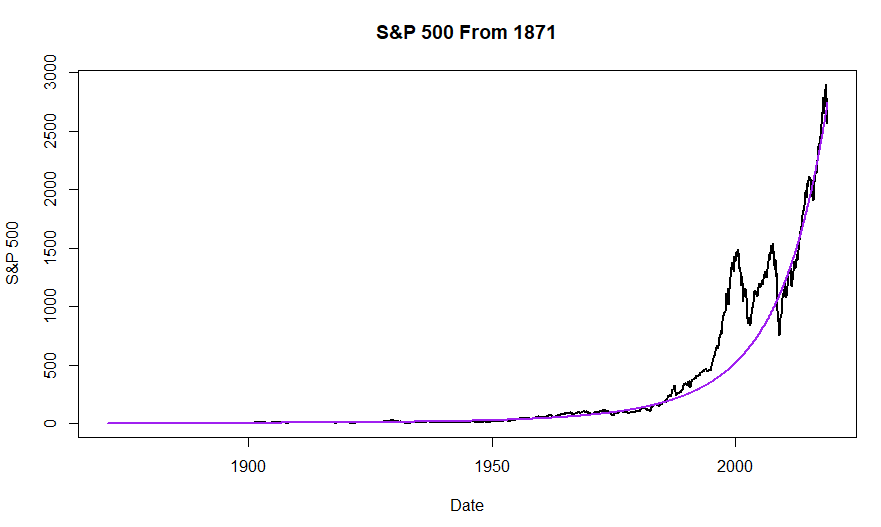
The graph below shows the best fit of an exponential-exponential trend line with the S&P 500 Index.. The correlation between the S&P 500 and the simple steady growth path is 0.95 — where a correlation of 1.0 would be a perfect match and 0 would be no match at all.  At first glance it looks like the trend curve and the actual Index match incredibly well except for two glaring divergences which turn out to be the Dot Com Bubble and the Great Recession.  That is very far from the truth.  The curve fit in earlier years was not as smooth as it looks and the recent divergences were not as bad as they look in this graph. Next, let’s see why.

(Click on image to enlarge.)


Percentage Growth is What Matters
The graph below also shows the path of the S&P 500 Index since 1871 with the same exponential trend. It is the same data as the previous graph, but the vertical axis plots the logarithm of the Index value.  Each vertical unit is a given percentage change in the Index, not a linear increase.  If the market grew at a constant percentage rate the resultant plot would be a straight line.  Since the actual plot curves up smoothly, it means the rate of growth has been slowly and somewhat-steadily increasing.

Focusing on percentage market shifts is essential. It becomes clear that the early years of the S&P 500 were nowhere near as smooth as they appear in the first graph.  For example, through the Dot Com crash, on a month by month basis the S&P 500 dropped roughly 650 points, a gut-wrenching collapse of over 40%.  In contrast, the Great Crash of 1929 amounted to only about a 25 point fall in the S&P 500 — but that amounted to an incredible drop of over 80%! This log-based plot shows how the Great Depression severely held back the stock market for over a decade.  Our more recent Great Recession was a minor blip in comparison. Overall, the Index recently was no more erratic than long ago.

(Click on image to enlarge.)
Sometimes Things Do Go Crazy

From the graph above — and my experienced reality — I take a general view that for, say, 75% of the time the stock market behaves normally. (Literally, its relative value and frequent variations tend to follow a statistical normal distribution very closely with large deviations happening every once in a while.) Investing bubbles and market busts, bull and bear markets are extremes /aberrations from normal market growth.

Through history most investors have not been able to spot the top of large developing market bubbles — they always expect “Greater Fools” to keep coming along. Most people did not see either the Great Crash of 1929 or the Dot Com Bubble coming.  The usual cry is “This time it’s different”  Probably not next time either. Probably.

So, in building a long term trend model let’s drop out what the market has been doing for the past few years. With certainty we can  identify past bubbles and busts.  So, as a definition, in my long term model, bubbles are times in the past when the market was way above the long term trend, and implosions were when the market was way below trend.  This is a major simplification of a lot of complexities in the market and the economy.  But, it turns out to be a very useful simplification.

The chart below shows the long term growth of the S&P 500 Index after elimination of the most egregious periods when the actual market value diverged from the first approximation of the long term trend. Most of the deletions were related to the Great Crash of 1929 and the Great Depression,  I could have gone a bit further in my data pruning and the Dot Com Bubble and Great Recession scars would have disappeared as well.  But, with just limited data scrubbing the correlation with smooth exponential goes up to 0.98 (again, 1.0 would be a perfect score.)

In all the analysis that follows, I’ll continue to drop out the largest market crises in order to better define the normal growth of the stock market.

 Market Growth from 1949

The Great Depression and World War II spurred incredible increases in the range and quality of economic data collected.  Later, computers made it possible to amass a tremendous volume and range of data and to develop sophisticated economic models. To get a more accurate long term model of the stock market we need to bring in additional information content that is only available from 1949 on.

I have a second motivation here beyond just increasing precision.  As shown above, we can show that with really surprising accuracy the U.S. stock market has followed an exponential-exponential growth trend. Also, because the U.S. economy is a massive behemoth, we can be pretty sure that the long term trend — even if it shifts — won’t shift all that much in the next few years.  But, several current economic factors could make the near term trend vary more than usual.  By pulling in the next data stream I can bring to bear another model of long term exponential economic growth that effectively reflects the combined efforts of some of the world’s top economists for the past few decades. By no coincidence, at its core this other model also focuses on exponential-exponential growth.

Real Potential GDP The Congressional Budget Office (CBO) is a highly respected, objective and non partisan arm of the U.S. Congress established in 1974. Both political parties and nearly every powerful vested interest group would like to bend the  CBO analysis to fit their agenda. That intense and highly bankrolled attention from all sides keeps the CBO model objective.  The stakes are very high in this game!

 Each year the office issues forecasts of government expenses and revenue along with anticipated 10-year impacts of proposed legislation — but, by its basic rules CBO does not make policy recommendations.

A central part of CBO analysis is a highly detailed  sector-by-sector computer model of the workings of the U.S. economy. The details of the CBO model are public, and are subject of extensive outside review.  The model is described  in 55 pages here.  CBO staff make minor adjustments to the model every few years.  Because of its pedigree, this model probably has more impact on the views of financial analysts than any other.  (Any Econ PhD student, professor or quant lobbyist would find fame and fortune if they could identify a flaw in the model or even just give the model a tweak.)

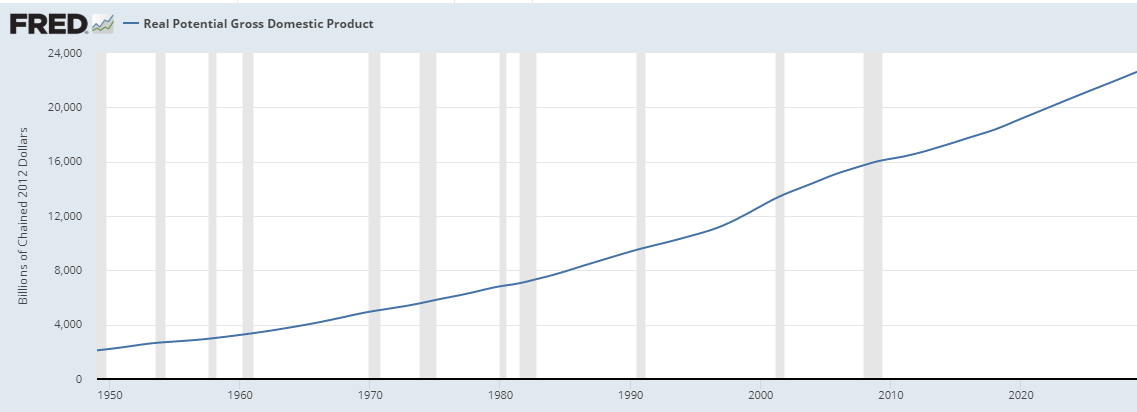
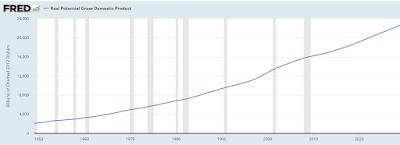
The CBO Real Potential GDP model closely matches the historical path of actual GDP (adjusted for inflation).  But, for the purposes of my long term stock market model, it does not matter much if the CBO model is accurate — it is a major cornerstone of what economists and financial analysts believe to be valid.  And, with the stock market “belief” trumps “accuracy” always. CBO Real Potential GDP data — projected 10 years into the future — is available from the Federal Reserve Economic Data (FRED) site here.

U.S. Gross Domestic Product data has only been available since 1949. That is the starting point for the CBO Real Potential GDP estimates as well. It is important to emphasize that the CBO model is focused on how the U.S. economy should perform at a sustainable pace at low unemployment. Also, the model addresses what economists call ” real” GDP — the confusing impacts of inflation are factored out.

There is a small difficulty here, however.  The CBO Real Potential GDP model addresses the U.S. economy, not the U.S. stock market.  They are far from being the same thing.

The S&P 500 Index grows faster than the U.S. economy. First, since 1949 the relative share of GDP attributable to major industry has increased. More and more we live in a world of gigantic corporations rather than small businesses. Second, the mega corporations that comprise the S&P 500 have become increasingly international in scope. In a continuing process of globalization, growth of S&P companies is not limited by the U.S. economy anymore. Third, over the second half of this period, to reduce shareholder tax burdens, corporations have shifting away from issuing dividends toward seeking faster growth and  using stock buybacks to increase stock prices.  Fourth, since the early ’80’s the rise of index-based funds, 401k – type retirement investment, no-load funds and ETF’s,  and online trading have drawn a disproportionate amount of investing directly to the S&P 500 and its component companies.  Fifth, the CBO model is of inflation-adjusted “real” , GDP, not actual raw GDP. To my mind, at least, there is an open question of which sorts of price inflation (commodity, food price, rents, entertainment, etc.) best relate GDP and stock market prices. Each of these 5 factors cause the S&P 500 Index, in particular, to grow at a different rate than the general economy.  For these reasons the long term model also includes an empirical exponential adjustment factor to better link the CBO Real Potential GDP and S&P 500 growth rates. (Yes, “empirical adjustment factor” is a contrivance or ‘kludge’ to force a better fit, but I think it is legitimate here.)
(Click on image to enlarge.)

10-Year Treasury Bond Rates Interest rates have a profound effect on the stock market. At the most simple level, it is relatively easy to start a profitable business if  your dad gives you many millions of dollars, or even if you borrow your start up money at 2% .  But, it would be near impossible to start a business if you can only borrow money at a 40% rate!

Another take on interest rates comes from seeing that owning stocks is an alternative to owning commercial or government bonds, or holding property such as real estate.  Changing interest rates makes some investments more attractive than others — spurring massive capital flows from one kind of investment to another.  Capital can flow fast, but the relative prices of alternative investments will shift even faster.

Additionally, changing interest rates also have a huge direct effect on business profitability, the business cycle, and recessions. More expensive borrowing directly reduces profits for most businesses. Large increases to interest rates can suddenly shut down the financial system and make previously successful businesses go bankrupt.

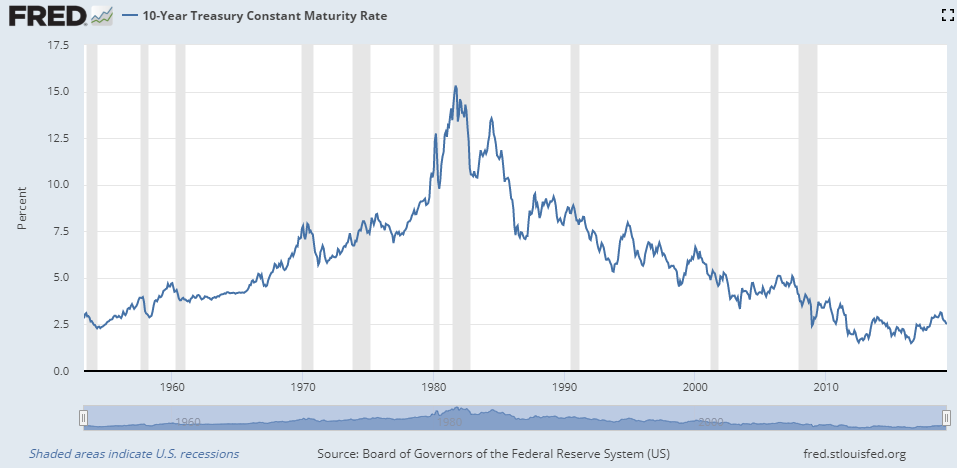
Take a bit of time to enlarge the graph of long term interest rates below. Notice that before most periods of recession interest rates rose sharply and significantly — that is the Federal Reserve “taking away the punch bowl just as the party is getting started”. Large and fast increases in long term interest rates bring on recessions.  And stock markets tend to crash well before a recession actually begins and often more than a year before a recession is officially announced..

Also, in the period from 1949 to the present there has been a major secular (long term) pattern to interest rates.  Over the course of decades long term interest rates increased, culminating in explosive rate increases from roughly 1970 to 1981.  The trend then reversed with a continuing decline in interest rates until recently.  This prolonged change has had a huge effect on the stock market.  Steadily rising interest rates put a damper on the stock market for decades. Market pundits called this slow growth period “stagflation” — stagnant economic growth coupled with high inflation.  Then Federal Reserve policy reversed. Interest rates fairly consistently fell and the stock market reaped wonderful gains that were well above the long term average.

That three decade run of good luck caused by declining long term interest rates is over.

Long term interest rate shifts are especially relevant now — in future years interest rates have little room to drop — they can only stay roughly level or go up. The past decade or so of historically low interest rates, besides making businesses more profitable, also led businesses to borrow huge amounts of capital in order to buy back shares of their own stock thereby directly increasing their per-share market price.   Further, the residential housing market — a major factor in the economy and family wealth –became based on very low long term interest rates.  For homeowners an increase of just a couple percent could lead to a mortgage payment increase of easily 20% to 60%.  That would shut down the housing and construction markets and cripple all the businesses that flourish when people move and change houses. When interest rates go up in the next round of increases the negative economic tidal waves may be huge..

The wonderful tail wind of gradually reducing interest rates benefited both the stock market and long term bond investors since 1981.  But, that tail wind is gone. The outlook for the next decade of stock ownership is much less rosy than the last few decades. Interest rates are a major key to what happens.

(Click on image to enlarge.)

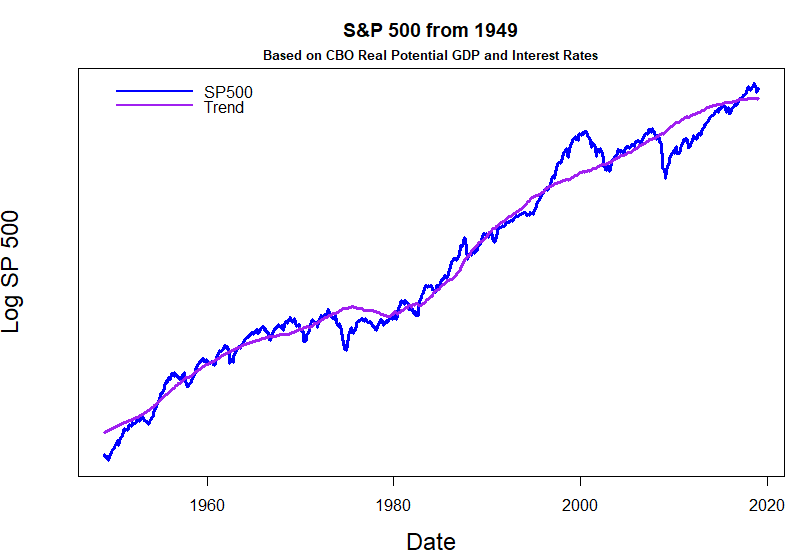
The next graph shows the S&P 500 since 1949 along with a modified trend line.  The modified line factors in long term exponential growth, CBO Real Potential GDP, smoothed 10-year Treasury rates, and a factor to reconcile the difference between GDP and stock market growth rates.

With the addition of Real Potential GDP and interest rates elements, trend correlation goes up to 0.995 if we ignore the excesses of the Dot Com Bubble and the Great Recession. But, if we include all data points, the correlation is still 0.98.

(Click on image to enlarge.)


Consider a Different Kind of Stock Market Index
Look at this next part as a way to gauge market speculation levels.

Though the S&P 500 Index is the most widely followed stock market average, it is not the only game in town.

As discussed earlier, the very popularity of the S&P 500 makes it subject to stock market speculation. Vast quantities of index funds and exchange traded funds based on the index mean that incredible trading volumes and dramatic price swings can occur in a flash.

The basic approach by which the value of the S&P 500 is calculated further makes it prone to speculative bubbles and sudden crashes.  The Index is based on 500 of the nation’s largest corporations that collectively amount for roughly 80% of total market capitalization. That’s good. But…

The Index is calculated based on the total capitalization of each company (number of shares times the current share price).  Those huge corporations are not weighted equally.  As this is written, Microsoft Corporation has a weight of 4.11 and Mattel Inc. has a weight of slightly under 0.016.  So, Microsoft is over 250 times more important than Mattel.

A net result is that a relatively small number of truly gigantic companies, generally with astronomical Price/Earnings ratios, dominate the S&P 500 calculation.  They don’t have to be profitable, just highly capitalized. During a market bubble a small number of companies can become the subject of massive speculation and rapidly rise within the Index, pushing down companies that are less in favor.  Once it was the Dot Com companies.  Now it is the FAANG companies like Facebook, Amazon, and Apple. Speculative greed can turn in a heartbeat to a panicked stock market crash.

I prefer to follow a major market index, the Value Line Arithmetic Average (VALUA) that includes roughly three times as many companies as the S&P 500, but weighs each of them equally. In VALUA both Microsoft and Mattel count the same — as do many companies you may never have even heard of.  VALUA is not currently available as an exchange traded fund.  An equal weight fund based on the S&P 500 companies is available with the ticker symbol RSP.

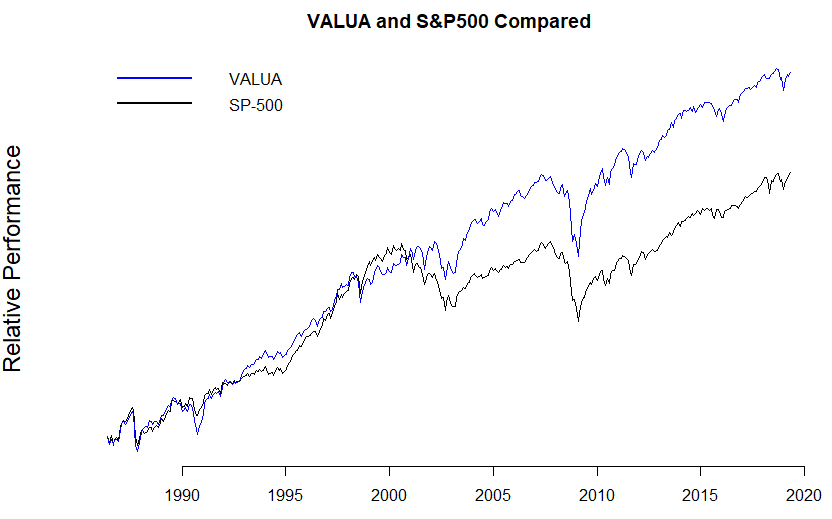
The plot below shows both VALUA and the S&P 500 Index from 1984 to the present. VALUA has performed significantly better than the S&P 500.  But, they both experience major market disruptions at about the same time.

Bringing It All Together
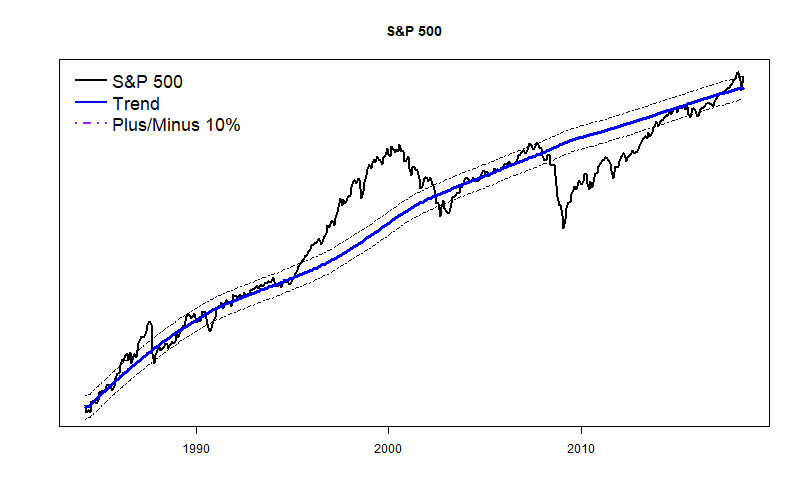
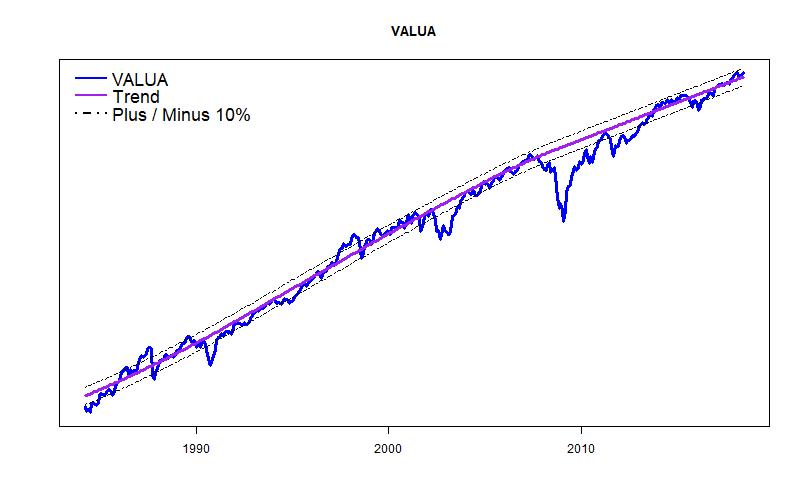
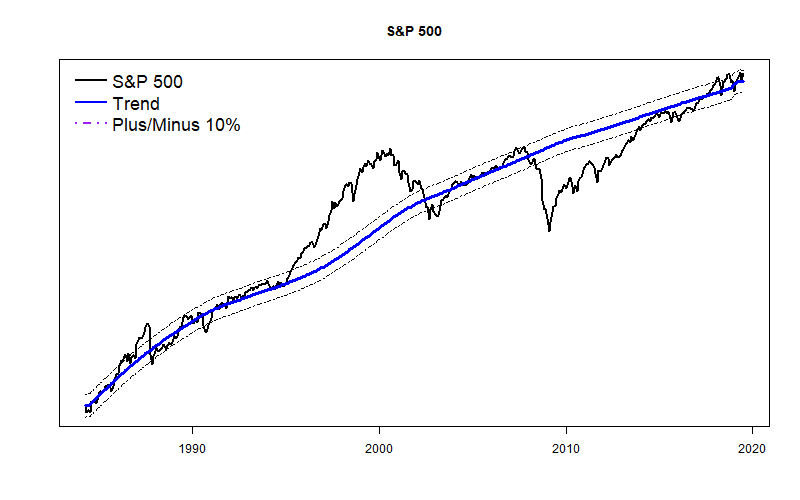
Finally, the two graphs below show the long term trends of VALUA and the S&P 500 since 1984.  Both are based on long term exponential-exponential growth, CBO Real Potential GDP and 10-year Treasury bond interest rates.  Both show bands that indicate 10% above and 10% below the respective trend lines.  I will be showing these graphs in most of my future blog posts. The relative strength of each compared to their long term trend lines should prove to be interesting.

(Graphs shown here are as of May, 2019)

(Click on image to enlarge.)

(Click on image to enlarge.)

And what, after all of this explanation do these charts say? First, both indexes are fairly close their very long term trend lines. That is comforting. Second, both indexes are somewhat above their long term trend lines.

So?

The stock market is a little high, but does not appear to be going really crazy now.  The long term odds, of course, favor “regression to the mean” — a small correction.
Stock Prediction August thru January, 2020 — Still Excellent

The statistical forecasting model says:
August, 2019:  +2.6% (Outstanding.)
Next 6 Months:  +14%  (Very high!)
Probability of at least breaking even: 96% – 98% (Excellent)
What am I doing? Fully invested since spring 2009.

My rosy forecasts are getting horribly boring, but this is what my econometric forecasting models are spitting out.

These stock market prediction models remain highly positive.  As long as the Federal Reserve continues to keep filling up the punch bowl of intoxicating low interest rates the story probably will not change.  The U.S. economy is an incredibly large and powerful juggernaut that just keeps chugging along — despite the current irresponsible administration. 

Hey, no one really wants to be the grownup in the place who will advocate fiscal responsibility.

When the stock market and the U.S. economy eventually crash down, hopefully these models will give us some warning. But, for right now the models — several of them in fact — see the party continuing.


(Click on image to enlarge.)

And, overall the stock market remains in its long term growth trend.  More speculative high flyers are doing better than the meat and potatoes stocks that make up most of the U.S. economy. Maybe the S&P 500 is going in to a little bubble? Or maybe not.


(Click on image to enlarge.)


(Click on image to enlarge.)


Stocks July thru December, 2019 : Still Very Positive

The statistical forecasting model says:
July, 2019:  +2.8% (Outstanding.)
Next 6 Months:  +15%  (Very high!)
Probability of at least breaking even: 97% – 98% (Excellent)
What am I doing? Fully invested since spring 2009.

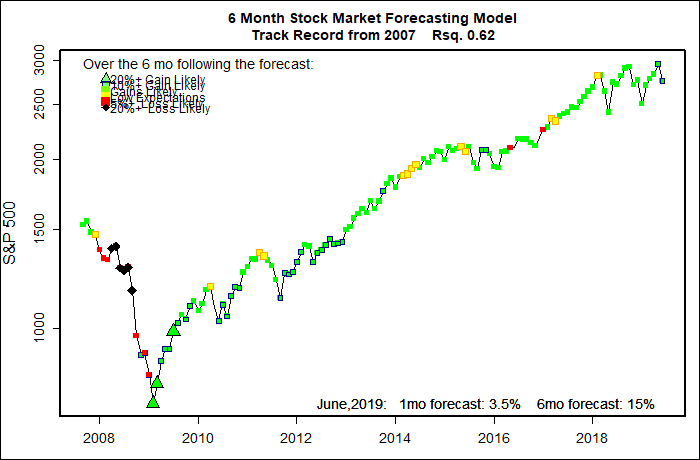
Last month the model was extremely positive, but I was dubious.  Once again, the model was more nearly right than I.  No surprise there. The model expected a one month gain of 3.5%, but the S&P 500 actually rose over 6%!  Best June in decades.

The model (actually, several flavors that each view data a bit differently) remains highly positive, seeing little chance that the stock market will fall during the second half of the year. That, of course, doesn’t mean that the market cannot possibly crash.  It just means that if the market does what it typically does in response to a number of economic variables, then it will do just fine. Fortunately, the market usually does what it usually does.


(Click on image to enlarge.)


Long Term Trend Lines
Not much news here.  Both the S&P 500 and the Value Line Arithmetic Average are within their normal envelopes. As a minor corroboration, the Morningstar Fair Value Graph , a favorite of mine, says the overall market is about 3% undervalued.

These are quite boring graphs, but hopefully they illustrate that the stock market is not in the middle of any wild and crazy bubble. It is just following the same basic trend it has followed for decade after decade.  The one worry is that these trend lines take account of prevailing interest rates. If interest rates shoot up, stocks will certainly tumble down. That does not appear likely for months at least.

(Click on image to enlarge.)


(Click on image to enlarge.)


Stocks June thru November, 2019: Really Great?

The statistical forecasting model says:
June, 2019:  +3.5% (Outstanding.)
Next 6 Months:  +15%  (Very high!)
Probability of at least breaking even: (Excellent . 97% – 98%)
What am I doing? Fully invested since spring 2009.

I guess it’s put up or shut up time for my forecasting models.  There is not much I can write to hedge or try to obscure what their calculations conclude.

Lots of scary financial / economic /political news. Not much positive sounding news. The models don’t seem to care. They look at other stuff, and still can’t read internet news stories.

There was a big stock market drop last month.  Interest rates have inverted (short term interest rates are lower than long term rates).  Usually that means a recession is in the cards sooner or later. The federal deficit (remember when that used to be big news?), well, it is growing faster than when the Obama stimulus plan kicked in to provide emergency economic relief. I can’t keep track of all the trade wars the President has started, or seems to want to start. Brexit seems more certain, whatever that means. Home sales are down — always a bad sign. The President seems to be sinking deeper and deeper into his swamp. The list of bad omens seems pretty long at the moment.

But, my forecasting models — all my current flavors — are incredibly optimistic. They appear to be shouting: Yippee! The one month predictive model points to a 3.5% gain, which for that model is very high.  The models dealing with probability of at least breaking even see winning over the next 6 months as a near-sure thing (around 97%) The 6 month models are uniformly expecting gains of around 15% — again, that is very high for them.

So, the models aren’t hedging their forecasts.

All I know for sure is that for the past 11 years the models have a much better track record than my gut feelings. I am just staying fully invested to see how this plays out.

Time will tell.

(Click on image to enlarge.)

The Long Term Picture

The Value Line Arithmetic Average (VALUA) is slightly worse than 10% below its long term trend line.  The S&P 500 is right at the long term trend line.  Combined, these say to me that there is room for the market to jump back up 10%. The market could certainly fall or do whatever it wants.  But, the net long term pressure to revert to the mean points upward.


(Click on image to enlarge.)

(Click on image to enlarge.)