The statistical forecasting model says:
November, 2019: +4.8% (Outstanding.)
Next 6 Months: +17% (Very high again.)
Probability of at least breaking even: 96% – 98% (Excellent)
What am I doing? Fully invested since spring 2009.
Since mid-spring all flavors of these data-driven predictive models have been amazingly optimistic toward the U.S. stock market. The market had been down in late spring and rebounded since then, so the models were not wrong headed. But, the market increase was not near as much as the models had forecast. So — what’s up?
First, I think the models are very aware that the Federal Reserve and the U.S. Treasury have turned financial stimulus up to near-full force using lowered interest rates, tremendous deficit spending, and a big injection of financial liquidity. Interest rates were already low, but have declined further due to a string of 3 Federal Reserve rate cuts.. Deficit spending — dramatically upped by the Trump tax cuts — is at record rates — nearly a trillion dollars of deficit per year. That’s a significantly higher rate of financial stimulus than Congress permitted the Obama administration to dole out after the Great Recession that started under President Bush in 2007. Also thanks to the Fed, money supply expansion (MZM) has been turned up to a very high annual rate of 7.7%.
These are the classic steps that Economics 101 would talk about for stimulating an economy. Rather than sending the economy into inflationary overdrive, all of the stimulus has left inflation still remarkably low. Economists of all stripes are scratching their balding scalps about this situation. Why is inflation still so low? (Sorry, I don’t have a ready answer.)
The second reason for the market models’ optimism is that a recession is not clearly in sight. It is normal for the Federal Reserve to start turning on the stimulus before a recession is formally logged, but usually there are clear signs of an imminent and serious downturn (like a stock market crash hitting). This time — not so much. Plenty of prognosticators are fretting about a coming recession, but so far they have been flat out wrong.
I use several sets of economic indicators, economic surveys, and business indicators to spot likely economic and business downturns. So far, though, there are no serious warning signs. Two of my favorite indicators at the Federal Reserve Economic Data (FRED) site still show there to be a recession probability of just a few percent.
Taken together, heavy financial stimulus and the absence of an impending recession lead the models to remain highly optimistic about the stock market.
So why has the stock market lagged behind my rosy forecasts? I don’t have a solid answer, but here are some guesses. I think all the U.S. financial stimulus has not been as effective as normal because of several sorts of pervasive anxieties — trade war fears, good chances of Democrats soon reversing Trump-made changes, Brexit, continuing fears about the Middle East, etc. I personally fear that part of the reason behind low long term U.S. interest rates is that major amounts of foreign money has been fleeing to the relative safety of the United States. I feel there is a lot of fear out there, and it is not unfounded.
All of this will change, of course. And most probably the change in the models forecasts will be sudden and dramatic. Hopefully models will shout their warnings several months before the stock market decides to crash. Stay tuned.
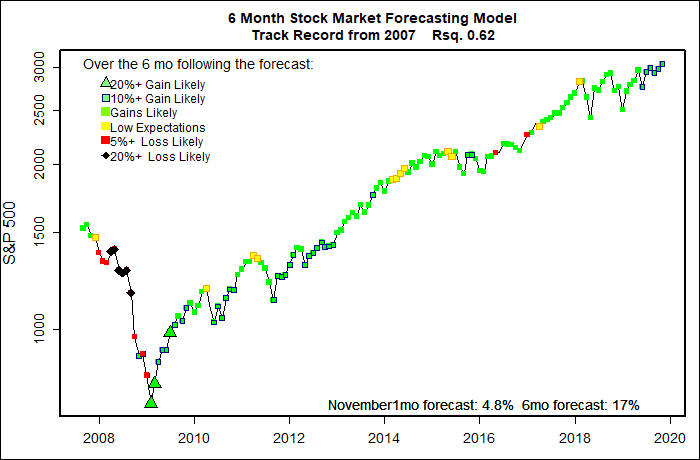
 Six Month Stock Market Forecast